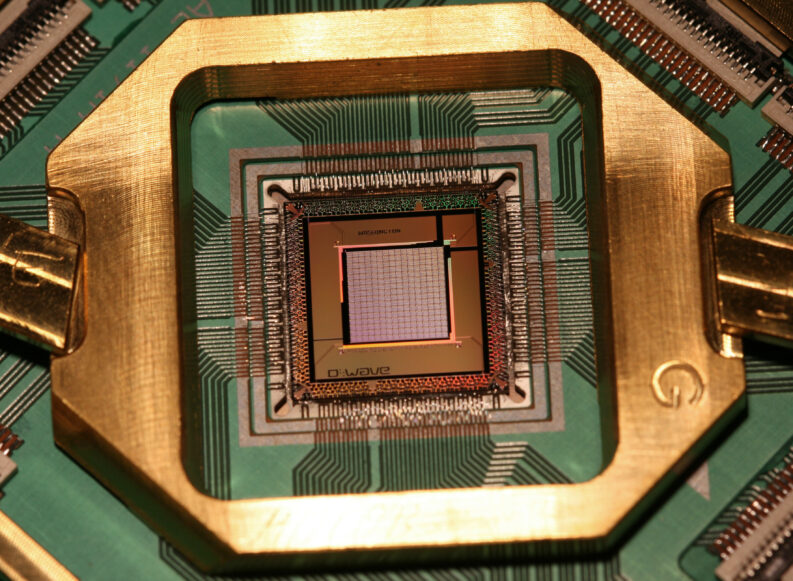

Rigetti Computing (NASDAQ: RGTI), which builds superconducting quantum computers and sells cloud access to them, announced this morning that it had signed a definitive agreement with the US Commerce Department for up to $100m in CHIPS Act funding. D-Wave Quantum (NYSE: QBTS) announced a separate, identically sized agreement the same morning, and the reaction in both stocks was muted.
RGTI shares traded at $15.20, up 0.13% from Friday’s close of $15.18, within a 52-week range of $12.53 to $58.15. QBTS shares traded at $16.58, down 1.43% from Friday’s close of $16.82, within a 52-week range of $12.75 to $46.75.
Rigetti’s award covers three named superconducting research projects: compressing readout electronics, expanding cryogenic capacity through a new cryostat architecture, and developing high-connectivity chip designs. D-Wave’s parallel agreement funds R&D across its annealing and gate-model technology. Under the CHIPS Act, the law that funds domestic semiconductor and advanced-technology manufacturing, Commerce will take a minority, non-controlling equity stake in each company as a condition of the funding, meaning Washington gets a small ownership slice but no board control. The exact size of that stake has not been disclosed.
The award dwarfs Rigetti’s existing business: trailing-twelve-month revenue is just $13.35m, so $100m represents several years of sales rather than a customer contract. D-Wave’s TTM revenue of $12.43m puts its own $100m award in the same light. This is R&D subsidy money disbursed over time, not booked revenue, which explains why neither stock jumped on the announcement. Rigetti chief executive Dr. Subodh Kulkarni said: “We are proud to be selected by the U.S. government to accelerate R&D and progress against our roadmap to deliver commercially viable quantum computing capabilities.”
According to StockTitan, quantum firm Quantinuum finalised an identical $100m CHIPS award the same morning, suggesting a government-wide push to fund quantum manufacturing rather than news specific to Rigetti alone. For traders, the near-term equity dilution and the multi-year funding timeline matter more than the headline figure.