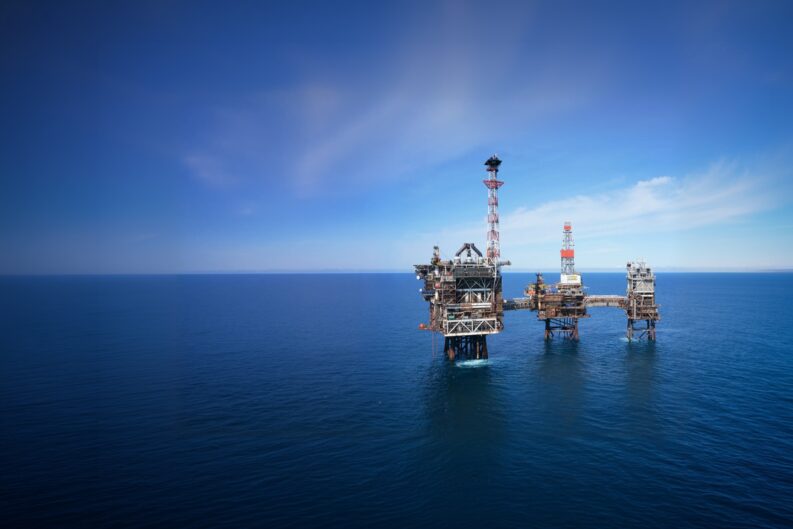

Serica Energy (LON: SQZ), the North Sea oil and gas producer, saw its shares rise after half-year results to 30 June showed production nearly doubling and the balance sheet flipping from net debt to net cash. The results were published earlier today.
Shares traded up 3.29% to 232.4p in early trading, against Wednesday’s close of 225p, having ranged between 222.8p and 235p on volume of just under a million shares.
Production averaged 44,700 barrels of oil equivalent per day, up from 24,700 boepd a year earlier, as uptime at the Triton Hub, its floating production facility, recovered to above 95% following last year’s turnaround, and new West of Shetland output added further barrels. Revenue rose to $677m from $305m, while EBITDAX, earnings before interest, tax, depreciation, amortisation and exploration costs, climbed to $301m from $118m.
The stronger operating performance converted into $184m of free cash flow, up from $26m a year earlier, enough to swing Serica from $200m of net debt at the end of 2025 to $26m of net cash at the end of June. Chief executive Chris Cox said the company had delivered “robust production, material free cash flow and a significantly strengthened balance sheet,” adding that Triton’s turnaround was “translating into much improved asset performance.” Serica also completed a $300m five-year Nordic Bond and a new $750m six-year RBL (reserve-based lending) facility, giving pro forma liquidity of $784m, and declared a flat 6p interim dividend.
Statutory accounts nonetheless showed a pre-tax loss of $75.6m, against a $100.8m profit a year earlier, reflecting $110.8m of unrealised hedging losses and a $95.6m goodwill write-off, both non-cash items. Completion of the Spirit Energy Southern North Sea acquisition has slipped to 1 October, prompting Serica to trim full-year cash-flow guidance to $450m-$475m and production guidance to “above 40,000 boepd.”
Cox said the recommended acquisition of Pharos Energy, an oil and gas company and Serica’s first step toward international diversification, announced after the period end, marked “the first step in delivering” a long-standing ambition to build a business beyond the UK North Sea, though he cautioned the deal was not yet certain to complete.