
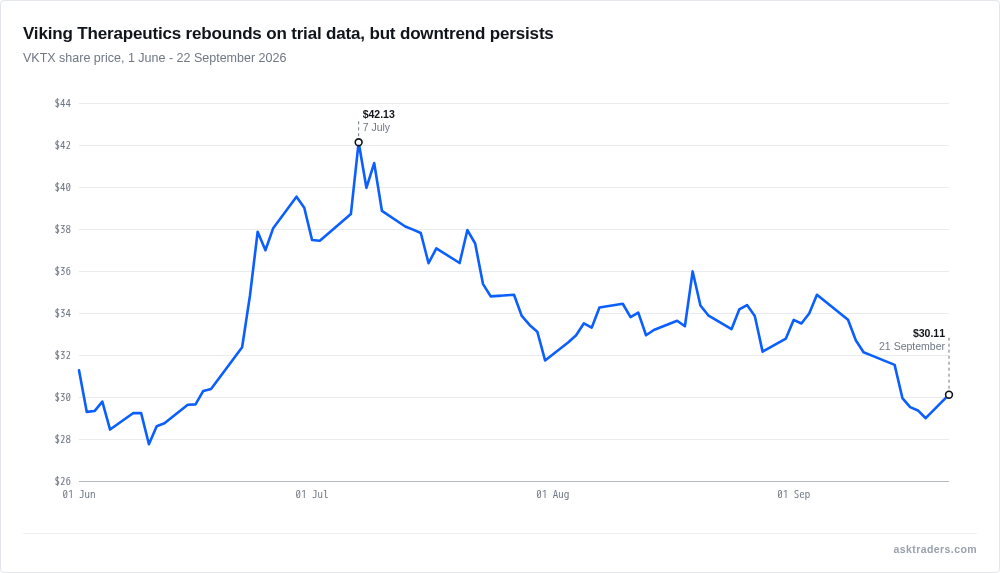
Viking Therapeutics (NASDAQ: VKTX), a clinical-stage biotech developing the obesity drug VK2735, rose sharply today after releasing mid-stage trial data that investors read as a competitive threat to the market’s two dominant obesity-drug makers. The stock had traded as high as around $42 in early July before falling roughly 10% over the past month, making today’s move a reversal within a broader downtrend.
VKTX shares stood at $30.11 during today’s session, up 3.86% from Monday’s close of $28.99, having ranged between $28.41 and $30.70 intraday. Investor’s Business Daily and Seeking Alpha reported premarket gains exceeding 30% before the stock pared back to its current level.
Viking released topline data from its VK2735-102 maintenance study, showing patients lost 16-19% of their body weight against roughly 0% for placebo over a 21-week induction phase. Those switched to less frequent maintenance dosing, once every other week or once monthly, retained up to 97% and 90% of that induction-phase weight loss respectively, compared with 61% for patients on placebo. On the 17.5mg weekly dose, patients recorded 22% placebo-adjusted weight loss over the full 33 weeks.
The data matter because they suggest VK2735 could support a maintenance regimen, where patients take the drug less often once they hit their target weight, that rivals the profile of Eli Lilly’s Zepbound and Novo Nordisk’s Wegovy. The reaction suggests markets are beginning to price Viking’s drug as a more credible long-term competitor in a market Lilly and Novo currently dominate. One participant discontinued the study during induction due to an adverse event, and one each dropped out during the maintenance phase among those switching to less frequent dosing.
Eli Lilly (NYSE: LLY), which markets the injectable Zepbound and oral Foundayo, traded at $1,164.89, up 1.04% from Monday’s close of $1,152.93. Novo Nordisk (NYSE: NVO), maker of Wegovy and Ozempic and already facing a 2032 US patent cliff, traded at $39.80, down 7.96% from $43.24, though that decline overlaps with the reaction to Novo’s own capital markets day held on Monday.
The moves reflect a broader rotation of capital toward next-generation obesity-drug challengers, even as Lilly and Novo continue to dominate current sales of approved treatments.