SpaceX's purchase of nationwide low-band spectrum, and its pitch for Starlink Mobile as a coming US carrier, has knocked more than 10% off the three big US wireless groups. Analysts say the real threat is years away.
Verizon (NYSE: VZ), the US wireless carrier, is down almost 11% today after SpaceX said it will buy a nationwide block of low-band spectrum. SpaceX said the deal addresses a key technical gap on the way to Starlink Mobile becoming a major US carrier. The announcement came late yesterday, after the US close.
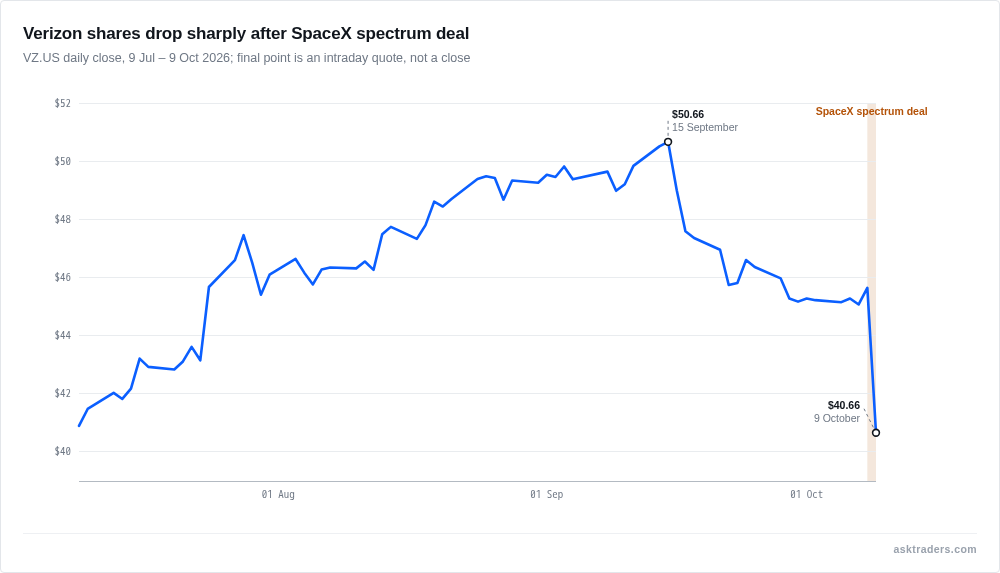
At about 2:30pm New York time Verizon was at $41.295, down 10.91% from yesterday’s close of $46.35, after a low of $40.81 on volume of 71 million shares. The shares sit about 20% below their September high close of $51.45, set on the 15th of September. AT&T was down 11.28% and T-Mobile US 12.81%.
SpaceX signed a definitive agreement to buy Grain Management’s nationwide 800 MHz low-band spectrum, up to 14 MHz paired, subject to approval from the Federal Communications Commission (FCC), the US regulator. It adds to SpaceX’s purchase of EchoStar’s 2 GHz spectrum.
Sponsored content
Ready to put what you’ve learned into practice?
Try IG’s platform with £10,000 in virtual funds and practise trading
without putting your own money at risk.
Spread bets and CFDs are complex instruments and come with a high risk of losing money rapidly due to leverage. 69% of retail investor accounts lose money when trading spread bets and CFDs with this provider.
Sponsored content
Learn the markets with IG Academy
Build your knowledge with IG Academy educational content, then use a
demo account to practise what you’ve learned on the IG platform.
Spread bets and CFDs are complex instruments and come with a high risk of losing money rapidly due to leverage. 69% of retail investor accounts lose money when trading spread bets and CFDs with this provider.
Sponsored content
See how trading works before risking real money
IG’s demo gives you access to thousands of markets and £10,000 in
virtual funds, so you can explore the platform and test your ideas first.
Spread bets and CFDs are complex instruments and come with a high risk of losing money rapidly due to leverage. 69% of retail investor accounts lose money when trading spread bets and CFDs with this provider.
Sponsored content
Turn trading theory into practical experience
Learn with IG Academy, explore charts and market tools, and practise
strategies in a simulated trading environment before going live.
Spread bets and CFDs are complex instruments and come with a high risk of losing money rapidly due to leverage. 69% of retail investor accounts lose money when trading spread bets and CFDs with this provider.
Sponsored content
Ready to take your learning further?
IG combines market education, analysis and an established trading platform,
giving you the tools to keep learning as you develop your trading skills.
Spread bets and CFDs are complex instruments and come with a high risk of losing money rapidly due to leverage. 69% of retail investor accounts lose money when trading spread bets and CFDs with this provider.
SpaceX plans a mix of a satellite-to-mobile constellation and an advanced terrestrial deployment. The FCC also approved 15,000 Gen2 Starlink Mobile satellites this week.
Verizon shares fell sharply today after SpaceX announced its 800 MHz spectrum purchase, pulling the stock well below its mid-September high. The last point is an intraday quote.
Analysts doubt the threat is close. Kutgun Maral, an analyst at broker Evercore, said the news undercut the carriers’ main defence, but called it a coverage fix rather than a capacity solution.
The carriers’ best argument just got weaker,
Kutgun Maral, Evercore
Evercore noted SpaceX would hold about 79 MHz against 280 to 380 MHz for each of the big three, and sees full 5G-quality service possible from the first half of 2028. TD Cowen puts a terrestrial network build at upwards of $80bn. JPMorgan’s Sebastiano Petti sees limited near-term risk given the time, infrastructure and capital required.
Sponsored
TD Cowen’s Gregory Williams thinks SpaceX wants a wholesale deal renting capacity on existing networks first, and so could be bluffing. The nearer cost may be bigger spectrum-auction bills: JPMorgan’s base case is about $40bn through 2028, rising to $53bn in its upside case.
The AskTraders Analyst Team features experts in technical and fundamental analysis, as well as traders specializing in stocks, forex, and cryptocurrency.