TD Cowen has trimmed its Unilever price target to $74 from $76 and kept its Buy rating. The US-listed shares were slightly lower late in the session, well below the new target.
TD Cowen has cut its price target on Unilever to $74 from $76 while keeping a Buy rating, MarketBeat reported, citing Benzinga. The target applies to the US-listed shares of Unilever (NYSE: UL), the consumer goods group behind food, beverage and personal care brands. A $2 trim with Buy retained is not a downgrade.
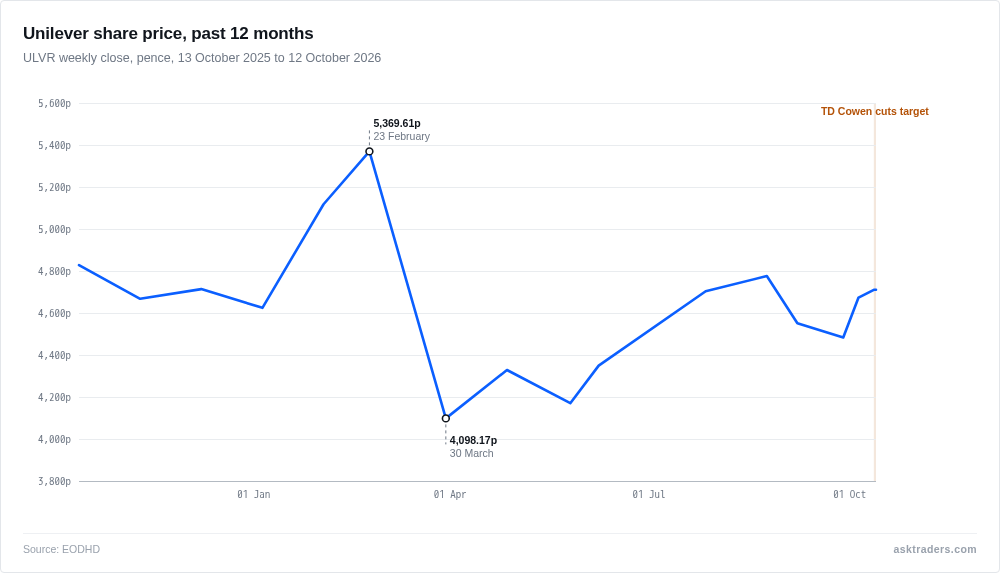
At 3.52pm New York time, shortly before the close, the US-listed shares were at $62.59, down about 0.6% from $62.95 yesterday. In London, Unilever (LON: ULVR) closed at 4,710.5p, down 27.5p or 0.58% from 4,738p. The timing of the note is not established, so the move cannot be attributed to it.
According to a summary of the note, TD Cowen adjusted price targets across food, beverage and personal care companies, not Unilever alone. Unilever’s cut is one of those adjustments.
Sponsored content
Ready to put what you’ve learned into practice?
Try IG’s platform with £10,000 in virtual funds and practise trading
without putting your own money at risk.
Spread bets and CFDs are complex instruments and come with a high risk of losing money rapidly due to leverage. 69% of retail investor accounts lose money when trading spread bets and CFDs with this provider.
Sponsored content
Learn the markets with IG Academy
Build your knowledge with IG Academy educational content, then use a
demo account to practise what you’ve learned on the IG platform.
Spread bets and CFDs are complex instruments and come with a high risk of losing money rapidly due to leverage. 69% of retail investor accounts lose money when trading spread bets and CFDs with this provider.
Sponsored content
See how trading works before risking real money
IG’s demo gives you access to thousands of markets and £10,000 in
virtual funds, so you can explore the platform and test your ideas first.
Spread bets and CFDs are complex instruments and come with a high risk of losing money rapidly due to leverage. 69% of retail investor accounts lose money when trading spread bets and CFDs with this provider.
Sponsored content
Turn trading theory into practical experience
Learn with IG Academy, explore charts and market tools, and practise
strategies in a simulated trading environment before going live.
Spread bets and CFDs are complex instruments and come with a high risk of losing money rapidly due to leverage. 69% of retail investor accounts lose money when trading spread bets and CFDs with this provider.
Sponsored content
Ready to take your learning further?
IG combines market education, analysis and an established trading platform,
giving you the tools to keep learning as you develop your trading skills.
Spread bets and CFDs are complex instruments and come with a high risk of losing money rapidly due to leverage. 69% of retail investor accounts lose money when trading spread bets and CFDs with this provider.
The summary says many large-cap staples stocks, meaning makers of everyday consumer goods, trade close to five-year lows, but that the sector’s risk/reward remains unfavourable. That is the sector view in the summary, not a statement about Unilever specifically.
On the businesses themselves, the summary says big food sales have stabilised but lack a clear path back to growth. TD raised its non-alcoholic beverage sales forecast, while alcohol volumes remained weak through the summer.
Unilever’s weekly London share price over the past 12 months, in pence, to the 12th of October.
The US-listed shares fell from $64.38 on the 1st of September to $59.58 on the 1st of October, then recovered to $62.95 by yesterday.
Sponsored
At $74, the new target sits roughly 18% above today’s late-session price of about $62.59. For UK holders, the note is a mild signal on a sector whose food sales, in the summary’s words, lack a clear path back to growth.
The AskTraders Analyst Team features experts in technical and fundamental analysis, as well as traders specializing in stocks, forex, and cryptocurrency.