

Rio Tinto (LON: RIO), the global miner, left all of its 2026 production guidance unchanged in third-quarter figures released at 7am today, before London opened. Global iron ore sales rose 3% from a year earlier to 90.8 million tonnes (Mt), and Pilbara sales rose 2% to 85.7 Mt.
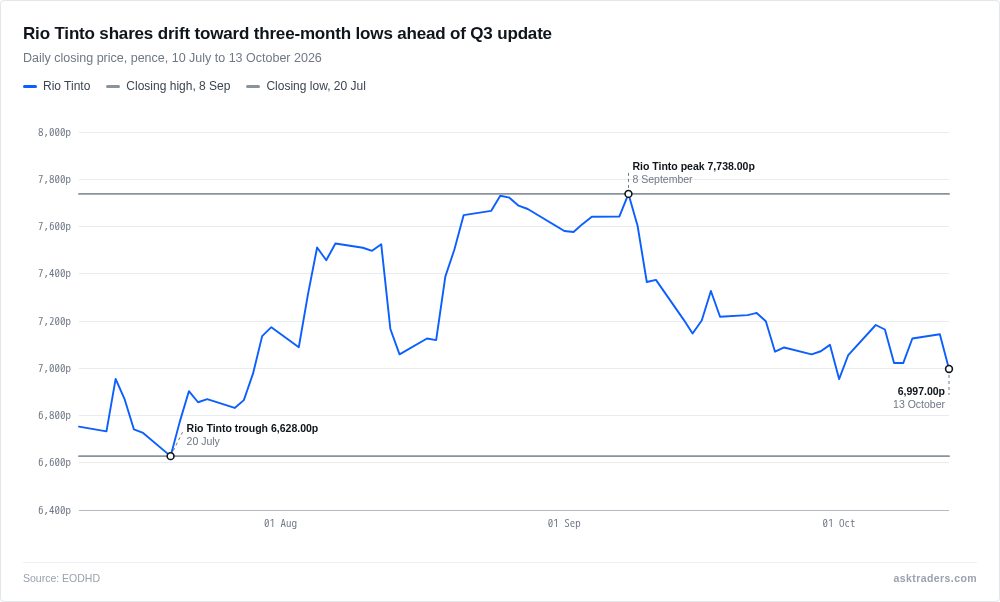
The shares closed yesterday at 6,997p, down 2.06% from 7,144p on Monday and 9.6% below the 7,738p close of the 8th of September. The lowest close since 10 July was 6,628p on the 20th of July.
The mix was uneven. Copper from Oyu Tolgoi, its Mongolian mine, rose 27% to 114 kt, but total copper was flat at 205 kt because Escondida concentrate fell 29% to 63 kt. Pilbara production slipped 1% to 83.4 Mt, and lithium output of 13.0 kt is guided to the low end of the 61-64 kt range after a slower Sal de Vida ramp-up.
The $5bn figure is a capital-release target, not production. Chief Executive Simon Trott said in the company’s statement:
Today, we announce that we have achieved more than $2 billion of capital release year-to-date, as we actively manage our portfolio with discipline to maximise long-term value, as part of the $5 to 10 billion capital release program.
Simon Trott, Chief Executive, Rio Tinto
That includes the proposed sale of the Dampier desalination plant, a Kitimat land sale to LNG Canada and a non-binding lithium sales contract with a pre-payment. Rio says it remains on track to announce around $5bn in total by the end of 2026, but completion and cash receipt depend on binding agreements.
Prices are the counterweight. Iron ore (61% grade, delivered to China) averaged $97 per dry metric tonne, down 8% from $105 in the second quarter, while full-year iron ore guidance of 343-366 Mt is unchanged. The copper price averaged 640 US cents a pound, up 6% on the quarter.
Beyond the quarter, Rio said its Simandou iron ore project in Guinea is running at an annualised rate of about 10 million tonnes a year and is on track for 60 million tonnes a year in the second half of 2028. It also targets a $1.8bn productivity run-rate by the end of 2026.
With volumes steady, the open questions are fourth-quarter output and whether binding capital-release deals follow, set against an iron ore price 8% lower than in the second quarter.


