

GSK (LON: GSK) said yesterday that the US Food and Drug Administration has approved Hibsago, also known as bepirovirsen, for chronic hepatitis B. The drugmaker calls it a first-in-class antisense oligonucleotide and says it offers unprecedented functional cure rates compared with standard of care.
The approval covers adults without cirrhosis who have been on nucleos(t)ide analogue therapy, the existing antiviral treatment, for at least six months. Their viral DNA must be suppressed and surface antigen (HBsAg) levels at or below 3,000 IU/ml. The drug came under priority review and Breakthrough Therapy Designation. Chronic hepatitis B affects about 1.7 million people in the US.
In the B-WELL phase III trials, 19% of adults with HBsAg at or below 3,000 IU/ml reached functional cure, or 233 of 1,220 patients, against none of 614 on placebo. In the subgroup at or below 1,000 IU/ml, about 45% of diagnosed cases worldwide, the rate was 26%, or 200 of 768, against none of 393.
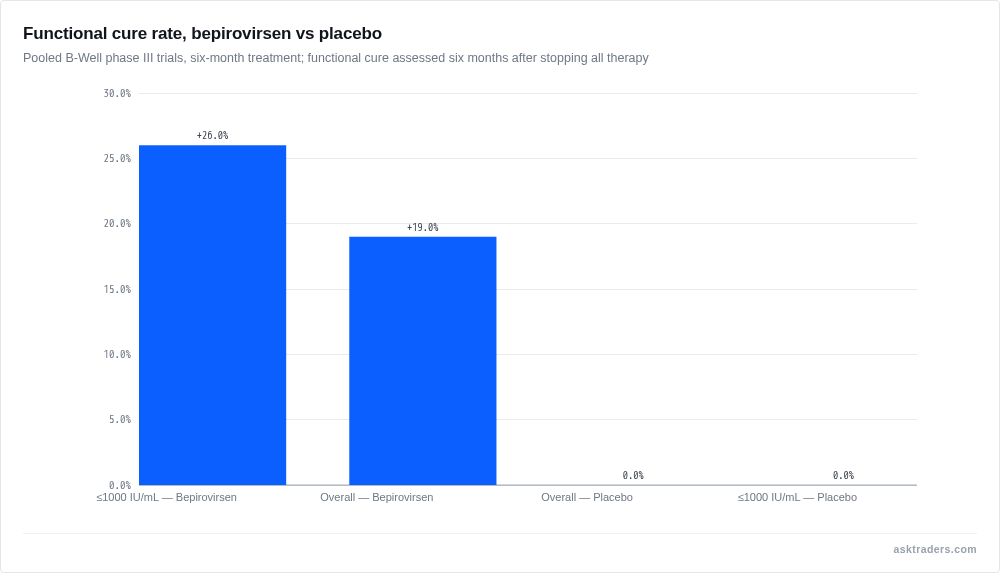
Functional cure means HBV DNA and HBsAg stay undetectable for at least 24 weeks after all treatment stops. Standard of care alone typically achieves less than 1% after one year, according to GSK.
Treatment lasts six months, and patients can self-administer after the first dose. In an exploratory measure at week 72, HBsAg fell to 100 IU/ml or below in 49% of patients overall and 62% of the subgroup. Common side effects were injection site redness, local pain and a temporary rise in a liver enzyme.
Tony Wood, GSK’s Chief Scientific Officer, said many people with the condition stay on treatment indefinitely and face a risk of serious liver complications. He added:
For the first time, with Hibsago, US patients have the potential to achieve functional cure after a six-month treatment course, with the added convenience of the option of self-administration after the first dose.
Tony Wood, Chief Scientific Officer, GSK
GSK licensed bepirovirsen from Ionis Pharmaceuticals. It is also approved in Japan, and GSK continues submissions in several regions, with key decisions expected in the coming months. GSK describes a growing hepatology pipeline that also covers MASH and alcohol-associated liver disease.