


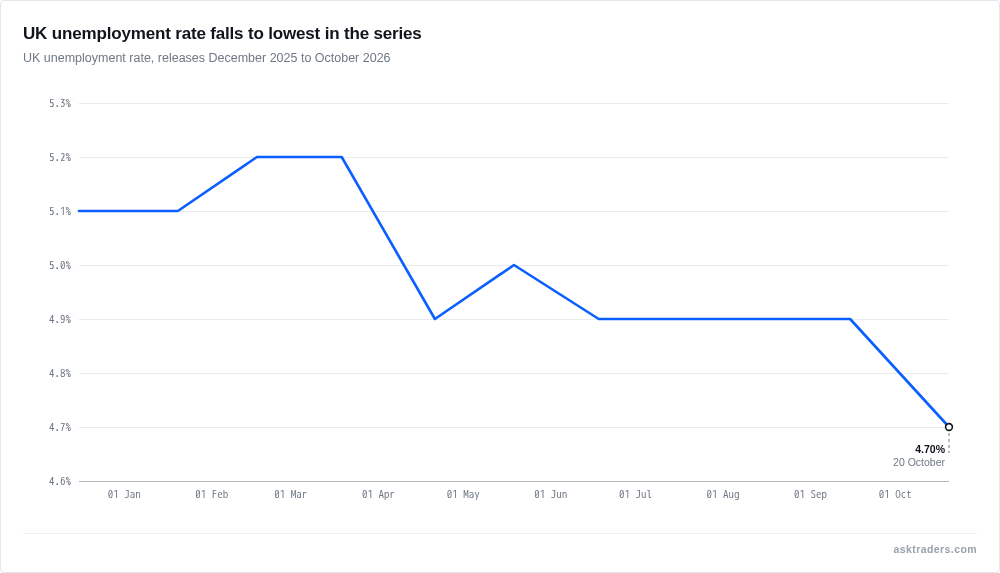
UK unemployment fell to 4.7% in the three months to August, below the 4.9% economists had expected, the Office for National Statistics (ONS) said.
The figure, for June to August 2026, was published today. Annual regular pay growth came in at 3.7% against a 3.6% consensus, while total pay growth of 3.7% was below the 3.8% consensus. The claimant count has been rising since July and redundancies increased in the quarter, so the release does not point one way.
What was announced
The ONS put the unemployment rate for people aged 16 and over at 4.7%, down 0.1 percentage points on both the quarter and the year. The comparison on the quarter is with March to May. The 4.9% consensus matches the previous release’s reading, so the surprise against expectations is 0.2 points. The number of unemployed people was 1,712 thousand, 47 thousand fewer than in the previous three months.
Employment looked firmer. The employment rate for 16 to 64-year-olds rose to 75.3%, up 0.2 points on the quarter and on the year, and the economic inactivity rate, which covers people neither working nor looking for work, fell to 20.9%.
The unemployment rate is the lowest in this series, which runs from 5.1% in the December 2025 release.
Sterling this morning
The London session is under way. GBP/USD stood at 1.3351 at 08:22 UK time, up 0.31% on the previous close of 1.3309. Nothing ties that move to the labour market figures.
A mixed picture beneath the headline
Pay growth cooled in total but not in regular earnings. The ONS said annual growth in employees’ average earnings was 3.7% for both regular pay, which excludes bonuses, and total pay, which includes them. Total pay growth was down from 3.9% in the previous three-month period and was last lower in August to October 2020, when it was 2.8%.
Consensus here means the average economist estimate.
| Measure | Latest | Previous | Consensus |
|---|---|---|---|
| Unemployment rate (%) | 4.7 | 4.9 | 4.9 |
| Regular pay growth (%) | 3.7 | 3.5 | 3.6 |
| Total pay growth (%) | 3.7 | 3.9 | 3.8 |
Unemployment and regular pay beat expectations while total pay undershot. Against that, the claimant count was 1.701 million in September and has risen since July, though the figure is provisional and can be revised. The redundancy rate was 3.8 per thousand, up 0.2 on the quarter.
The ONS also stresses the survey’s limits. The 0.1 point fall on the quarter sits inside a margin of error of 0.3 points, and the ONS Labour Market team advises:
Caution should be taken when drawing conclusions from short-term changes, and we advise users to focus on long term movements in the data.
ONS Labour Market team
What it means for Bank Rate
For UK traders the link runs through the Bank of England, whose Bank Rate sets the tone for mortgage and savings rates and for sterling. Bank Rate is 3.75% and was unchanged through September and into October. A looser jobs market and cooler headline pay could shape the Bank’s thinking, but one survey-based release with a mixed set of signals does not settle it.