

BP (LON: BP.), the oil and gas major, expects net debt of $13.5bn to $14.5bn at the end of the third quarter, down from $22.3bn at the end of the second. It said so in a trading statement published at 7am today.
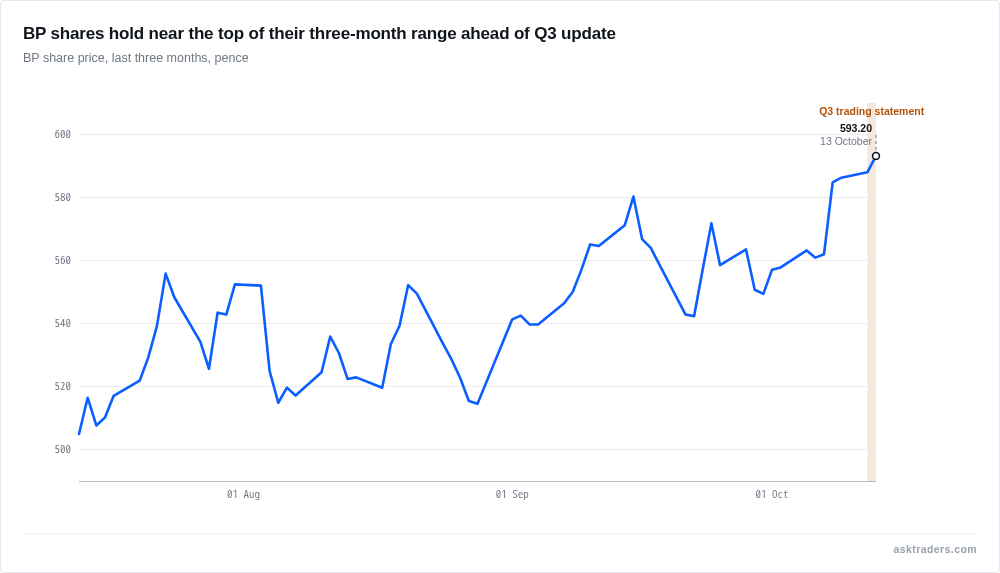
The shares were at 593.3p at 8:07am, up 0.90% on yesterday’s close of 588p. That close was already a three-month high, 21.8% above the 482.65p close on the 10th of July, so the shares had reached this level before the statement appeared.
The guided fall is roughly $8bn to $9bn, about 35% to 40% of the second-quarter figure. Refining is a key earnings driver: the bp refining indicator margin (RIM), BP’s benchmark for refining profit per barrel, averaged $46.7 a barrel in the quarter against $29.6 in the second.
BP said realised refining margins were $1.9bn to $2.1bn higher than in the second quarter. Refinery throughput is guided at 1,375 to 1,405 thousand barrels a day, down from 1,467 after the sale of its Gelsenkirchen refinery completed on the 31st of July.
The debt guidance also reflects a $1.0bn hybrid bond redemption on the 30th of September, capital spending of about $3.0bn, a working capital release of $0 to $1.0bn and about $1.0bn more tax paid. BP did not present these as a complete bridge. Including hybrids, leases and Gulf of America settlement liabilities, the total is guided to fall by about $9.0bn to $10.0bn.
The statement was not uniformly positive. BP guided earnings in its customers segment significantly lower, citing weaker fuels margins and higher Castrol base oil prices, and Brent averaged $96.99 against $103.85 in the second quarter. Gas marketing and trading was significantly higher than in the second quarter.
It also flagged post-tax impairments of $3.0bn to $4.5bn, mainly in its transition businesses, which are excluded from underlying replacement cost profit. Full-year divestment proceeds are guided at $8bn to $9bn, including the $6bn Castrol transaction, with capital spending of $13.5bn to $14.0bn.
The statement gives no buyback guidance. A lighter balance sheet is what any bigger shareholder return would rest on, but that remains inference until full results on the 30th of October and the strategy update on the 15th of December.


