


Devon Energy has agreed to sell its Eagle Ford assets to Crescent Energy for $4.2bn in cash, and the two companies’ shares moved in opposite directions today. Devon Energy (NYSE: DVN) is a US oil and gas producer; Crescent Energy (NYSE: CRGY) is a Houston-based producer focused on the Eagle Ford, a major shale field in south Texas.
In delayed quotes at about 3pm London time, Devon traded at $48.76, up 1.84% from yesterday’s close of $47.88. Crescent was at $12.865, down 4.49% from $13.47 and well below its 52-week high of $15.47. Both announcements came before the US open, and the moves came alongside them.
The sale covers about 90,000 net acres in Karnes, DeWitt and Gonzales Counties, Texas, roughly 4% of Devon’s total production. The economics transfer from the 1st of July. Crescent puts its net price at about $3.85bn once purchase-price adjustments are made. Devon expects to close around year-end; Crescent says the fourth quarter or early 2027.
Devon chief executive Clay Gaspar called the sale “a direct outcome of our ongoing portfolio review, and it sharpens our focus on the highest-return, longest-duration assets”.
Devon says after-tax proceeds will go to accelerated share buybacks and debt reduction, without giving amounts, and will detail the effect on its outlook with third-quarter results on the 5th of November. Crescent says the assets add about 68 Mboe/d (thousand barrels of oil equivalent a day) of net production and more than 600 Tier 1 net locations, its best-quality drilling spots, next to its existing operations. It also identifies about $140m of annual synergies, or cost savings.
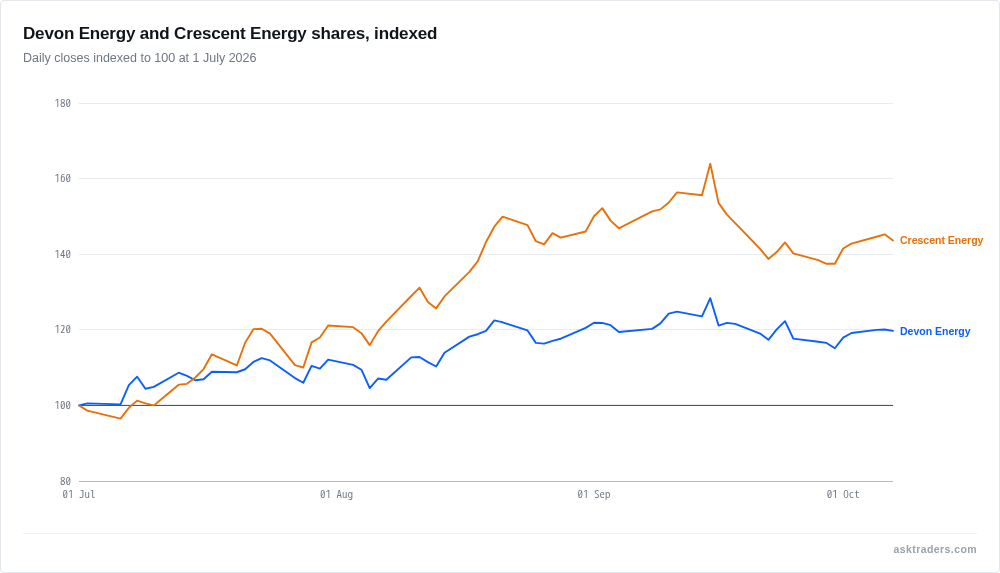
Crescent will fund the purchase from cash, debt and equity, including an underwritten $1bn offering of new Class A shares, which dilutes existing holders. A KKR affiliate holding about 7.9% of those shares has indicated interest in up to $500m. Crescent chief executive David Rockecharlie said the company knows the assets well through its minerals ownership and nearby operations.
The offering is not contingent on the acquisition closing. Otherwise its proceeds go to general corporate purposes, including repaying subsidiaries’ debt.


