

D.R. Horton reports fiscal Q1 2026 results this morning (January 20), before market open. The quarter provides the first read on whether management’s guided 20% to 20.5% gross margin band can hold as incentive intensity persists across the homebuilding sector.
Consensus sits at $1.92 EPS and $6.65B revenue, modestly below the company’s guided revenue midpoint of $6.55B, creating a setup where execution at the high end of guidance combined with margin stability would constitute a beat.
$45.55B
13.5
$1.92
$6.65B
The DHI stock price has once again bumped into resistance at $160 leading in to the earnings print, falling 3.13% during the previous session. Despite the pullback, DR Horton’s stock (NYSE:DHI) remains 7% higher since the start of the year.
The quarter’s significance extends beyond the headline numbers. Following October’s FQ4 miss, where DHI delivered $3.04 EPS against $3.29 consensus despite a revenue beat, the market has focused on profitability trajectory rather than volume resilience.
Management’s Q1 margin guide of 20% to 20.5% confirmed that elevated incentives would continue pressuring profitability, a message reinforced by recent analyst downgrades from Wells Fargo and Citizens in early January. The result will determine whether DHI’s scale advantages can offset affordability headwinds or whether margin compression becomes the dominant narrative for fiscal 2026.
Estimate revisions have trended negative. The consensus EPS estimate declined 1.66% over the past 30 days, from $1.97 to $1.92, consistent with a market shading profitability assumptions lower rather than stabilizing them.
Full-year fiscal 2026 expectations sit at $11.21 EPS on $34.26B revenue, implying that the Street anticipates continued pressure on per-unit economics even as DHI maintains volume through its entry-level and affordable housing focus.
Consensus Estimates
| Metric | Consensus Est. | Range | Prior Guidance | YoY Change |
|---|---|---|---|---|
| EPS (Adjusted) | $1.92 | $1.79 – $2.02 | N/A | -26.5% |
| Revenue | $6.65B | $6.53B – $6.74B | $6.3B – $6.8B (mid: $6.55B) | -12.6% |
| Gross Margin | 20.3% | 20.0% – 20.5% | 20.0% – 20.5% (mid: 20.25%) | -190 bps |
Analysts Covering: 13
Estimate Revisions (30d): 0 up / multiple down
Consensus revenue of $6.65B sits modestly above DHI’s guided midpoint of $6.55B, a gap of approximately 1.5% that creates limited room for error. The estimate range spans $6.53B to $6.74B, with the high end representing a 3% beat against the midpoint guide.
More consequential is the margin setup: consensus gross margin of 20.3% falls within management’s 20% to 20.5% band but leaves no buffer for slippage. Any print below 20% would likely trigger a reassessment of full-year profitability assumptions, as it would suggest incentive costs are running ahead of management’s October expectations.
The 26.5% year-over-year EPS decline reflects the sector’s transition from a period of pricing power to one where volume is maintained through incentives. Estimate momentum has been consistently negative, with the 30-day revision trend showing zero upward adjustments and the consensus drifting from $1.97 to $1.92.
This pattern mirrors the broader reset that began in April 2025, when DHI cut full-year fiscal 2025 revenue guidance to $33.3B to $34.8B following slower-than-expected spring selling season activity. The Street has not restored prior optimism despite a July beat, instead embedding the view that elevated incentives represent a structural feature of the current cycle rather than a temporary adjustment.
Management Guidance and Commentary
“We expect our home sales gross profit margin in the first quarter of fiscal 2026 to be in the range of 20.0% to 20.5%.”
Management’s Q1 margin guidance, issued with the October FQ4 results, established the profitability framework for the quarter. The 20% to 20.5% band represents a continuation of the incentive-heavy environment that characterized the second half of fiscal 2025, when DHI used mortgage rate buydowns and smaller home offerings to sustain demand amid affordability constraints. The guidance confirmed that the company views elevated incentive costs as necessary to protect absorption rates and market share, even at the expense of near-term margin compression.
The revenue guide of $6.3B to $6.8B (midpoint $6.55B) implies a 12% to 17% year-over-year decline at the range endpoints, consistent with management’s messaging that demand elasticity remains sensitive to affordability pressures. Consensus revenue of $6.65B sits 1.5% above the midpoint, creating a scenario where a “beat” requires delivery at or near the high end of the guided range. More importantly, the setup suggests that revenue outperformance without corresponding margin stability would likely be interpreted negatively, as it would imply that incremental volume came at an unacceptable profitability cost.
The gap between consensus and guidance is tighter than in recent quarters. In FQ4, consensus revenue of $9.42B sat below the actual $9.7B result, yet the stock sold off on the EPS miss driven by margin pressure. That dynamic established the current framework: investors are prioritizing profitability over volume, and any deviation from the 20% to 20.5% margin band carries more weight than modest revenue variance. Management’s ability to deliver within the guided margin range while maintaining absorption will determine whether the quarter is viewed as execution in line with a difficult environment or as evidence of deteriorating fundamentals.
Analyst Price Targets & Ratings
Wall Street sentiment has cooled on D.R. Horton, with only 46% of analysts maintaining Buy or Strong Buy ratings. The consensus target of $162.36 implies modest 4.3% upside, reflecting tempered expectations following the October miss and subsequent downgrades. The Hold-heavy distribution (46% of ratings) indicates that analysts view the stock as fairly valued at current levels, pending evidence that margin pressure has stabilized.
Sector & Peer Comparison
| Company | Ticker | Market Cap | P/E | Fwd P/E | Profit Margin |
|---|---|---|---|---|---|
|
D.R. Horton
⭐ Focus |
DHI | $45.55B | 13.5 | 11.9 | 10.5% |
|
Lennar Corp
|
LEN | $42.8B | 11.2 | 10.8 | 12.1% |
|
NVR Inc
|
NVR | $28.4B | 15.8 | 14.2 | 14.3% |
|
PulteGroup
|
PHM | $24.1B | 10.9 | 10.3 | 13.8% |
|
Toll Brothers
|
TOL | $12.6B | 9.8 | 9.2 | 11.9% |
|
KB Home
|
KBH | $5.2B | 8.4 | 8.1 | 9.7% |
D.R. Horton trades at a forward P/E of 11.9, a modest premium to the peer group median of approximately 10.5, reflecting its position as the largest homebuilder by volume and its operational scale advantages. The valuation premium is narrower than historical norms, compressed by concerns that scale may not fully offset margin pressure in the current environment.
Lennar, the closest peer by market capitalization, trades at a lower forward multiple (10.8) despite a higher profit margin (12.1%), suggesting the market is pricing in DHI’s entry-level exposure as a headwind rather than a structural advantage.
DHI’s 10.5% profit margin sits below the peer group average, with NVR (14.3%) and PulteGroup (13.8%) demonstrating that higher margins are achievable within the sector. The gap reflects DHI’s strategic focus on affordable housing, which generates higher unit volumes at lower per-unit profitability.
This positioning has historically supported market share gains during downturns, but the current cycle’s combination of elevated rates and affordability constraints has pressured margins without delivering corresponding volume upside. The relative valuation suggests investors are questioning whether DHI’s scale can translate into superior through-cycle returns if margins remain structurally lower than peers.
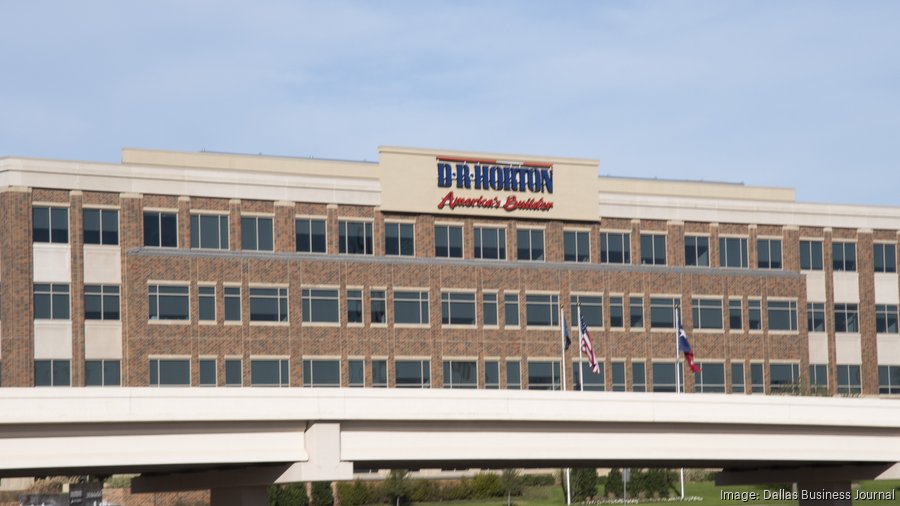
D.R. Horton maintains its position as the nation’s largest homebuilder by volume
Earnings Track Record
| Quarter | EPS Actual | EPS Est. | Result | Surprise % |
|---|---|---|---|---|
| 2025-09-30 | $3.04 | $3.29 | Miss | -7.6% |
| 2025-06-30 | $3.36 | $2.87 | Beat | +17.1% |
| 2025-03-31 | $2.58 | $2.65 | Miss | -2.6% |
| 2024-12-31 | $2.61 | $2.37 | Beat | +10.1% |
| 2024-09-30 | $3.92 | $4.16 | Miss | -5.8% |
| 2024-06-30 | $4.10 | $3.75 | Beat | +9.3% |
| 2024-03-31 | $3.52 | $3.06 | Beat | +15.0% |
| 2023-12-31 | $2.82 | $2.88 | Miss | -2.1% |
D.R. Horton has beaten EPS estimates in 14 of the past 20 quarters, a 70% beat rate with an average surprise of 5.8%. The track record, however, masks a pattern shift over the past year. The last four quarters alternated between beat and miss (beat, miss, beat, miss), with the misses driven by margin pressure rather than revenue shortfalls. In FQ4 2025, DHI delivered $9.7B revenue against $9.42B consensus but missed on EPS ($3.04 vs $3.29), demonstrating that volume resilience no longer guarantees profitability beats when incentive costs run ahead of expectations.
The July 2025 FQ3 beat (+17.1% EPS surprise) represented the last quarter where elevated incentives translated into a positive earnings surprise, as management’s willingness to deploy buydowns drove volume that exceeded Street models. By October, the market had adjusted: consensus for FQ4 embedded higher incentive assumptions, yet the actual margin pressure still exceeded estimates. This progression suggests that the Street is now attempting to forecast incentive intensity quarter-by-quarter, a more difficult task than modeling steady-state margins, and that DHI’s ability to beat will depend on either margin outperformance or revenue significantly above the high end of guidance.
DHI Post-Earnings Price Movement History
| Date | Surprise | EPS vs Est. | Next Day Move | Price Change |
|---|---|---|---|---|
| 2025-09-30 | -7.6% | $3.04 vs $3.29 | +1.5% | $169.83 to $172.44 |
| 2025-06-30 | +17.1% | $3.36 vs $2.87 | +4.0% | $128.69 to $133.90 |
| 2025-03-31 | -2.6% | $2.58 vs $2.65 | +1.1% | $125.99 to $127.41 |
| 2024-12-31 | +10.1% | $2.61 vs $2.37 | -1.4% | $139.56 to $137.64 |
| 2024-09-30 | -5.8% | $3.92 vs $4.16 | +1.2% | $190.35 to $192.72 |
D.R. Horton’s post-earnings price reactions have been muted relative to the magnitude of earnings surprises, with an average next-day move of 1.1% regardless of beat or miss status. The pattern suggests that guidance and forward commentary drive stock movement more than the reported quarter’s results. In December 2024, a 10.1% EPS beat resulted in a 1.4% decline the following day, consistent with a market focused on management’s cautious tone about spring 2025 demand. Conversely, the September 2025 miss (7.6% below consensus) produced a 1.5% gain, as investors interpreted the revenue beat and stable guidance as sufficient.
The July 2025 reaction (+4.0% on a 17.1% EPS beat) represents the outlier, occurring when the beat provided relief from the prior quarter’s guidance cut and suggested that incentives could still drive upside. Since then, reactions have compressed, indicating that the market has adjusted to a new regime where beats and misses within a few percentage points of consensus generate limited movement. For the upcoming quarter, this history implies that a result within the consensus range ($1.92 EPS, $6.65B revenue) would likely produce a muted reaction, while a significant deviation, particularly on margins, could drive a larger move as it would force a reassessment of full-year profitability assumptions.

The company’s focus on entry-level and affordable housing positions it for eventual market recovery
Expected Move & Implied Volatility
32%
58%
28%
The options market is pricing a 4.2% move in either direction following the earnings release, implying a range of $149.14 to $162.20. This expected move sits above the historical average next-day reaction of 1.1%, suggesting that options traders are positioning for the possibility of a larger-than-typical response. Implied volatility of 32% exceeds the 30-day historical volatility of 28%, consistent with elevated uncertainty about whether DHI can deliver within its guided margin band while maintaining volume.
The IV percentile of 58% indicates that current implied volatility sits in the middle of its historical range, neither extreme nor subdued. This positioning reflects a market that acknowledges downside risk from margin pressure but has not priced in a worst-case scenario. The gap between the implied move (4.2%) and recent actual moves (1.1% average) creates an opportunity for option sellers if the result falls within consensus expectations, but also highlights that any significant deviation, particularly on gross margin, could produce a move toward the upper end of the implied range.
Expert Predictions & What to Watch
Key Outlook: Guidance Will Drive the Trade
The neutral stance reflects a setup where consensus expectations have been sufficiently reset following the October miss and January downgrades, but where execution risk remains elevated. The 1.5% gap between consensus revenue ($6.65B) and the guided midpoint ($6.55B) is narrow enough that a “beat” requires only modest outperformance, yet the margin band of 20% to 20.5% leaves limited room for error. Management’s track record over the past year shows alternating beats and misses, with the misses driven by margin pressure that exceeded Street models. This pattern suggests that the company’s ability to forecast incentive intensity quarter-to-quarter is imperfect, creating risk that actual margins could fall outside the guided range.
Key Metrics to Watch
The setup heading into this print centers on margin execution within the guided band. A clean beat likely requires revenue and gross margin landing closer to the top end of guided ranges—otherwise it risks reading as “fully priced.” The 70% historical beat rate provides some confidence, but the pattern shift toward margin-driven misses over the past year remains a fresh concern for investors focused on profitability sustainability.
Searching for the Perfect Broker?
Supplement your charting with a free trading platform that rivals the best out there – multiple charts on one screen for easy monitoring, ProRealTime provides the perfect support for your investing or trading journey.
Discover our top-recommended brokers for trading stocks, forex, cryptos, and beyond. Dive in and test their capabilities with complimentary demo accounts today!
- IG Top-tier regulation – Read our Review
- eToro Wide range of instruments available to trade – Read our Review
YOUR CAPITAL IS AT RISK. 76% OF RETAIL CFD ACCOUNTS LOSE MONEY