
Netflix reports Q4 2025 results after market close today, with all eyes looking to the streaming giant for signs of a reversal.
Consensus expectations for the quarter sits at $11.51B revenue and $6.97 EPS, essentially matching management’s prior $11.96B revenue guide and $5.45 EPS outlook, creating a setup where execution meets expectations but forward commentary on the Warner Bros. Discovery acquisition will determine the stock’s reaction.
Netflix’s stock price (NFLX) enters the print down 33% from its 52-week high of $134.12, and 28.09% lower over the past 6 months, with the decline accelerating after the company announced its $83 billion bid for Warner Bros. Discovery’s film and television assets in late 2025.
That overhang has overshadowed three consecutive quarters of EPS beats through Q2 2025, before Q3’s Brazil tax charge miss broke the pattern. The market’s tolerance for acquisition uncertainty has narrowed: options traders are pricing a 7.3% move in either direction for contracts expiring January 23, above the stock’s 1.7% average historical post-earnings move, reflecting elevated uncertainty around both the quarter and the strategic narrative.
$372.9B
36.8
$6.97
$11.51B
The valuation setup compounds the tension. Netflix trades at 36.8x trailing earnings, a premium to the sector but near three-year lows on a forward basis, with the consensus target of $122.96 implying 39% upside if the company can demonstrate that core streaming economics remain intact while articulating a credible integration path for Warner assets. The quarter itself is unlikely to move the stock materially on reported numbers alone; the catalyst is whether management can shift the narrative from acquisition risk to strategic opportunity.

Netflix headquarters in Los Gatos, California, where the company will report Q4 2025 results that test the sustainability of its advertising and live events strategy.
Consensus Estimates
| Metric | Consensus Est. | Range | Prior Guidance | YoY Change |
|---|---|---|---|---|
| EPS (Adjusted) | $6.97 | $6.83 – $8.00 | $5.45 | +29.1% |
| Revenue | $11.51B | $11.29B – $11.63B | $11.96B | +17.2% |
| Operating Margin | 29.1% | 28.5% – 30.0% | N/A | +90 bps |
Analysts Covering: 35 analysts (EPS), 39 analysts (Revenue)
Estimate Revisions (30d): 2 up / 0 down (EPS momentum flat)
The consensus EPS of $6.97 sits 27.9% above the prior-year quarter, but the figure carries less weight than usual because it reflects a significant gap above management’s $5.45 guidance. That divergence suggests analysts are embedding margin upside or expense timing benefits not contemplated in the company’s October outlook. Revenue consensus of $11.51B is 3.8% below the $11.96B guide, an unusual inversion that likely reflects conservative adjustments after Q3’s revenue came in exactly at guidance while EPS missed on the Brazil tax charge.
The estimate revision pattern is muted. Only two upward EPS revisions in the past 30 days, with no downward moves, indicates the Street is holding its view rather than building conviction. The wide EPS range of $6.83 to $8.00 reflects disagreement on margin trajectory and one-off cost assumptions, making the quality of the beat as important as the magnitude.
Operating margin is the decisive metric. Analysts project 29.1%, up 90 basis points year-over-year, after Q3’s 28.2% result fell 330 basis points short of expectations. A clean margin print above 29% would validate that Q3’s shortfall was isolated to the Brazil tax dispute, while a result below 28.5% would raise questions about structural cost pressure tied to live events or content amortization.
Management Guidance and Commentary
“We are confident in our ability to deliver strong revenue and profit growth in 2026, driven by our scaled advertising business, live programming, and continued pricing power across our core subscription tiers.”
Management’s Q3 commentary emphasized that the operating margin would have exceeded the prior outlook absent the $619 million Brazil tax expense, framing the miss as non-operational. That messaging set a higher bar for Q4: investors expect not just a return to clean execution, but evidence that the margin trajectory can absorb incremental costs from live events and advertising infrastructure without diluting the 2026 outlook.
The company’s prior Q4 revenue guide of $11.96B was issued in October alongside full-year 2025 guidance of $44.8B to $45.2B. Consensus has since drifted to $11.51B, below the guide, likely reflecting conservative positioning after the Q3 miss. The gap creates asymmetry: a revenue result at or above $11.96B would be framed as a beat relative to lowered Street expectations, even though it merely matches the company’s own projection.
On advertising, management has repeatedly stated the business will double revenue year-over-year in 2025 and double again in 2026, but has not disclosed absolute figures. The market is looking for more specificity on ad tier subscriber counts, average revenue per user, and contribution margin to assess whether the advertising narrative can offset slowing subscriber growth in mature markets. Similarly, live events commentary will need to quantify the economics of the NFL Christmas Day games and outline the 2026 live programming slate to justify the strategic pivot.
Analyst Price Targets & Ratings
Wall Street maintains a bullish stance despite the Warner acquisition uncertainty, with 80% of analysts rating shares a Buy or Strong Buy. The consensus target of $122.96 implies significant upside from current levels, though the wide range reflects disagreement about the timing and success of the Warner integration. Recent downgrades have focused on execution risk rather than fundamental concerns about the streaming business model.
Sector & Peer Comparison
| Company | Ticker | Market Cap | P/E | Fwd P/E | Profit Margin |
|---|---|---|---|---|---|
|
Netflix Inc
⭐ Focus |
NFLX | $372.9B | 36.8 | 28.0 | 24.1% |
|
Walt Disney Co
|
DIS | $168.5B | 22.4 | 18.6 | 8.2% |
|
Warner Bros Discovery
|
WBD | $18.2B | N/A | 8.4 | -2.1% |
|
Paramount Global
|
PARA | $7.1B | N/A | 6.2 | -8.4% |
|
Comcast Corp
|
CMCSA | $145.3B | 9.8 | 9.1 | 11.6% |
Netflix trades at a 64% premium to Disney on forward P/E and commands a 24.1% profit margin nearly triple Disney’s 8.2%, reflecting the market’s view that Netflix’s pure-play streaming model has structurally higher profitability than legacy media conglomerates burdened by linear television assets. The valuation gap to Warner Bros. Discovery is even starker: Netflix’s forward P/E of 28.0x versus Warner’s 8.4x underscores the risk Netflix is taking on by acquiring a business the market values at a significant discount.
The peer set highlights Netflix’s competitive advantage in margin and scale, but also the strategic rationale for the Warner acquisition. Warner’s content library, including HBO, could enhance Netflix’s pricing power and reduce content spend per subscriber, but only if integration costs and potential subscriber churn are managed. Paramount’s negative margins and low valuation illustrate the downside risk if Netflix’s acquisition execution falters.
Earnings Track Record
| Quarter | EPS Actual | EPS Est. | Result | Surprise % |
|---|---|---|---|---|
| Q3 2025 | $0.59 | $0.70 | Miss | -15.7% |
| Q2 2025 | $0.72 | $0.71 | Beat | +1.4% |
| Q1 2025 | $0.66 | $0.57 | Beat | +15.8% |
| Q4 2024 | $0.43 | $0.42 | Beat | +2.4% |
| Q3 2024 | $0.54 | $0.51 | Beat | +5.9% |
| Q2 2024 | $0.49 | $0.47 | Beat | +4.3% |
Netflix’s 72.2% beat rate over the past 18 quarters establishes a pattern of consistent execution, but the Q3 2025 miss broke a six-quarter beat streak and introduced credibility risk heading into Q4. The 15.7% EPS miss in Q3, tied to the Brazil tax charge, was the largest negative surprise since Q4 2023’s shortfall. Importantly, both misses were attributed to one-off items rather than operational underperformance, but the market’s reaction to Q3 suggests tolerance for non-operational noise has diminished at the stock’s premium valuation.
Post-Earnings Price Movement History
| Date | Result | EPS vs Est. | Next Day Move | Price Change |
|---|---|---|---|---|
| Q3 2025 | -15.7% | $0.59 vs $0.70 | -2.9% | $120.41 to $117.90 |
| Q2 2025 | +1.4% | $0.72 vs $0.71 | -2.2% | $132.12 to $129.60 |
| Q1 2025 | +15.8% | $0.66 vs $0.57 | -0.6% | $93.85 to $92.38 |
| Q4 2024 | +2.4% | $0.43 vs $0.42 | -1.5% | $90.43 to $88.73 |
Netflix’s post-earnings price action reveals a pattern of selling pressure regardless of beat or miss, with an average next-day move of negative 1.7%. Even large EPS beats have failed to sustain gains, as Q1 2025’s 15.8% beat resulted in only a 0.6% decline. The market’s consistent negative reaction suggests investors are either taking profits after run-ups into earnings or reacting to forward guidance that fails to meet elevated expectations.
Expected Move & Implied Volatility
52%
78%
38%
The options market’s 7.3% implied move for January 23 expiration contracts is more than four times Netflix’s 1.7% average historical post-earnings move, signaling that traders expect significantly higher volatility than the stock has delivered in recent quarters. The elevated expectation reflects not just the quarterly result, but the potential for material news on the Warner Bros. acquisition, regulatory developments, or a shift in 2026 guidance that could reset the stock’s valuation framework.
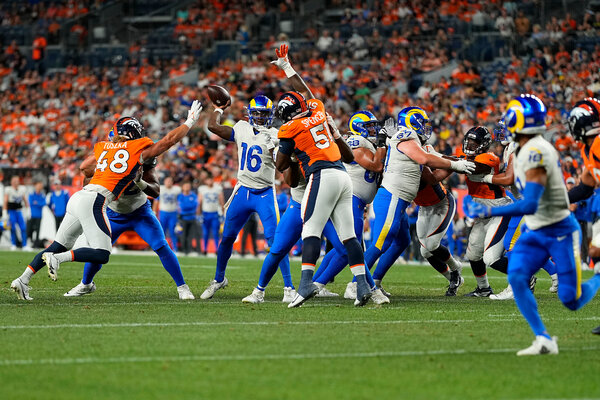
Promotional material for Netflix’s Christmas Day NFL games, which set streaming viewership records and represent a key test of the company’s live events strategy.
Expert Predictions & What to Watch
Key Outlook: Guidance Will Drive the Trade
The base case assumes Netflix delivers revenue at or slightly above the $11.96B guide, with EPS in the $6.50 to $7.00 range reflecting clean margin execution. That result would be framed as a beat relative to the Street’s lowered $11.51B revenue consensus, but the market’s focus will shift immediately to the 2026 outlook and Warner commentary.
Key Metrics to Watch
The interplay between these metrics will determine the stock’s direction. A scenario where operating margin beats but advertising revenue disclosure remains vague would likely result in a muted positive reaction, as investors conclude the quarter was clean but the forward narrative is unchanged. Conversely, a scenario where margin is in-line but management provides specific advertising and Warner integration metrics could drive a stronger reaction, as the strategic uncertainty that has weighed on the stock begins to resolve.
The most important single metric is operating margin, because it directly addresses the credibility question raised by Q3’s miss. A result above 29.5% would allow management to credibly argue that the business model remains intact and the Warner acquisition can be absorbed without structural margin dilution. A result below 28.5% would force a reassessment of the 2026 margin trajectory and raise questions about whether live events and advertising are adding costs faster than revenue.
Understanding the difference between trading vs investing becomes crucial when considering Netflix’s earnings volatility, as short-term traders may focus on the immediate reaction to quarterly results while long-term investors should evaluate the company’s strategic positioning and Warner acquisition potential. Additionally, investors interested in tax-efficient exposure to Netflix and other growth stocks might consider utilizing Stocks & Shares ISAs to shelter gains from capital gains tax.
Searching for the Perfect Broker?
Supplement your charting with a free trading platform that rivals the best out there – multiple charts on one screen for easy monitoring, ProRealTime provides the perfect support for your investing or trading journey.
Discover our top-recommended brokers for trading stocks, forex, cryptos, and beyond. Dive in and test their capabilities with complimentary demo accounts today!
- IG Top-tier regulation – Read our Review
- eToro Wide range of instruments available to trade – Read our Review
YOUR CAPITAL IS AT RISK. 76% OF RETAIL CFD ACCOUNTS LOSE MONEY