


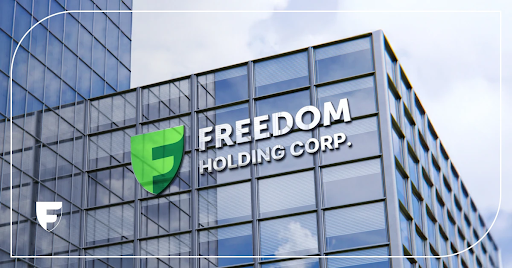
Freedom Holding Corp. is attracting interest from some of the world’s largest institutional investors. Leading asset managers, including BlackRock, State Street and Vanguard, hold its Nasdaq-listed stock. This comes as Freedom Holding grows its business, expands its financial ecosystem and enters new markets.
In Good Company
According to data from Bloomberg Terminal compiled by Freedom analysts, the ten largest institutional holders collectively own 1.55 million shares of Freedom Holding Corp., worth approximately $272.9 million. That represents 2.43% of the company’s outstanding shares.
Major institutional investors among its shareholders can help a company gain market credibility, attract other investors, increase stock liquidity, and make it easier to raise capital.
Freedom Holding’s largest institutional shareholders come from different sectors of the global financial industry. The list includes asset managers BlackRock, State Street, Vanguard and Geode Capital Management; investment firm AQR Capital Management; financial groups Morgan Stanley, UBS and JPMorgan Chase; as well as Northern Trust and Bank of New York Mellon, which provide custody and other financial infrastructure services to institutional investors.
BlackRock, Vanguard and State Street stand out in the list. International financial media often refer to them as the “Big Three.” The term reflects not so much the size of their assets under management, although BlackRock is the world’s largest asset manager by AUM, as the influence these firms have on global financial markets.
These asset managers hold shares in some of the world’s biggest companies, including Nvidia, Apple, Microsoft and Amazon. BlackRock and State Street also count Alphabet among their major holdings. As part of these portfolios, Freedom sits alongside some of the most prominent names in the global stock market.

The Growth Equation
Institutional investors are taking notice of Freedom Holding’s rapid growth and expanding business. Over the past seven years, the company’s share price has risen 12.5-fold. On October 29, 2026, Freedom Holding Corp. (FRHC) closed at $183.67 on Nasdaq, giving the company a market capitalization of $11.67 billion. In October 2019, when its shares began trading on Nasdaq under the FRHC ticker, they were priced at $14.40, and the company was valued at approximately $800 million.
In the seven years since its Nasdaq listing, Freedom Holding Corp. has evolved from a specialized brokerage business operating in a handful of countries across Eastern Europe and Central Asia into a diversified digital financial ecosystem headquartered in Kazakhstan and present in 24 countries across the United States, Europe and Asia. Its operations now span brokerage, banking, insurance and payments, as well as consumer services such as online grocery shopping, travel booking and event ticketing. The group is also expanding into telecommunications and digital infrastructure, including cloud computing and artificial intelligence. At the center of this ecosystem is the Freedom SuperApp, a single mobile platform that gives users access to the group’s full range of services in one place.
This transformation is reflected in Freedom Holding’s financial performance. Over the past three completed fiscal years, revenue has grown steadily, from $1.65 billion in FY2024 to $2.00 billion in FY2025 and $2.19 billion in FY2026. Total assets rose over the same period, from $8.30 billion to $9.92 billion and $13.16 billion, respectively.
For comparison, in FY2019, which ended in March 2019, before its Nasdaq listing, Freedom Holding Corp. reported revenue of $74.3 million and total assets of $350.9 million. Over the following seven years, revenue grew nearly 30-fold and total assets approximately 37.5-fold.
Business expansion has also brought a sharp increase in customer numbers. As of June 30, 2026, Freedom had 8.743 million customers across its banking, brokerage, insurance and other businesses. By comparison, in 2019 the company served more than 115,000 client accounts. While the figures cover different parts of the business, they illustrate how much the group has grown.

Global Ambition
“I want investors to look at Freedom not only as a Kazakhstani company. We are Kazakhstani in origin, but very global in our ambitions,” the founder and CEO of Freedom, Timur Turlov, said in one of the recent interviews.
Turkey is one of the key markets in Freedom’s international expansion. In July 2026, the company completed the acquisition of a 99.32% stake in Turkish Bank A.Ş. The following month, its subsidiary Freedom Yatırım received an operating license to provide brokerage services. This gives Freedom two important building blocks for its Turkish business: a local bank and its own brokerage infrastructure. Freedom plans to bring the two together in an integrated financial platform, drawing on its experience in building an ecosystem in Kazakhstan. Turlov has estimated that developing the business in Turkey will require an investment of around $300 million.
Europe is another important part of Freedom Holding’s expansion strategy. The company already has an established presence in the region through Cyprus-based Freedom Finance Europe, which has been providing brokerage services for several years under the Freedom24 brand. Its next step is to expand into banking. In June 2026, Freedom Holding applied for a banking license in France and announced plans to invest €500 million over five years in building a digital bank and the infrastructure it needs.
In the U.S., Freedom Holding already operates a brokerage business through its subsidiary, Freedom Capital Markets, and is now looking to add banking services, either by partnering with a local bank or obtaining a banking license.
Timur Turlov’s long-term goal is to get Freedom Holding Corp. included in the S&P 500, an index of 500 leading publicly traded U.S. companies. To qualify, the company would need to nearly double its current market capitalization to meet the minimum threshold for new additions. The threshold is set by S&P Dow Jones Indices, the company that maintains the index. It reviews the market capitalization requirement at the start of each calendar quarter and updates it when market conditions warrant. The latest published threshold is $22.7 billion, which has remained in effect since July 1, 2025.
Timur Turlov himself, however, believes this ambitious goal is well within reach. Achieving it would mark an important milestone for Freedom and a new chapter in its relationship with the global investment community.