




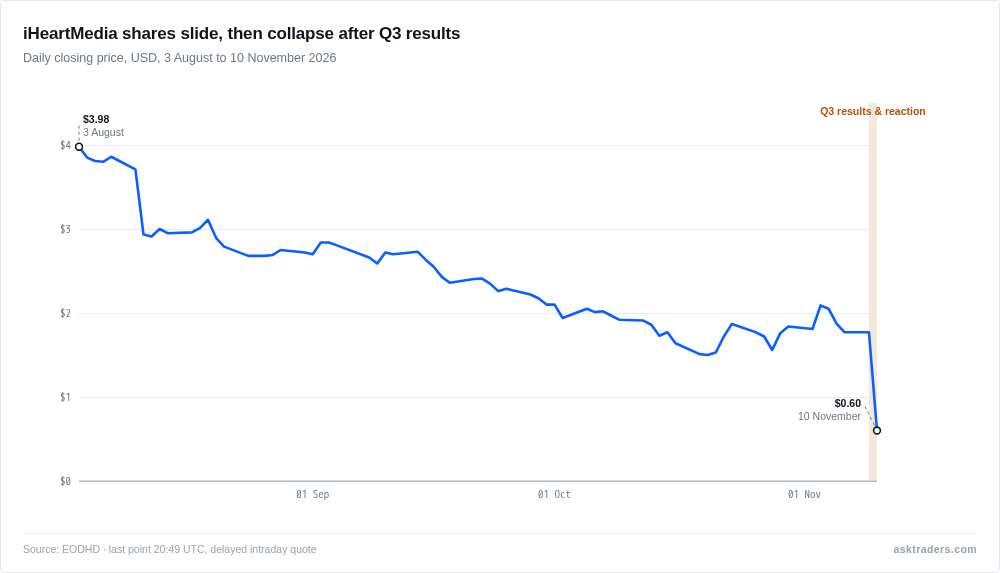
iHeartMedia (NASDAQ: IHRT) shares fell about two-thirds on Tuesday after the radio and podcast group’s third-quarter results missed its own guidance. The figures came after the US close yesterday, so Tuesday was the first trading reaction.
The stock closed yesterday at $1.77 and stood at $0.6052 at the last delayed quote before the close, down roughly 65%, on about 33 times yesterday’s volume. It had already fallen 55.5% since the 3rd of August, and its previous 52-week low was $1.38 on the 21st of October.
Revenue rose 3.3% to $1.03bn, below management’s guide of mid-single-digit growth and the $1,053.0m consensus of four analysts. Adjusted EBITDA, the company’s own operating profit measure before interest, tax and one-offs, was $170.5m. That was under its $180m to $220m range and down from $204.8m a year earlier.
Chairman and CEO Bob Pittman told analysts on the results call that political advertising, meaning election-campaign spending, went elsewhere.
We got less than our normal share of revenue through the political process, and again, TV was the major beneficiary of that.
Bob Pittman, Chairman and CEO, iHeartMedia
Political revenue still rose, to $29.7m from $5.5m, but fell short of what management expected. Excluding it, revenue grew only 0.9%. President and COO Rich Bressler said political is the company’s highest-margin business, so a shortfall hits EBITDA harder than other categories. Pittman also cited big advertisers delaying spend until after the election, a faster shift to programmatic buying (ads bought automatically through software) and a weak economy.
The radio-led Multiplatform Group saw revenue fall 4.9% to $562.4m and segment EBITDA drop 42.9% to $68.0m. Podcast revenue rose 24.4% to $173.7m, but did not offset it.
The company now guides full-year 2026 adjusted EBITDA to $550m to $600m and fourth-quarter EBITDA to $135m to $185m, the latter including about $100m of net negative impact from non-cash trade and barter marketing.
That matters because net debt, borrowings minus cash, was $4,680.1m at the end of September, and full-year interest expense is guided to about $440m. Bressler said this is one of the most uncertain advertising periods the company has managed through, including COVID-19, which makes narrowing its range difficult.
For UK traders, this is a heavily indebted NASDAQ small-cap now trading below $1, which is high risk. The fourth-quarter EBITDA guide is the next marker to watch.