





The S&P 500 fell 0.35% to 7,592.40 on Thursday, and the Nasdaq Composite slipped 0.39% to 25,366.09. The drag was the exit of Jensen Huang, chief executive of chipmaker Nvidia (NASDAQ: NVDA), whose shares fell nearly 12% at one point before closing 4.3% lower.
Key points
- S&P 500 closed down 0.35% and Nasdaq Composite down 0.39%
- Nvidia shares ended 4.3% lower after Jensen Huang’s exit
- Energy was the best S&P 500 sector, up 1.5%
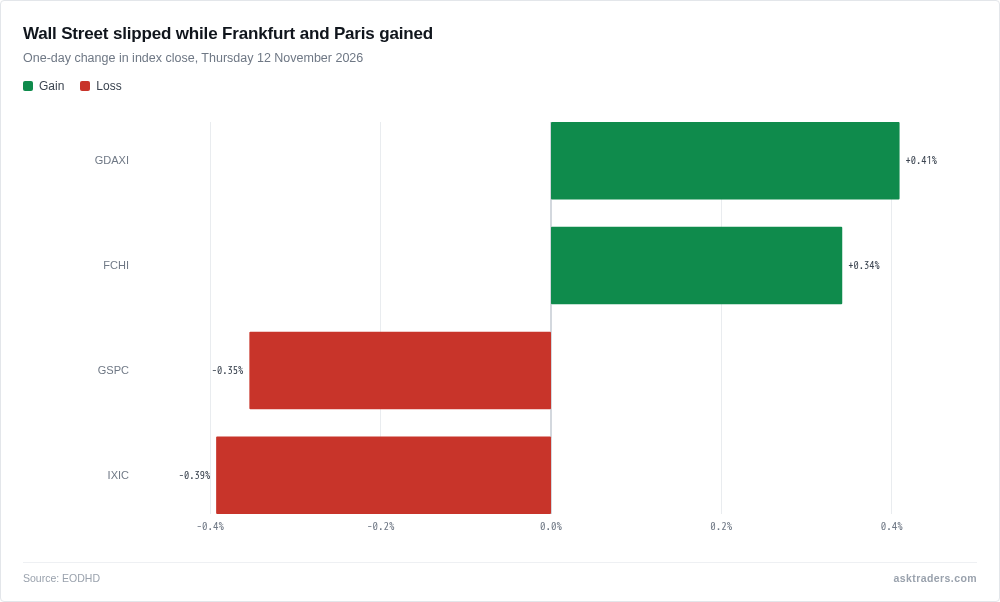
- DAX rose 0.41% and CAC 40 rose 0.34%
AI names take the hit
Both US indices recovered most of their early losses. The Nasdaq Composite now sits 4.46% below its close of 26,549.85 on the 28th of October, and the S&P 500 is 1.96% below its close of 7,743.98 that day.
Other AI names fell harder. Nebius dropped 16.8% after results and an outlook, and CoreWeave lost 6.9%. The Philadelphia Semiconductor index fell 0.5%, having gained 17.2% over the previous four sessions.
Breadth was weak, with decliners outnumbering advancers 3.4-to-1 on the NYSE. Energy was the best S&P 500 sector, up 1.5% for a fourth straight gain, as crude rose after Trump wrote that the US did not need a deal with Iran.
Jed Ellerbroek, portfolio manager at Argent Capital Management, described the selling as a rotation he expected to reverse.
Right now, the market is selling AI stocks and tech stocks and buying safe stuff, just like it did in the first halo trade in January and February of this year, but it will flip back,
Jed Ellerbroek, Argent Capital Management
Europe holds up better
In Europe, the DAX in Frankfurt rose 0.41% and the CAC 40 in Paris gained 0.34%, both on corporate earnings. The FTSE 100 was 0.25 higher on earnings and UK third-quarter GDP growth of 0.7%, the fastest in two and a half years.
| Index | Close | Change | % change |
|---|---|---|---|
| S&P 500 | 7,592.40 | -26.98 | -0.35% |
| Nasdaq Composite | 25,366.09 | -100.10 | -0.39% |
| DAX | 26,771.88 | +109.11 | +0.41% |
| CAC 40 | 8,361.36 | +28.49 | +0.34% |
Rates frame all of it. After a hotter-than-expected CPI reading earlier in the week, CME FedWatch shows a December Fed rate rise of at least 25 basis points as fully priced, with a 15% chance of 50 basis points. US producer prices (PPI) are due tomorrow.