






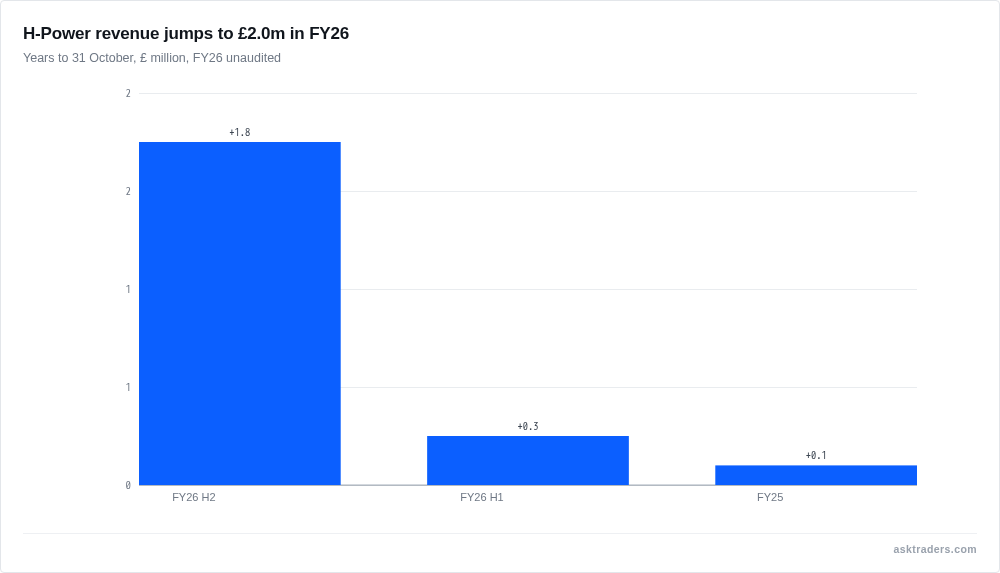
H-Power (HPOW.L) said unaudited revenue for the year to the 31st of October rose to £2.0m, from £0.1m a year earlier. The AIM-listed company, which makes fuel-cell generators and equipment that turns ammonia into hydrogen, gave the figure in a trading update earlier today.
That is roughly a twentyfold rise, though from a very small base. Revenue came from sales of the LC30, a 30kW fuel-cell generator, from hydrogen sales, and from the first phase of a joint development agreement with Komatsu. The second half delivered £1.75m against £0.25m in the first, the third straight half-year of growth.
The Speedy order is for 15 LC30 units from a joint venture with Speedy Hydrogen Solutions, which the company calls a replenishment order. The offer to customers is weekly rental plus fuel at cost parity with diesel. Utilisation is above target, and H-Power and Speedy agreed to establish an H-Power depot at Speedy’s flagship London Gateway location. The order’s value was not stated.
H-Power also agreed to sell 5,000kg of hydrogen to Protium over the contract term, having begun hydrogen sales in May, ahead of target. Non-binding heads of terms have been agreed with Protium for an initial two-year supply and deployment of an HY5, an ammonia cracker producing up to 500kg of hydrogen a day. H-Power counts that as FY27 revenue.
Komatsu’s agreement is worth about US$2m in milestones. The first phase is delivered and the second is due by the end of calendar 2027.
Cash and short-term deposits stood at about £11.1m on the 31st of October, down about £14.2m, or 56%, from £25.3m a year earlier. The company says the fall reflects investment in commercial growth. The update gives no loss figure.
John Wilson, H-Power’s chief executive, described the year as a change of identity:
FY26 was an important year in the reset of H-Power from a technology-led business into a commercially focused products company.
John Wilson, chief executive, H-Power
H-Power expects revenue to keep growing in FY27 and beyond. Talks with an unnamed S&P 500 partner on further HY5 applications are moving to commercial terms, and the first HY5 deployment is on track to produce hydrogen in calendar 2026.