


Allergy Therapeutics (LON: AGY) reported full-year revenue of £59.9m, up 9%, as sales growth accelerated after the launch of its Grassmuno allergy treatment in Germany. The biotech, which makes and sells allergy immunotherapies mainly in Europe, also reported a wider loss.
The shares were at 1.445p at 09:41 this morning, down 3.0% from 1.49p at yesterday’s close. The bigger drop came earlier, from a weekly close of 4.0p in the week of the 26th of October to 1.275p a week later, and the 12-month weekly high was 12.1p in January.
Grassmuno is a short-course grass pollen injection. Germany’s regulator, the Paul-Ehrlich-Institut, granted marketing authorisation in December, and it launched on the 15th of January, after most of the peak treatment season. The company says the launch was later than planned.
Second-half revenue was £23.6m against £21.0m a year earlier. Growth was over 12%, or 9% at constant currency (excluding exchange-rate effects), compared with 7% in the first half. Revenue for the previous year was £55.0m.
The launch cost money before it earned any. The operating loss widened to £38.6m from £28.2m, and the adjusted EBITDA loss, the company’s own measure, to £14.9m from £9.0m, which it attributes to Grassmuno sales and marketing costs incurred before launch. Research and development spending rose 24% to £19.1m.
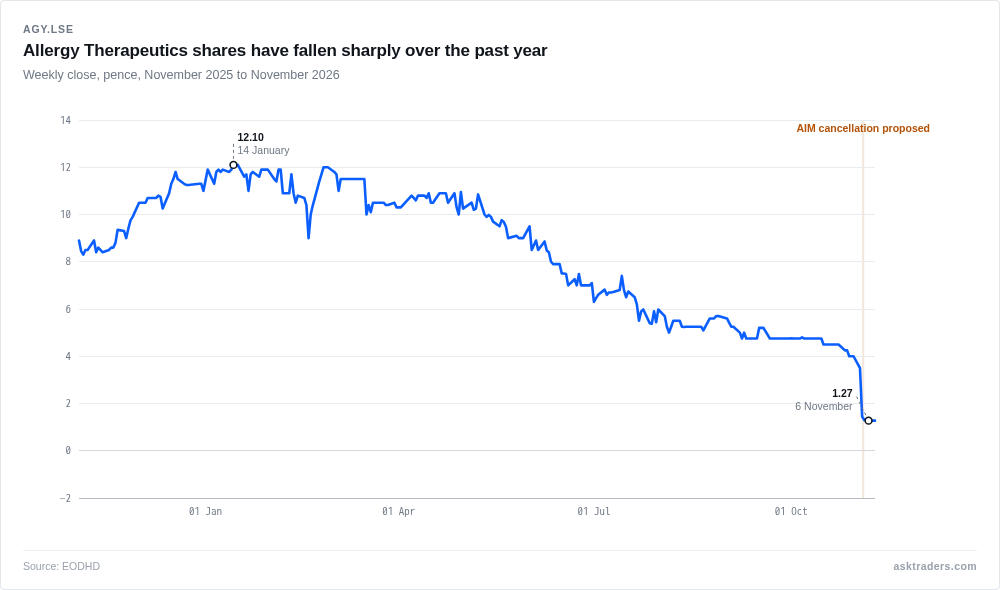
Chief executive Manuel Llobet said the launch came after most of the peak season had passed, and that the company expects “strong revenue growth” this financial year, the first full high season for Grassmuno. There is no numerical target, and the company says delivery is not assured. He added:
Going forwards, maintaining financial discipline whilst achieving sustainable revenue growth is our priority.
Manuel Llobet, Chief Executive Officer
Funding limits the upside. Cash was £24.2m at the 30th of June, up from £12.8m a year earlier, but £12.2m by the end of September. Shareholder lenders committed a £50m facility on the 29th of October, and the pipeline, including a paediatric Phase III trial, needs more money.
On the 3rd of November the board said it intends to propose cancelling AIM admission and becoming a private company, subject to a shareholder vote at the annual general meeting. If approved, the shares would stop trading on AIM.