





EnQuest (LON: ENQ), the independent oil and gas producer, has agreed to sell its entire UK North Sea business to NEO NEXT+ Energy Upstream UK Limited for up to $960m. The sale would leave it producing only in South East Asia, and the shares opened sharply higher before fading.
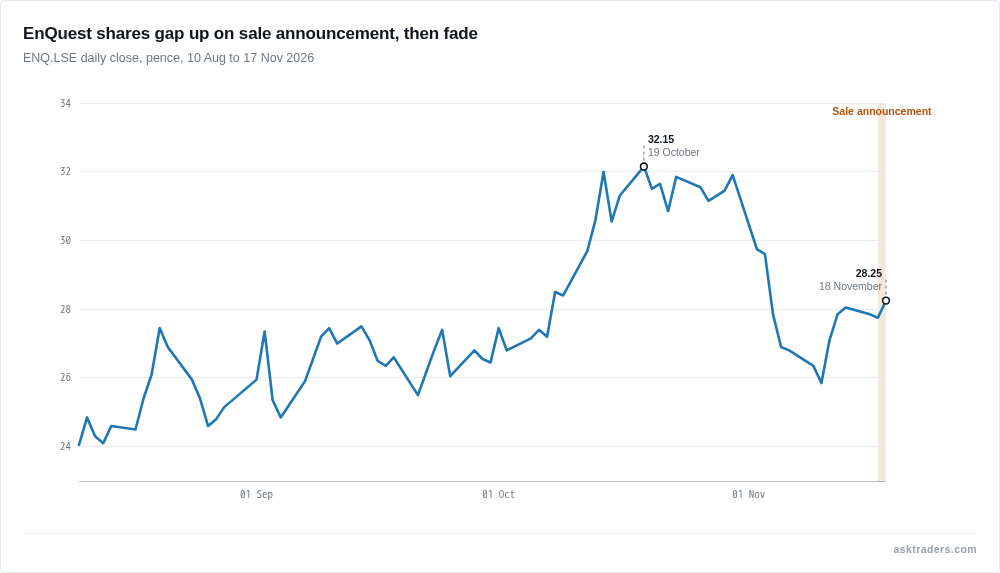
The stock opened at 31.0p, 11.7% above yesterday’s close of 27.75p, and reached 31.97p, close to its 32.15p closing high of the 19th of October. At 08:39 GMT, it was at 28.45p, up 2.5%, with 5.9m shares traded, more than double yesterday’s full-day 2.6m.
EnQuest said in a statement at 7am, before the London open, that the sale agreement was signed yesterday. It covers EnQuest Britain Limited, which holds the Magnus and Kraken fields, other UK fields, the Sullom Voe Terminal and pipelines. The price is $840m in cash plus up to $120m contingent, and the buyer pays a $67.2m deposit on signing.
The contingent money depends on Brent crude averaging above $75 a barrel in 2027 to 2029, or on cuts to the Energy Profits Levy, the windfall tax on UK oil and gas profits. EnQuest expects completion in the first quarter of 2027, subject to regulatory approvals, lender consent and its Malaysia acquisitions completing. No shareholder vote is required.
The company says proceeds will repay its reserves-based lending facility, a bank loan secured on reserves, including debt drawn for the Malaysia deals. It puts pro forma net debt to EBITDA at 0.5 to 0.7 times at the end of 2025, down from 1.1 times, and says $2,125m of UK decommissioning, lease and other liabilities passes to the buyer. The company puts the valuation at up to $9 per barrel of proven and probable reserves.
The company describes what remains as a South East Asia business of about 70,000 barrels of oil equivalent a day, with unit operating costs of about $11 a barrel against the group’s $25 in 2025, and pro forma EBITDA of about $500m. Chief executive Amjad Bseisu said:
The resulting business will have a materially lower cost base and significantly enhanced balance sheet strength to pursue both organic investment and further value-accretive acquisitions across South East Asia, while supporting sustainable shareholder returns.
Amjad Bseisu, EnQuest
The company lists the trade-offs itself: reserves fall and must be replaced, the portfolio becomes less geographically diverse, and the sale could be delayed or not complete. The assets sold held about 122m barrels of proven and probable reserves at the end of 2025.