






Filtronic (LON: FTC) has won a $3m follow-on pre-production order from an undisclosed US satellite-communications customer. The AIM-listed company, which designs radio-frequency (RF) products for the space, aerospace, defence and telecoms infrastructure markets, announced the order at 7 am today, and its shares rose in early trading.
The shares were 4.6% higher at 219.7p in a delayed quote at 8.37am, against yesterday’s close of 210p. They opened at 212.15p and reached 225p at the day’s high. Yesterday’s close was about 36% below the 330p close of the 7th of October, and the session is still running.
The order is incremental to the $8m development programme with the same customer that Filtronic announced on the 26th of March. A follow-on contract is a further order from an existing customer, and this one pays for critical long lead-time components, meaning parts that take a long time to source.
Filtronic says securing them reduces supply-chain risk and supports accelerated development and delivery timelines. It describes the order as the next step towards full commercial sales. Chief Executive Officer Nat Edington said:
Securing this follow-on contract with the customer reflects the strength of our growing relationship with them and their continued confidence in Filtronic’s technical expertise and delivery capabilities.
Nat Edington, Chief Executive Officer, Filtronic
The $3m is about 38% of the $8m programme, which covers the design, development, production and qualification of amplifiers and runs into 2027. Set against trailing twelve-month revenue of roughly £55.5m, the order is small. The news is that the customer relationship is growing.
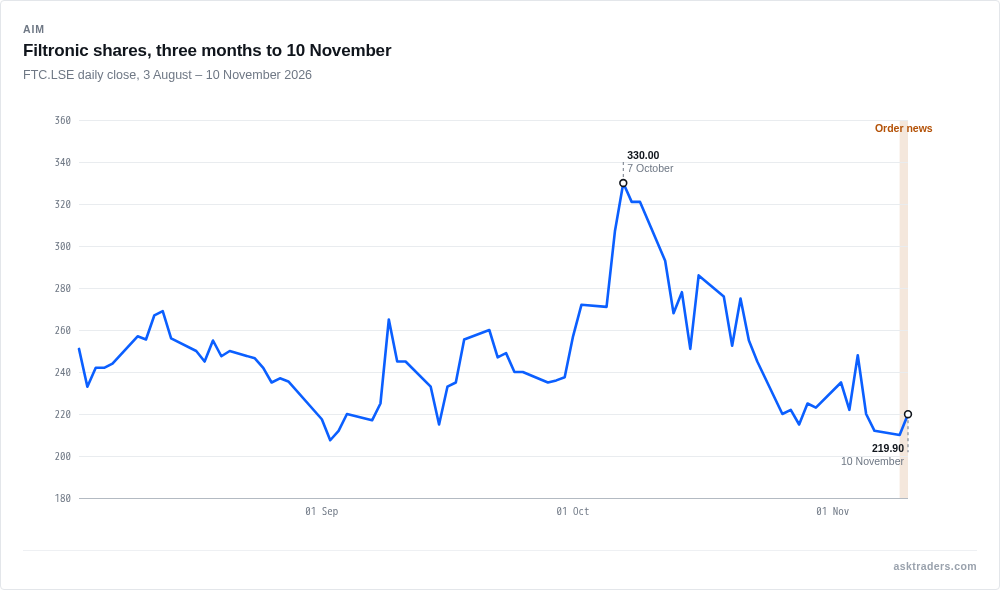
The shares have been volatile, with daily swings of 4% to 10% recently. They closed at 248p on the 4th of November, and the 50-day moving average is 248.12p. The trailing price-to-earnings ratio is 105, a high multiple that sets a demanding bar for further news.
The announcement carries no change to guidance, no detail on when revenue will be recognised and no name for the customer. It does not address whether the pre-production phase will lead to full commercial volumes, which would be much larger.