






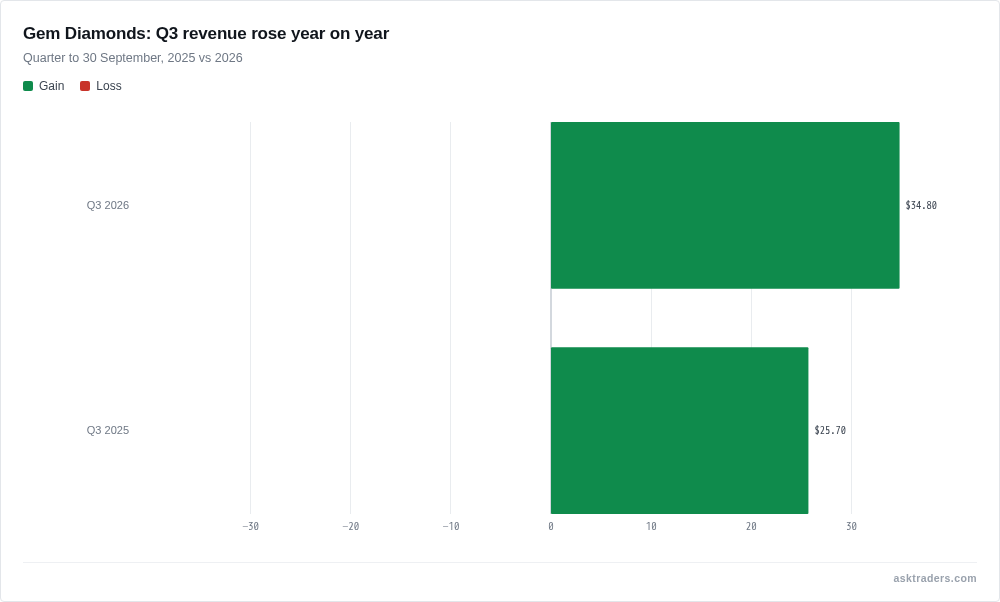
Gem Diamonds (LON: GEMD) reported third-quarter revenue of US$34.8m today, up from US$25.7m a year earlier, on 17,899 carats sold. The London-listed producer owns 70% of the Letšeng mine in Lesotho.
The trading update covers the three months from the 1st of July to the 30th of September. Carats sold fell 21.6% on our arithmetic, from 22,830 a year earlier, yet revenue rose 35% because the average price climbed to US$1,945 per carat from US$1,124, a rise of 73%.
Large stones did the work. Four diamonds that each sold for more than US$1.0m contributed US$22.2m of the quarter’s revenue. Two stones above 100 carats were sold, including the 347 carat Lesotho Jubilee, a white Type II diamond recovered in the second quarter.
Chief executive Clifford Elphick said the September sales and the Jubilee were encouraging for demand:
Sales of Letšeng’s rough diamonds in September achieved good prices, with results further supported by the sale of the exceptional 347 carat Lesotho Jubilee. These results are encouraging indicators that demand and prices for Letšeng quality diamonds are firm.
Clifford Elphick, CEO, Gem Diamonds
Production was softer. Carats recovered fell about 13% to 19,299 from 22,268, and the grade, the carats found per hundred tonnes of ore treated, slipped to 1.42 from 1.69.
Despite that, the company raised its full-year guidance, citing strong operational performance and cost containment. Carats recovered are now expected at 78,000 to 80,000 (previously 75,000 to 78,000) and carats sold at 79,000 to 81,000 (previously 77,000 to 80,000). Operating costs fall to 305 to 315 Maloti, Lesotho’s currency, per tonne treated from 310 to 325, and capital spending to US$0.34m to US$0.45m from US$1.0m to US$1.5m.
The royalty now has a new basis. Letšeng’s royalty remission, a temporary waiver of payments, ran to the end of September. The Government of Lesotho has approved a variable rate of 3% to 6%, set on the six-monthly average dollar per carat, for sales after the 1st of October. Elphick called it a good policy decision for the mine’s long-term sustainability.
Financing is unresolved. The group’s revolving credit facilities expire on the 21st of December. Commercial terms for renewal are still being finalised with lenders Nedbank and Standard Bank, and the refinancing is not yet concluded.