

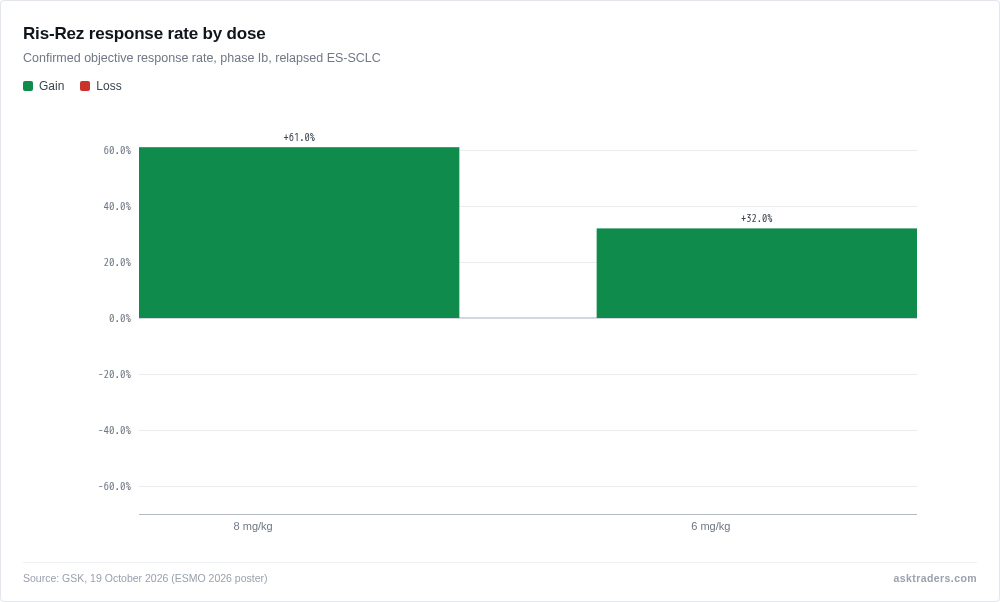
GSK (LON: GSK) has reported first global data for its experimental lung cancer drug Ris-Rez, with a 61% confirmed response rate at the dose now being evaluated in its global phase III. The results cover relapsed extensive-stage small cell lung cancer and are being presented as a poster at the ESMO Congress in Madrid.
The phase Ib part of the EMBOLD PanTumour-101 study randomised patients who had already relapsed to 6 or 8 mg/kg, given by intravenous infusion every three weeks. At 8 mg/kg, 11 of 18 evaluable patients responded (61%), against 7 of 22 (32%) at 6 mg/kg.
Those groups are small. The 8 mg/kg response rate carries a 95% confidence interval, the range the true figure plausibly sits in, of 35.7% to 82.7%.
GSK said the data, together with a phase III trial run by its licensor Hansoh Pharma, supported choosing 8 mg/kg for its own global phase III, EMBOLD SCLC-301. Hansoh’s pivotal trial in Chinese patients showed a statistically significant overall survival benefit.
The higher dose carried more severe side effects. Grade 3 or worse treatment-related events hit 42% of patients at 8 mg/kg and 15% at 6 mg/kg, mostly blood-related. Interstitial lung disease affected 1 of 50 patients (2%) at grade 2.
Hesham Abdullah, GSK’s SVP and Global Head of Oncology R&D, said “we remain focused on accelerating development in extensive-stage small cell lung cancer, where patients often relapse quickly and urgently need more treatment options.”
The caveats are plain. The analysis covered 50 patients, median follow-up was only 100.5 days, and enrolment was still ongoing at the data cut-off. GSK said longer follow-up is needed to show how durable responses are.
Small cell lung cancer is about 10% to 15% of lung cancers worldwide, and about 70% of cases are diagnosed at the extensive stage. Median overall survival on current standard care is about 12 to 13 months. Hye Ryun Kim of Yonsei Cancer Center, a study investigator, said the response rates and manageable safety profile “are encouraging and support its ongoing development in this setting.”
Ris-Rez targets B7-H3, a protein found at high levels in more than 10 solid tumour types, and GSK is aiming for more than 40 indications by 2040. The data are pipeline news rather than an immediate earnings driver, with phase III under way in this setting and in prostate cancer.