Wizz Air September Passengers Rise 24.2% as Pricing Firms and Load Factor Dips
Wizz Air carried almost a quarter more passengers in September than a year earlier, while its load factor dipped slightly as the airline grew seats faster than demand and pricing strengthened.
Wizz Air (LON: WIZZ) carried 7,780,835 passengers in September, up 24.2% from 6,265,236 a year earlier. The airline’s load factor, the share of seats it filled, slipped 0.8 percentage points to 92.0%.
Capacity grew faster than traffic, up 25.3% to 8,459,005 seats. Wizz said the load factor in part reflected a stronger pricing environment, with notable improvement in the month versus earlier periods.
Over the rolling 12 months, passengers rose 19.0% to 79,326,688 and the load factor eased to 91.0% from 91.2%. On emissions, CO2 per passenger per kilometre fell 1.6% to 49.0 grams, though total September CO2 rose 17.1% with the larger operation.
Sponsored content
Ready to put what you’ve learned into practice?
Try IG’s platform with £10,000 in virtual funds and practise trading
without putting your own money at risk.
Spread bets and CFDs are complex instruments and come with a high risk of losing money rapidly due to leverage. 69% of retail investor accounts lose money when trading spread bets and CFDs with this provider.
Sponsored content
Learn the markets with IG Academy
Build your knowledge with IG Academy educational content, then use a
demo account to practise what you’ve learned on the IG platform.
Spread bets and CFDs are complex instruments and come with a high risk of losing money rapidly due to leverage. 69% of retail investor accounts lose money when trading spread bets and CFDs with this provider.
Sponsored content
See how trading works before risking real money
IG’s demo gives you access to thousands of markets and £10,000 in
virtual funds, so you can explore the platform and test your ideas first.
Spread bets and CFDs are complex instruments and come with a high risk of losing money rapidly due to leverage. 69% of retail investor accounts lose money when trading spread bets and CFDs with this provider.
Sponsored content
Turn trading theory into practical experience
Learn with IG Academy, explore charts and market tools, and practise
strategies in a simulated trading environment before going live.
Spread bets and CFDs are complex instruments and come with a high risk of losing money rapidly due to leverage. 69% of retail investor accounts lose money when trading spread bets and CFDs with this provider.
Sponsored content
Ready to take your learning further?
IG combines market education, analysis and an established trading platform,
giving you the tools to keep learning as you develop your trading skills.
Spread bets and CFDs are complex instruments and come with a high risk of losing money rapidly due to leverage. 69% of retail investor accounts lose money when trading spread bets and CFDs with this provider.
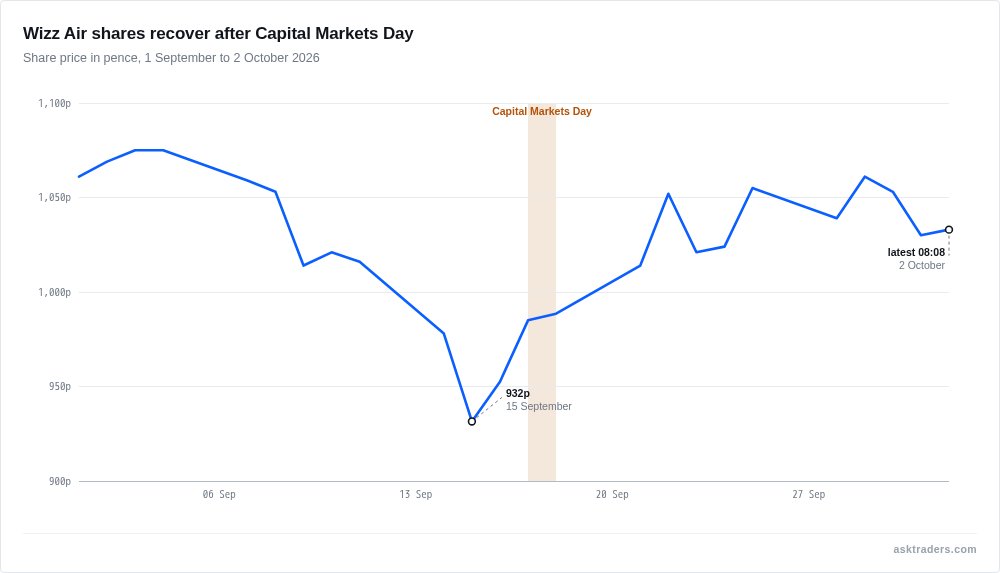
Wizz shares stood at 1033p at 8.08am today, against yesterday’s close of 1030p, a gain of 0.29%. Volume was very thin, with the session only minutes old.
Wizz Air share price in pence, 1 September to 2 October 2026; the latest point is the 08:08 London quote today, not a close
That quote is 8.45% above the 952.5p close on the 16th of September, the day before the company’s capital markets day. It is 4.87% above the 985p close on the 17th of September, when the shares gained 3.41%.
The shares remain down 19.04% this year from 1276p at the end of 2025, and about 28.6% below the 1447p closing high of the 4th of February.
Sponsored
At the capital markets day on the 17th of September, chief executive József Váradi set targets for the financial year 2030: revenue of EUR 10bn, ex-fuel unit costs (CASK) of EUR 3.00 cents, a 10% operating profit margin and a return to an investment grade balance sheet.
By F30, we intend to operate an all-neo fleet of 335 aircraft, carry 127 million passengers and deliver sustainable, industry-leading margins.
József Váradi, chief executive of Wizz Air
The company gave no guidance for the 2027 financial year. It did improve its second-quarter RASK (revenue per available seat kilometre) guidance to flat on last year from down low single digits, citing stronger than expected summer revenue, and trimmed its originally planned second-half capacity by 5% because of geopolitical and fuel price volatility.
The AskTraders Analyst Team features experts in technical and fundamental analysis, as well as traders specializing in stocks, forex, and cryptocurrency.