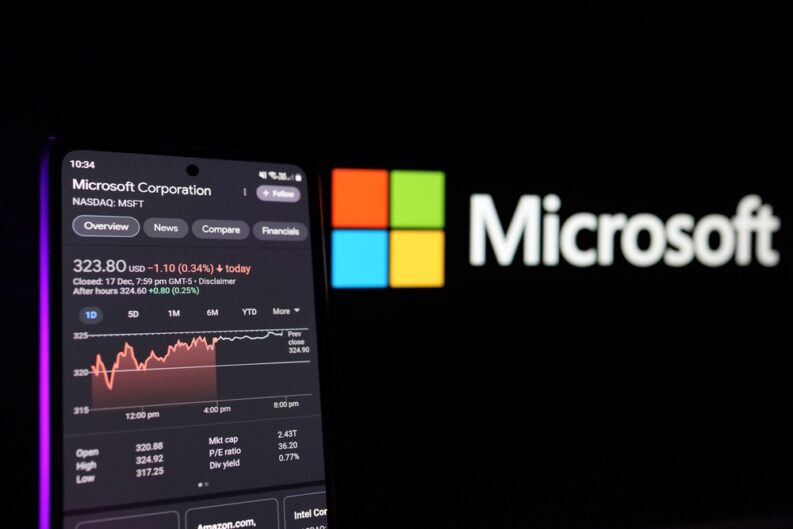

Microsoft’s stock price (NASDAQ:MSFT) remains in correction territory, more than 11% over the past 3 months, despite a 6.84% gain over the past week of trading. Despite underperforming broader markets over the past year (+6.95%), the stock is building up a little steam ahead of earnings, with MSFT set to print after the closing bell.
Expectations for the quarter sits at $3.85 EPS and $80.28B revenue, both above management’s guided midpoint of $80.1B. After a year where the stock has delivered less than half the gains of the S&P 500 (+14.85%) on the same period, the setup reflects a valuation reset in progress.
$3,495.7B
33.5
$3.85
$80.28B
The moves in the stock come despite delivering consistent operational beats, as investors recalibrate expectations around the pace of AI monetization and the cost of delivering it. The company trades at 29.2x forward earnings, a discount to its five-year average, with the market demanding evidence that capacity constraints are easing and that AI revenue contribution is scaling beyond pilot programs.
FY26 Q1 established the current framework: Microsoft beat FactSet estimates by 12.5% on adjusted EPS ($4.13 vs. $3.67) and 3.1% on revenue ($77.7B vs. $75.4B), yet the stock fell in after-hours trading as capex surged and management commentary reinforced that Azure demand remains ahead of available capacity through at least the fiscal year.
The question for this print is whether Azure’s guided 37% constant-currency growth can be delivered without incremental margin pressure or extended capacity constraints that push monetization further into the future.

Consensus Estimates
| Metric | Consensus Est. | Range | Prior Guidance | YoY Change |
|---|---|---|---|---|
| EPS (Adjusted) | $3.85 | $3.41 – $4.03 | $3.80 (midpoint) | +19.3% |
| Revenue | $80.28B | $78.58B – $81.66B | $80.05B (midpoint) | +15.3% |
| Intelligent Cloud | $32.40B | $32.25B – $32.55B | $32.40B (midpoint) | +17.8% |
Analysts Covering: 34 (EPS) / 41 (Revenue)
Estimate Revisions (30d): 1 up / 0 down
Consensus has converged tightly around management’s guidance framework, with revenue estimates clustering within $200M of the $80.05B midpoint. The EPS estimate of $3.85 sits 1.3% above the implied guidance midpoint of $3.80, reflecting confidence that Azure revenue mix and operating leverage can offset elevated depreciation from recent capex. Estimate revisions have been minimal over the past 30 days, with one upward revision and no downgrades, suggesting analysts are waiting for the print to reassess rather than front-running the result.
The narrow estimate range creates a binary setup. Revenue landing at or below the $80.05B midpoint would likely be interpreted as a miss even if it technically beats the low end of guidance, because the Street has positioned for outperformance.
Can Azure growth commentary support the 37% constant-currency target without introducing new capacity constraint language?
Management Guidance and Commentary
“We expect revenue to be between $79.5 billion and $80.6 billion. In Intelligent Cloud, we expect revenue between $32.25 billion and $32.55 billion. We expect Azure growth to be approximately 37% in constant currency, with demand continuing to be higher than our available capacity.”
Management’s FY26 Q1 outlook established a framework that assumes capacity additions will enable Azure to sustain high-30s constant-currency growth while demand remains ahead of supply. The guidance implies total company revenue growth of 12.5% to 14.3% year-over-year, a modest deceleration from Q1’s 15.8% reported growth, driven by tougher comps in the Productivity and Business Processes segment.
The critical phrase is “demand continuing to be higher than our available capacity.” This language has appeared in every quarter since FY25 Q3, and its persistence signals that capacity constraints remain a binding constraint on near-term Azure growth. The market’s tolerance for this narrative is eroding. Investors want evidence that the $20B+ in quarterly capex is translating into capacity that can be monetized within the current fiscal year, not deferred into FY27.
Microsoft’s guidance construction also creates a valuation sensitivity around Intelligent Cloud margins.
The segment’s guided revenue midpoint of $32.40B implies 17.8% year-over-year growth, but the company has not provided explicit margin guidance.
Azure’s mix shift toward AI workloads, which carry lower initial margins due to infrastructure intensity, means that revenue growth alone may not satisfy investors if gross margin contracts more than expected.
Analyst Price Targets & Ratings
Sector & Peer Comparison
| Company | Ticker | Market Cap | P/E | Fwd P/E | Profit Margin |
|---|---|---|---|---|---|
|
Microsoft Corporation
⭐ Focus |
MSFT | $3,495.7B | 33.5 | 29.2 | 35.7% |
|
Oracle Corporation
|
ORCL | $524.2B | 34.2 | 26.0 | 25.3% |
|
Salesforce.com Inc
|
CRM | $218.4B | 30.6 | 17.6 | 17.9% |
|
Adobe Systems Incorporated
|
ADBE | $127.6B | 18.2 | 12.8 | 30.0% |
|
Intuit Inc
|
INTU | $156.4B | 38.6 | 24.4 | 21.2% |
Microsoft trades at a 12.3% premium to Oracle on forward P/E but commands a 41% profit margin advantage, reflecting superior operating leverage from its integrated cloud and productivity platform. The company’s 29.2x forward multiple sits between Oracle’s 26.0x and Intuit’s 24.4x, positioning it in the middle of the enterprise software peer set despite having the largest market cap and highest absolute profit margins.
The valuation premium is justified by Microsoft’s exposure to both cloud infrastructure and AI monetization, which peers lack at comparable scale. However, the premium has compressed over the past three months as investors reassess the timeline for AI revenue contribution.
Microsoft’s forward P/E has contracted from approximately 32x in October 2025 to 29.2x currently, even as Oracle and Salesforce have held their multiples, suggesting the market is applying a higher bar for Microsoft to validate its AI spending thesis.

Earnings Track Record
| Quarter | EPS Actual | EPS Est. | Result | Surprise % |
|---|---|---|---|---|
| 2025-09-30 | $3.72 | $3.66 | Beat | +1.6% |
| 2025-06-30 | $3.65 | $3.38 | Beat | +8.0% |
| 2025-03-31 | $3.46 | $3.22 | Beat | +7.5% |
| 2024-12-31 | $3.23 | $3.10 | Beat | +4.2% |
| 2024-09-30 | $3.30 | $3.11 | Beat | +6.1% |
| 2024-06-30 | $2.95 | $2.93 | Beat | +0.7% |
| 2024-03-31 | $2.94 | $2.82 | Beat | +4.3% |
| 2023-12-31 | $2.93 | $2.78 | Beat | +5.4% |
| 2023-09-30 | $2.99 | $2.65 | Beat | +12.8% |
| 2023-06-30 | $2.69 | $2.55 | Beat | +5.5% |
Microsoft has beaten EPS estimates in 17 of the last 18 quarters, with an average surprise of 5.5%. The lone miss occurred in Q2 FY24, when the company delivered in-line results but the stock sold off on guidance concerns. The pattern over the past year shows consistent but moderating beat magnitudes, from 12.8% in September 2023 to 1.6% in September 2025, reflecting tighter estimate convergence as analysts have learned to model Azure capacity constraints and AI spending intensity more accurately.
The most recent quarter (FY26 Q1) demonstrated that beat magnitude no longer determines stock reaction. Despite a 12.5% EPS beat on an adjusted basis, the stock declined in after-hours trading because capex commentary and capacity constraint language overshadowed the headline numbers. This shift indicates the market is now focused on forward-looking indicators of AI monetization and margin trajectory rather than backward-looking execution.
Post-Earnings Price Movement History
| Date | Surprise | EPS vs Est. | Next Day Move | Price Change |
|---|---|---|---|---|
| 2025-09-30 | +1.6% | $3.72 vs $3.66 | +1.0% | $514.60 to $519.71 |
| 2025-06-30 | +8.0% | $3.65 vs $3.38 | -0.8% | $495.94 to $492.05 |
| 2025-03-31 | +7.5% | $3.46 vs $3.22 | +0.9% | $378.80 to $382.19 |
| 2024-12-31 | +4.2% | $3.23 vs $3.10 | -1.5% | $424.83 to $418.58 |
| 2024-09-30 | +6.1% | $3.30 vs $3.11 | -1.7% | $428.02 to $420.69 |
Microsoft’s post-earnings price reactions have become increasingly disconnected from beat magnitude. The stock’s average next-day move is -0.4% on beats, with four of the last six earnings reports resulting in negative price action despite headline beats. This pattern reflects a market that is pricing in execution and focusing instead on guidance quality, Azure commentary, and capex trajectory.
The most instructive comparison is between June 2025 (8.0% EPS beat, -0.8% stock move) and March 2025 (7.5% EPS beat, +0.9% stock move). Both quarters delivered similar beat magnitudes, but the June quarter’s negative reaction was driven by capacity constraint language that extended the timeline for Azure growth acceleration, while the March quarter’s positive reaction followed commentary suggesting constraints were beginning to ease. The takeaway is that Azure growth trajectory and capacity commentary now drive stock reaction more than reported results.
Expected Move & Implied Volatility
28.5%
62%
24.2%
The options market is pricing a $36 swing in either direction, reflecting heightened uncertainty. Implied volatility of 28.5% sits 420 basis points above realized 30-day volatility of 24.2%, indicating that options buyers are paying a premium for protection or speculation around this print.
The IV percentile of 62% suggests this is elevated but not extreme relative to the past year, consistent with a market that sees binary outcomes tied to specific guidance variables rather than broad uncertainty about the business model.
The 3.8% expected move creates a framework for evaluating surprise scenarios. A move beyond $488 (upside breakout) would likely require not only a revenue beat but also Azure commentary that signals accelerating capacity additions and a credible path to margin expansion.

Expert Predictions & What to Watch
Key Outlook: Guidance Will Drive the Trade
The base case assumes Microsoft delivers revenue of $80.5B to $81.0B (0.5% to 1.4% above the $80.05B midpoint) and EPS of $3.90 to $3.95 (1.3% to 2.6% above consensus). This would represent a continuation of the company’s pattern of modest beats, but it would not be sufficient to drive a sustained stock rally without accompanying commentary that changes the narrative on capacity constraints or AI monetization.
The critical variable is Azure’s constant-currency growth rate. Management guided to approximately 37%, and consensus is positioned for that figure or slightly higher. A print of 38% to 39% would be viewed as positive, but only if management indicates that capacity additions are on track to support sustained high-30s growth through at least FY26 Q4. A print of 36% or below, even if technically within guidance, would likely trigger a selloff as it would suggest demand conversion is slowing or capacity constraints are worsening.
Key Metrics to Watch
The interplay between these metrics will determine the stock’s reaction. A scenario where Azure growth meets or beats 37% but gross margin contracts sharply would create a debate about whether Microsoft is sacrificing profitability for growth. Conversely, a scenario where Azure growth comes in at 36% but management indicates capacity constraints are easing would create a debate about whether near-term softness is acceptable if the long-term trajectory is improving.
The most important takeaway from the past year’s earnings cycle is that Microsoft’s stock now trades on forward-looking indicators of AI monetization and capacity trajectory rather than backward-looking execution. The company has proven it can beat estimates consistently, but the market is demanding evidence that the AI investment cycle is transitioning from “build” to “monetize.” This print will either provide that evidence or extend the timeline, with valuation implications that are likely to be immediate and significant.
For investors looking to gain exposure to Microsoft through tax-efficient vehicles, Stocks & Shares ISAs provide an excellent opportunity to invest in individual stocks or funds containing Microsoft shares while benefiting from tax-free growth. Understanding the difference between trading and investing is crucial when deciding whether to hold Microsoft through earnings volatility or take a more active approach.
Searching for the Perfect Broker?
Supplement your charting with a free trading platform that rivals the best out there – multiple charts on one screen for easy monitoring, ProRealTime provides the perfect support for your investing or trading journey.
Discover our top-recommended brokers for trading stocks, forex, cryptos, and beyond. Dive in and test their capabilities with complimentary demo accounts today!
- IG Top-tier regulation – Read our Review
- eToro Wide range of instruments available to trade – Read our Review
YOUR CAPITAL IS AT RISK. 76% OF RETAIL CFD ACCOUNTS LOSE MONEY