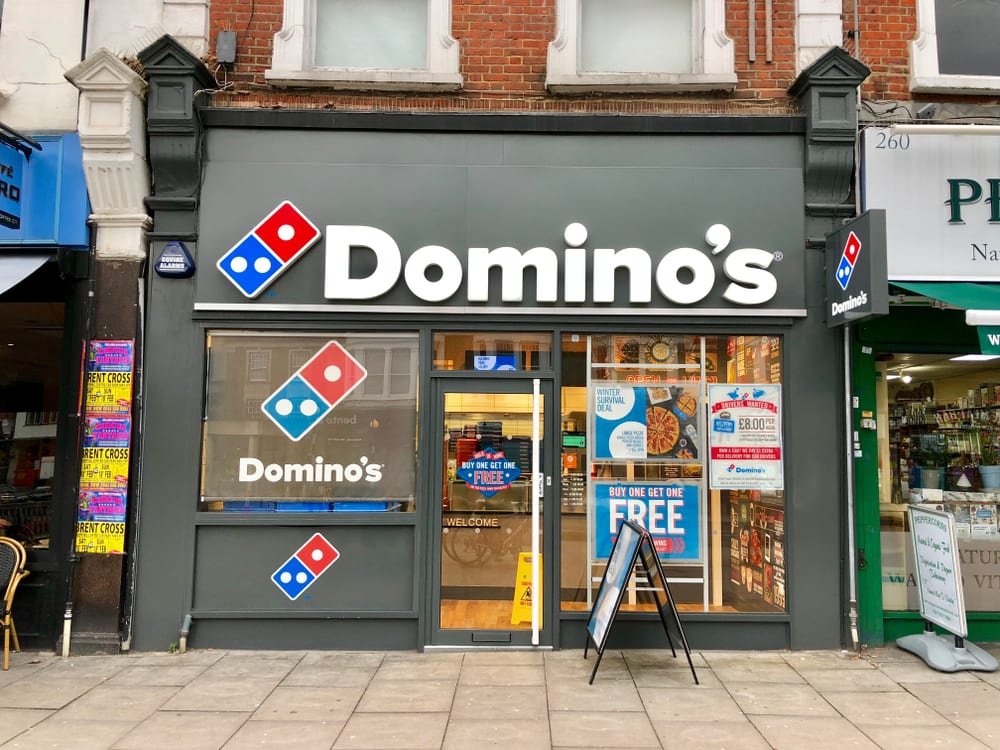

Domino’s reports fiscal fourth-quarter 2025 results on February 23 before market open. The quarter tests whether U.S. same-store sales momentum from the second and third quarters sustained through year-end, and whether the DoorDash aggregator rollout contributed meaningfully without eroding franchisee economics.
Consensus sits at $5.38 EPS on $1.52B revenue, representing 9.8% and 5.3% year-over-year growth respectively, but management has not issued formal quarterly guidance, leaving the Street to extrapolate from prior commentary about modest international growth and U.S. demand resilience.
Domino’s exited the third quarter with 5.2% U.S. comparable sales growth, the strongest print in the trailing 12-month period, driven by promotional activity (stuffed crust, value bundles) and aggregator reach. If that momentum held into the fourth quarter, the company clears consensus and resets expectations for 2026.
If demand faded post-promotion or international markets deteriorated further from the 1.7% comp growth reported in Q3, the stock faces a de-rating from its current 22.5x trailing P/E, which sits below the five-year average of 26.9x but still prices in execution on the “Hungry for More” strategic plan.
$13.06B
22.5
$5.38
$1.52B
The valuation discount reflects skepticism about durability. The stock trades down more than 20% over the past 12 months, pressured by food inflation, modest international growth, and recurring earnings-quality noise from DPC Dash investment mark-to-market swings. A clean fourth-quarter print that demonstrates sustainable U.S. transaction growth and margin stability would support multiple expansion toward historical norms. Conversely, a result that meets consensus but signals softer demand or heavier discounting into 2026 will reinforce the view that promotional activity borrowed from future quarters rather than unlocking durable traffic.
Consensus Estimates
| Metric | Consensus Est. | Range | Prior Guidance | YoY Change |
|---|---|---|---|---|
| EPS (Adjusted) | $5.38 | Not disclosed | Not provided | +9.8% |
| Revenue | $1.52B | Not disclosed | Not provided | +5.3% |
| U.S. Franchise Advertising | $165.42M | Not disclosed | Not provided | +7.6% |
| Supply Chain Revenue | $924.23M | Not disclosed | Not provided | +5.5% |
| International Franchise Royalties | $105.22M | Not disclosed | Not provided | +6.9% |
Analysts Covering: 22 analysts (EPS), 23 analysts (Revenue)
Estimate Revisions (30d): 4 up / Not disclosed down
Consensus expectations embed continued execution on the core business model with modest acceleration. The $5.38 EPS estimate represents a step-up from the $4.89 reported in fiscal Q4 2024, when the company posted only 0.4% U.S. same-store sales growth and missed revenue expectations. The revenue estimate of $1.52B assumes supply chain volumes grow in line with store count expansion (analysts expect 22,150 total stores, up from 21,366 a year ago) and that U.S. franchise advertising revenue reflects sustained promotional activity.
The absence of formal quarterly guidance from management creates uncertainty around the bar. Domino’s has historically provided annual outlook rather than quarterly targets, leaving investors to triangulate from commentary about “modest international same-store sales growth of 1-2%” and expectations that aggregator partnerships would contribute meaningfully to U.S. comps following full rollout in Q3. The 0.1% downward revision in consensus EPS over the past 30 days suggests some recent analyst caution, likely reflecting concerns about whether promotional intensity can sustain without margin pressure or whether international markets deteriorated further from the weak 1.7% comp growth reported in Q3 2025.
The key risk lies in the composition of revenue growth. If the $1.52B revenue estimate materializes primarily through supply chain volume (which carries lower margins) rather than royalty growth from robust same-store sales, the earnings quality will disappoint even if headline numbers clear consensus. Conversely, if U.S. same-store sales held above 5% and international markets stabilized, the mix would support margin expansion and justify a higher multiple.
Management Guidance and Commentary
“We have best-in-class franchisee economics in QSR pizza, the largest advertising budget, a supply chain with incredible purchasing power, a rewards program that is bigger than ever. And we’re just getting started. As you know, we don’t usually do LTOs at Domino’s. So, everything we have launched over the last two years, aggregator ordering, new loyalty platform, stuffed crust, and more is a part of our base and will be part of our growth in the future.”
Management’s Q3 2025 earnings call commentary emphasized that recent product launches and technology implementations are now embedded in the base business rather than temporary promotional lifts. This framing matters because it sets expectations for sustainable growth rather than one-time boosts. The explicit mention of aggregator ordering, the new loyalty platform, and stuffed crust as permanent additions signals management’s view that these initiatives will continue driving traffic without requiring incremental promotional spend.
The absence of formal fourth-quarter guidance leaves the Street to interpret management’s broader commentary about international markets. In Q3, management reiterated expectations for “modest international same-store sales growth of 1-2%,” a cautious outlook that reflects volatile macro conditions in various global markets. If international comps came in below that range in Q4, it would represent a miss against the implied guidance even without an explicit quarterly target. The company also highlighted that the DoorDash partnership was fully rolled out in Q3 and expected to be a meaningful contributor to U.S. comps, creating a specific watch item for whether that contribution materialized in Q4 results.
The gap between consensus and management’s implied expectations centers on U.S. momentum sustainability. Consensus revenue of $1.52B assumes roughly 5% total growth, which requires either sustained U.S. same-store sales above 5% or stronger international performance than the 1-2% management signaled. If management’s Q4 commentary suggests U.S. comps moderated from the 5.2% Q3 level or that promotional intensity will need to increase to maintain traffic, the forward outlook will compress even if the quarter clears consensus.
Analyst Price Targets & Ratings
Wall Street maintains a constructive outlook with 80% of analysts rating shares a Buy or Strong Buy. The consensus target of $482.97 implies 25.6% upside from current levels, reflecting expectations that the company can sustain recent U.S. momentum and stabilize international markets. The target range varies significantly based on assumptions about promotional sustainability and international recovery timing.
Sector & Peer Comparison
| Company | Ticker | Market Cap | P/E | Fwd P/E | Profit Margin |
|---|---|---|---|---|---|
|
Domino’s Pizza Inc
⭐ Focus |
DPZ | $13.06B | 22.5 | 19.6 | 12.2% |
|
McDonald’s Corp
|
MCD | $214.8B | 25.3 | 23.1 | 32.4% |
|
Yum! Brands Inc
|
YUM | $37.2B | 27.8 | 24.6 | 24.1% |
|
Restaurant Brands Intl
|
QSR | $28.9B | 21.4 | 19.8 | 18.7% |
|
Chipotle Mexican Grill
|
CMG | $72.4B | 48.6 | 42.3 | 16.9% |
|
Papa John’s Intl
|
PZZA | $1.8B | 18.2 | 16.4 | 5.3% |
Domino’s trades at a 22.5x trailing P/E, below the broader QSR peer group average but at a premium to direct pizza competitor Papa John’s (18.2x). The 19.6x forward P/E implies the market expects earnings growth to justify a modest multiple expansion, but the current valuation sits well below Domino’s five-year average of 26.9x, reflecting skepticism about the sustainability of recent U.S. momentum and concerns about international growth constraints.
The valuation discount relative to McDonald’s (25.3x) and Yum! Brands (27.8x) is partially justified by Domino’s lower profit margin (12.2% vs 32.4% and 24.1% respectively), which reflects the company’s asset-light franchising model with significant supply chain operations. However, Domino’s operating margin of 18.1% sits in line with peers, suggesting the profit margin gap stems from below-the-line items, including recurring DPC Dash investment mark-to-market volatility that has distorted reported earnings in recent quarters.
The key question is whether Domino’s can command a premium to Restaurant Brands International (21.4x P/E) given similar profit margins and franchising models. The answer depends on growth trajectory. If Q4 demonstrates that U.S. same-store sales can sustain above 5% and international markets stabilize, the stock should re-rate toward the peer group average. If results show U.S. momentum fading or international weakness deepening, the current discount will persist or widen.
Earnings Track Record
| Quarter | EPS Actual | EPS Est. | Result | Surprise % |
|---|---|---|---|---|
| Q3 2025 | $4.08 | $3.95 | Beat | +3.3% |
| Q2 2025 | $3.81 | $3.94 | Miss | -3.3% |
| Q1 2025 | $4.33 | $4.07 | Beat | +6.3% |
| Q4 2024 | $4.89 | $4.90 | Miss | -0.1% |
| Q3 2024 | $4.19 | $3.65 | Beat | +14.8% |
| Q2 2024 | $4.03 | $3.68 | Beat | +9.5% |
| Q1 2024 | $3.58 | $3.39 | Beat | +5.6% |
| Q4 2023 | $4.48 | $4.38 | Beat | +2.3% |
| Q3 2023 | $4.18 | $3.30 | Beat | +26.7% |
| Q2 2023 | $3.08 | $3.05 | Beat | +1.0% |
| Q1 2023 | $2.93 | $2.73 | Beat | +7.3% |
| Q4 2022 | $3.97 | $3.94 | Beat | +0.8% |
Domino’s has delivered 13 beats in the last 20 quarters, a 65% beat rate with an average surprise of 3.0%. The pattern shows consistent execution on EPS, but the stock’s reaction to beats has been inconsistent, reflecting the market’s focus on guidance and same-store sales momentum rather than quarterly earnings arithmetic. The most notable pattern is that beats driven by operational strength (Q3 2024’s 14.8% surprise, Q3 2023’s 26.7% surprise) generated positive stock reactions, while beats accompanied by soft guidance or weak U.S. comps (Q1 2025’s 6.3% beat) saw the stock decline.
The two recent misses (Q4 2024 and Q2 2025) illustrate the earnings-quality issue. Q4 2024’s miss was marginal (0.1%) but came with weak 0.4% U.S. same-store sales growth, triggering a negative market reaction. Q2 2025’s 3.3% miss occurred despite strong 3.4% U.S. comp growth, with management attributing the EPS shortfall to DPC Dash investment mark-to-market impacts and tax effects. The stock rose on that report, demonstrating that the market prioritizes operating momentum over GAAP earnings noise.
The track record suggests the bar for Q4 is not simply clearing the $5.38 EPS estimate but doing so with evidence of sustained U.S. momentum and improved international performance. A beat accompanied by commentary that promotional intensity will need to increase or that international markets remain challenged would likely produce a muted or negative reaction despite the headline surprise.
Post-Earnings Price Movement History
| Date | Result | EPS vs Est. | Next Day Move | Price Change |
|---|---|---|---|---|
| Q3 2025 | +3.3% | $4.08 vs $3.95 | -1.4% | $434.41 to $428.16 |
| Q2 2025 | -3.3% | $3.81 vs $3.94 | +2.5% | $446.39 to $457.53 |
| Q1 2025 | +6.3% | $4.33 vs $4.07 | +4.1% | $447.12 to $465.47 |
| Q4 2024 | -0.1% | $4.89 vs $4.90 | +3.4% | $420.72 to $434.93 |
| Q3 2024 | +14.8% | $4.19 vs $3.65 | +0.4% | $429.03 to $430.66 |
The historical price reaction data reveals a counterintuitive pattern: the average move on misses (+2.9%) exceeds the average move on beats (+1.0%), with the overall average move at +1.8%. This pattern reflects the market’s focus on forward guidance and same-store sales trends rather than backward-looking earnings surprises. The most recent example is Q3 2025, when a 3.3% EPS beat produced a 1.4% decline the next day, likely due to concerns about sustainability or margin implications of the promotional activity that drove the strong U.S. comp.
Conversely, Q2 2025’s 3.3% EPS miss generated a 2.5% gain because the underlying operating momentum (3.4% U.S. comp growth) improved and management attributed the earnings shortfall to below-the-line items rather than operational weakness. Q1 2025’s 6.3% beat produced a 4.1% gain, the strongest positive reaction in the recent set, because it combined an earnings surprise with evidence that promotional initiatives were gaining traction.
The pattern suggests the market will look through a modest EPS miss if management can articulate a credible path to sustained U.S. momentum and improved international performance. Conversely, a beat accompanied by cautious guidance or evidence of margin pressure from promotional intensity will produce a muted or negative reaction. The median move of +2.5% provides a reasonable baseline for what the options market should price, but the wide dispersion (from -1.4% to +4.1% on recent beats) indicates that guidance tone will dominate the reaction.
Expected Move & Implied Volatility
38.4%
62%
32.1%
The options market prices a 6.2% expected move in either direction, translating to a range of $360.77 to $408.45 based on the current $384.61 price. This expected move sits well above the historical median post-earnings move of 2.5%, reflecting elevated uncertainty about whether U.S. momentum sustained and how management will frame 2026 expectations. The 38.4% implied volatility exceeds the 30-day historical volatility of 32.1%, indicating options buyers are paying a premium for event risk.
The 62nd percentile IV rank suggests current levels are elevated but not at panic levels. For context, the stock’s one-year low of $370.70 sits within the lower bound of the expected move range, indicating the options market is pricing some probability of a sharp selloff if results or guidance disappoint. Conversely, the upper bound of $408.45 would represent a recovery toward the 50-day moving average of $408.94, implying the market sees limited upside even on a strong beat unless guidance materially improves.
The elevated implied move relative to historical reactions suggests either (1) options market participants expect higher volatility than recent quarters due to increased uncertainty around 2026 guidance, or (2) the market is overpricing event risk, creating potential opportunity for volatility sellers if the actual move comes in closer to the historical median. The key determinant will be whether management provides specific 2026 same-store sales and margin guidance or maintains the broader strategic commentary that has characterized recent calls.
What to Watch
Key Outlook: Cautiously Bullish
The base case assumes Domino’s clears consensus on both EPS and revenue, driven by sustained U.S. promotional effectiveness and modest international stabilization. The key variable is whether management can demonstrate that the 5.2% U.S. comp growth from Q3 represents a sustainable trajectory rather than a promotional pull-forward. If the DoorDash aggregator partnership contributed meaningfully to Q4 comps without cannibalizing direct ordering or eroding franchisee economics, it validates the strategic rationale and supports the view that recent initiatives unlock durable growth.
The risk to this outlook is twofold. First, if U.S. comps moderated significantly from the Q3 level (below 4%), it would signal that promotional fatigue is setting in or that consumer spending weakened into year-end. Second, if international markets deteriorated further from the 1.7% Q3 growth rate, it would reinforce concerns about the company’s ability to execute in volatile macro environments and limit the upside case for global store count expansion.
The valuation support comes from the current discount to historical norms. At 22.5x trailing P/E versus a five-year average of 26.9x, the stock prices in continued skepticism about growth sustainability. A clean Q4 print with constructive 2026 guidance would justify multiple expansion toward 24-25x, implying 8-12% upside from current levels even without earnings estimate revisions.
Key Metrics to Watch
The five watch items above represent the hierarchy of what will move the stock. U.S. same-store sales growth is the primary driver because it validates the core thesis that promotional activity and technology investments are unlocking sustainable demand. International performance matters for the long-term unit expansion story but is less immediately relevant to near-term valuation. The DoorDash contribution is a specific catalyst that management has highlighted, making it a binary watch item: either the partnership delivers quantifiable incrementality or it doesn’t.
Supply chain metrics provide the earnings-quality read-through. If revenue growth comes primarily from volume increases at stable margins, it supports the view that franchisee health is improving and the business model is working. If margins compress, it raises questions about whether promotional intensity is sustainable or whether commodity inflation is outpacing pricing power. The 2026 guidance framework is the ultimate determinant of forward estimates and multiple: specific targets reduce uncertainty and allow the market to model a path to earnings growth, while vague commentary perpetuates the current valuation discount.
For investors interested in building positions in restaurant stocks through tax-advantaged accounts, understanding what you can invest in within ISAs can help optimize portfolio construction while maintaining exposure to growth opportunities in the consumer discretionary sector.
Searching for the Perfect Broker?
Supplement your charting with a free trading platform that rivals the best out there – multiple charts on one screen for easy monitoring, ProRealTime provides the perfect support for your investing or trading journey.
Discover our top-recommended brokers for trading stocks, forex, cryptos, and beyond. Dive in and test their capabilities with complimentary demo accounts today!
- IG Top-tier regulation – Read our Review
- eToro Wide range of instruments available to trade – Read our Review
YOUR CAPITAL IS AT RISK. 76% OF RETAIL CFD ACCOUNTS LOSE MONEY