Spread bets and CFDs are complex instruments and come with a high risk of losing money rapidly due to leverage. 69% of retail investor accounts lose money when trading spread bets and CFDs with this provider. You should consider whether you understand how spread bets and CFDs work, and whether you can afford to take the high risk of losing your money.
61% of retail CFD accounts lose money. Don’t invest unless you’re prepared to lose all the money you invest. This is a high-risk investment and you should not expect to be protected if something goes wrong. Take 2 mins to learn more at https://etoro.tw/44JRWLY
CFDs and FX are complex instruments and come with a high risk of losing money rapidly due to leverage. Between 74-89% of retail investor accounts lose money when trading CFDs. You should consider whether you understand how CFDs work and whether you can afford to take the high risk of losing your money.
Spread bets and CFDs are complex instruments and come with a high risk of losing money rapidly due to leverage. 69% of retail investor accounts lose money when trading spread bets and CFDs with this provider. You should consider whether you understand how spread bets and CFDs work, and whether you can afford to take the high risk of losing your money.
61% of retail CFD accounts lose money. Don’t invest unless you’re prepared to lose all the money you invest. This is a high-risk investment and you should not expect to be protected if something goes wrong. Take 2 mins to learn more at https://etoro.tw/44JRWLY
CFDs are complex instruments and come with a high risk of losing money rapidly due to leverage. 74% of retail investor accounts lose money when trading CFDs with this provider. You should consider whether you understand how CFDs work and whether you can afford to take the high risk of losing your money.
Spread bets and CFDs are complex instruments and come with a high risk of losing money rapidly due to leverage. 69% of retail investor accounts lose money when trading spread bets and CFDs with this provider. You should consider whether you understand how spread bets and CFDs work, and whether you can afford to take the high risk of losing your money.
61% of retail CFD accounts lose money. Don’t invest unless you’re prepared to lose all the money you invest. This is a high-risk investment and you should not expect to be protected if something goes wrong. Take 2 mins to learn more at https://etoro.tw/44JRWLY
CFDs and FX are complex instruments and come with a high risk of losing money rapidly due to leverage. Between 74-89% of retail investor accounts lose money when trading CFDs. You should consider whether you understand how CFDs work and whether you can afford to take the high risk of losing your money.
Spread bets and CFDs are complex instruments and come with a high risk of losing money rapidly due to leverage. 69% of retail investor accounts lose money when trading spread bets and CFDs with this provider. You should consider whether you understand how spread bets and CFDs work, and whether you can afford to take the high risk of losing your money.
61% of retail CFD accounts lose money. Don’t invest unless you’re prepared to lose all the money you invest. This is a high-risk investment and you should not expect to be protected if something goes wrong. Take 2 mins to learn more at https://etoro.tw/44JRWLY
CFDs are complex instruments and come with a high risk of losing money rapidly due to leverage. 74% of retail investor accounts lose money when trading CFDs with this provider. You should consider whether you understand how CFDs work and whether you can afford to take the high risk of losing your money.
AskTraders may earn a commission when you click through to a broker.
BT Raises Interim Dividend, Cash Flow Falls
BT Group reported first-half revenue and profit growth, with EBITDA helped by Openreach and cost cuts. It raised its interim dividend and held its full-year guidance, though normalised free cash flow fell by more than half.
BT Group (LON: BT.A) today reported first-half revenue up 1% to £8,753m and raised its interim dividend 2% to 2.50p. Adjusted EBITDA, a measure of core operating earnings, rose 1% to £4,097m in the six months to 30 September. The figures cover continuing operations, with International now treated as discontinued after June’s agreement with Verizon (NYSE: VZ).
Handset sales in Consumer lifted revenue, while adjusted service revenue, which excludes such sales, slipped 1% to £7,685m. Lower staff costs and cost transformation more than offset the decline in voice revenue. Reported profit before tax rose 12% to £1,071m, helped by lower restructuring costs, and basic earnings per share reached 8.5p from 7.5p.
BT-A.LSE
Chief Executive Allison Kirkby said:
Sponsored content
Ready to put what you’ve learned into practice?
Try IG’s platform with £10,000 in virtual funds and practise trading
without putting your own money at risk.
Spread bets and CFDs are complex instruments and come with a high risk of losing money rapidly due to leverage. 69% of retail investor accounts lose money when trading spread bets and CFDs with this provider.
Sponsored content
Learn the markets with IG Academy
Build your knowledge with IG Academy educational content, then use a
demo account to practise what you’ve learned on the IG platform.
Spread bets and CFDs are complex instruments and come with a high risk of losing money rapidly due to leverage. 69% of retail investor accounts lose money when trading spread bets and CFDs with this provider.
Sponsored content
See how trading works before risking real money
IG’s demo gives you access to thousands of markets and £10,000 in
virtual funds, so you can explore the platform and test your ideas first.
Spread bets and CFDs are complex instruments and come with a high risk of losing money rapidly due to leverage. 69% of retail investor accounts lose money when trading spread bets and CFDs with this provider.
Sponsored content
Turn trading theory into practical experience
Learn with IG Academy, explore charts and market tools, and practise
strategies in a simulated trading environment before going live.
Spread bets and CFDs are complex instruments and come with a high risk of losing money rapidly due to leverage. 69% of retail investor accounts lose money when trading spread bets and CFDs with this provider.
Sponsored content
Ready to take your learning further?
IG combines market education, analysis and an established trading platform,
giving you the tools to keep learning as you develop your trading skills.
Spread bets and CFDs are complex instruments and come with a high risk of losing money rapidly due to leverage. 69% of retail investor accounts lose money when trading spread bets and CFDs with this provider.
BT delivered a strong first half, with further strategic momentum in a competitive market, resulting in growth in revenue, EBITDA and customer satisfaction.
Allison Kirkby, Chief Executive, BT Group
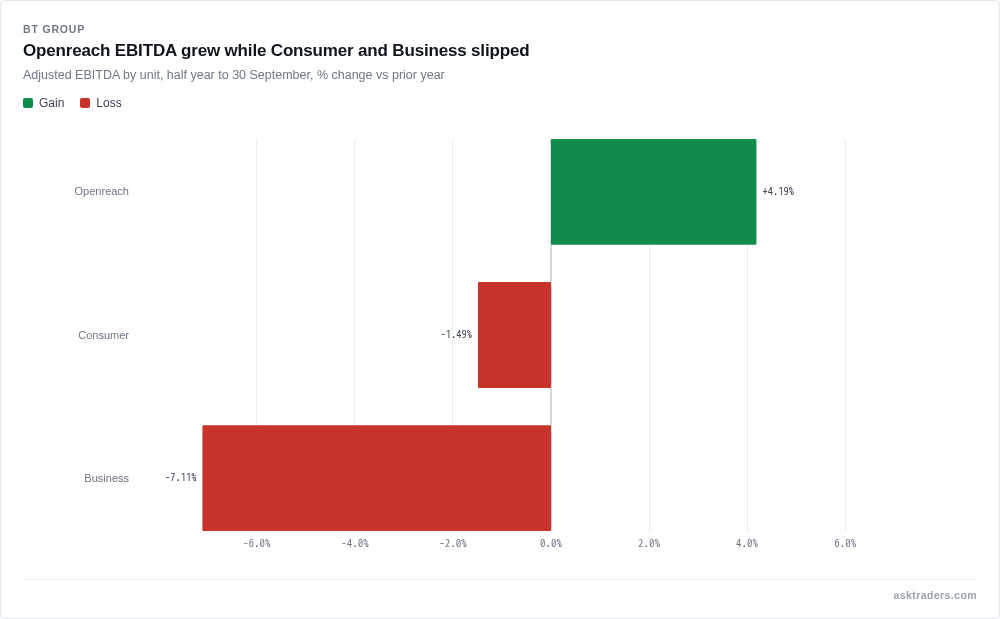
The EBITDA growth came from the network arm. Openreach, which runs the UK’s broadband infrastructure, lifted adjusted EBITDA 4% to £2,238m, with more than 1.1m net full-fibre additions. Consumer EBITDA fell 1% to £1,255m and Business dropped 7% to £601m.
Adjusted EBITDA change by customer-facing unit, half year to 30 September 2026 vs 2025 (re-presented, continuing operations). Source: BT Group results, 5 November 2026.
Cash was weaker. Normalised free cash flow, the cash left after investment and routine obligations, fell 59% to £236m from £569m on higher working capital outflows. Net debt rose to £21.0bn from £20.0bn at the end of March, on scheduled pension payments and the full-year dividend.
A triennial pension agreement put the BT pension scheme deficit at £2.7bn at June, with scheduled contributions largely replaced by zero-coupon bonds.
Sponsored
BT reconfirmed its outlook for the year to March, including adjusted EBITDA within £8.1bn to £8.2bn and normalised free cash flow of about £2.0bn, so most of that cash target falls in the second half. The outlook excludes TalkTalk, which BT acquired out of administration on the 5th of October, protecting service for 2.5m UK customers, subject to a regulatory review.
The interim dividend of 2.50p compares with 2.45p a year earlier. It goes ex-dividend on the 24th of December, with a record date of the 29th of December and payment on the 10th of February.
The AskTraders Analyst Team features experts in technical and fundamental analysis, as well as traders specializing in stocks, forex, and cryptocurrency.
Stay ahead of the markets
Sign up to our free Morning Markets email, every weekday before the open.
Stay ahead of the markets
Morning Markets
Weekdays
FTSE, overnight moves and what matters before the open.
Show personalised advertising and content, and measure how adverts and content perform
Learn about our audience and develop and improve our services
Learn more
Advertising pays for our free market news, analysis and trading tools.
If you accept, we and our partners may also match and combine data from other sources, link your devices, and identify your device from its characteristics, precise location or by actively scanning it. Some partners rely on legitimate interest rather than consent for certain purposes; you can object in the full list.
You can reject, or choose which purposes to allow under Manage options. Your choice is kept for this browser and you can change it at any time. See every purpose and partner
Necessary
Always active
Needed to run AskTraders and to remember your choice here. Always on.
Preferences
Remembers choices you make on AskTraders, such as display settings.
Analytics
Lets us count visits and see which pages are useful, using tools such as Google Analytics.The technical storage or access that is used exclusively for anonymous statistical purposes. Without a subpoena, voluntary compliance on the part of your Internet Service Provider, or additional records from a third party, information stored or retrieved for this purpose alone cannot usually be used to identify you.
Advertising and personalisation
Lets us and our advertising partners show personalised adverts and content, measure them and learn about our audience, and lets us offer web push notifications. See every purpose and partner
We and our advertising partners use cookies to show relevant advertising and measure its performance. You can opt out of the sale or sharing of your personal information, and of personalised advertising, at any time using the link below.
Necessary
Always active
Needed to run AskTraders and to remember your choice here. Always on.
Preferences
Remembers choices you make on AskTraders, such as display settings.
Analytics
Lets us count visits and see which pages are useful, using tools such as Google Analytics.The technical storage or access that is used exclusively for anonymous statistical purposes. Without a subpoena, voluntary compliance on the part of your Internet Service Provider, or additional records from a third party, information stored or retrieved for this purpose alone cannot usually be used to identify you.
Advertising and personalisation
Lets us and our advertising partners show personalised adverts and content, measure them and learn about our audience, and lets us offer web push notifications. See every purpose and partner