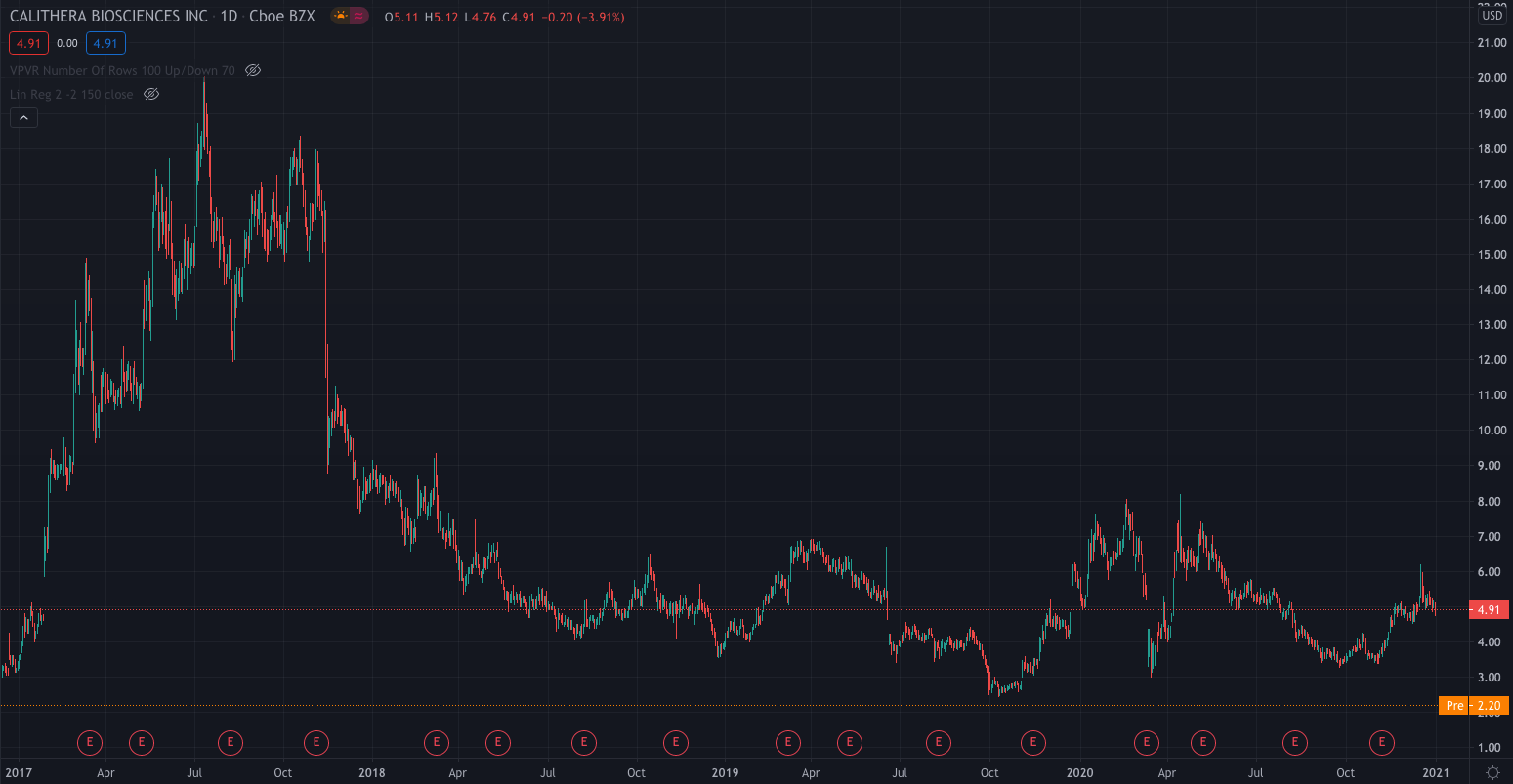
Calithera Biosciences (NASDAQ: CALA) shares are falling premarket on Monday after the company reported that its CANTATA study of telaglenastat in patients with advanced or metastatic renal cell carcinoma (RCC) failed to achieve its primary endpoint.
Calithera shares are trading 51.32% lower at $2.39.
Ready to put what you’ve learned into practice?
Try IG’s platform with £10,000 in virtual funds and practise trading
without putting your own money at risk.
Try IG with a demo account →
Spread bets and CFDs are complex instruments and come with a high risk of losing money rapidly due to leverage. 69% of retail investor accounts lose money when trading spread bets and CFDs with this provider.
Learn the markets with IG Academy
Build your knowledge with IG Academy educational content, then use a
demo account to practise what you’ve learned on the IG platform.
Explore IG →
Spread bets and CFDs are complex instruments and come with a high risk of losing money rapidly due to leverage. 69% of retail investor accounts lose money when trading spread bets and CFDs with this provider.
See how trading works before risking real money
IG’s demo gives you access to thousands of markets and £10,000 in
virtual funds, so you can explore the platform and test your ideas first.
Open an IG demo →
Spread bets and CFDs are complex instruments and come with a high risk of losing money rapidly due to leverage. 69% of retail investor accounts lose money when trading spread bets and CFDs with this provider.
Turn trading theory into practical experience
Learn with IG Academy, explore charts and market tools, and practise
strategies in a simulated trading environment before going live.
Start practising with IG →
Spread bets and CFDs are complex instruments and come with a high risk of losing money rapidly due to leverage. 69% of retail investor accounts lose money when trading spread bets and CFDs with this provider.
Ready to take your learning further?
IG combines market education, analysis and an established trading platform,
giving you the tools to keep learning as you develop your trading skills.
Discover IG →
Spread bets and CFDs are complex instruments and come with a high risk of losing money rapidly due to leverage. 69% of retail investor accounts lose money when trading spread bets and CFDs with this provider.
The San Francisco-based biotechnology company said that compared to cabozantinib treatment, the combination of telaglenastat and cabozantinib did not meet the primary endpoint of improving progression-free survival (PFS) in the study population.
“We are disappointed that the CANTATA trial did not achieve its primary endpoint, particularly on behalf of the people living with advanced RCC, many of whom could benefit from additional treatment options with novel mechanisms of action to address this difficult-to-treat disease,” said Susan Molineaux, president and CEO of Calithera.
The news means the company will make a 35% reduction in its workforce.
Calithera expects cash, cash equivalents and investments to be approximately $115 million at December 31, 2020, based on preliminary estimates, which it believes will be sufficient to meet its current operating plan through 2022.
The anticipated one-time severance charge through the workforce reduction is expected to be $1.3-1.5 million.
The company said it will now focus its financial resources on its ongoing KEAPSAKE trial, assessing the arginase inhibitor CB-280 in cystic fibrosis patients.