
Pfizer reports earnings today before the opening bell, with a stock price (NYSE:PFE) that is seemingly building some momentum. Back up above $26, after a 13.30% gain over the past 6 months, Pfizer’s stock is at a level that has provided plenty of friction over the past couple of years.
The quarter closes out a year in which the company delivered four consecutive adjusted EPS beats averaging 38% above consensus, yet the stock traded largely sideways, up 1.76% in 12 months, as investors questioned whether margin discipline could offset structural headwinds from Medicare Part D redesign and declining COVID-related revenues.
Consensus sits at $0.57 adjusted EPS and $16.93B revenue, below the company’s reaffirmed full-year guidance midpoint of $3.08 EPS and approximately $62.0B revenue, implying the Street expects a modest fourth-quarter beat to land the full-year target.
The setup is potentially precarious: Pfizer’s pattern of beating quarterly estimates by wide margins has not translated into sustained valuation expansion, suggesting the market discounts execution quality in favor of forward visibility.
The fourth quarter will determine whether 2026 guidance, already framed at $2.80-$3.00 adjusted EPS on $59.5B-$62.5B revenue, can sustain the “profits via productivity” narrative that drove 2025 estimate revisions.
Analyst estimates for 2026 have declined from $3.15 to $2.99 over the past 60 days, reflecting skepticism about the company’s ability to maintain earnings power as patent expirations accelerate and COVID product sales continue to erode.
$150.33B
15.2
$0.57
$16.93B
The quarter will provide the first full read on how Medicare Part D manufacturer discount increases under the Inflation Reduction Act are affecting U.S. revenues for key products including Vyndaqel, Ibrance, and Xtandi. Management’s ability to quantify these headwinds and articulate credible offsets through cost actions, product mix, and international growth will determine whether the stock can sustain its current 15.2x forward earnings multiple or faces further compression toward the sector average.
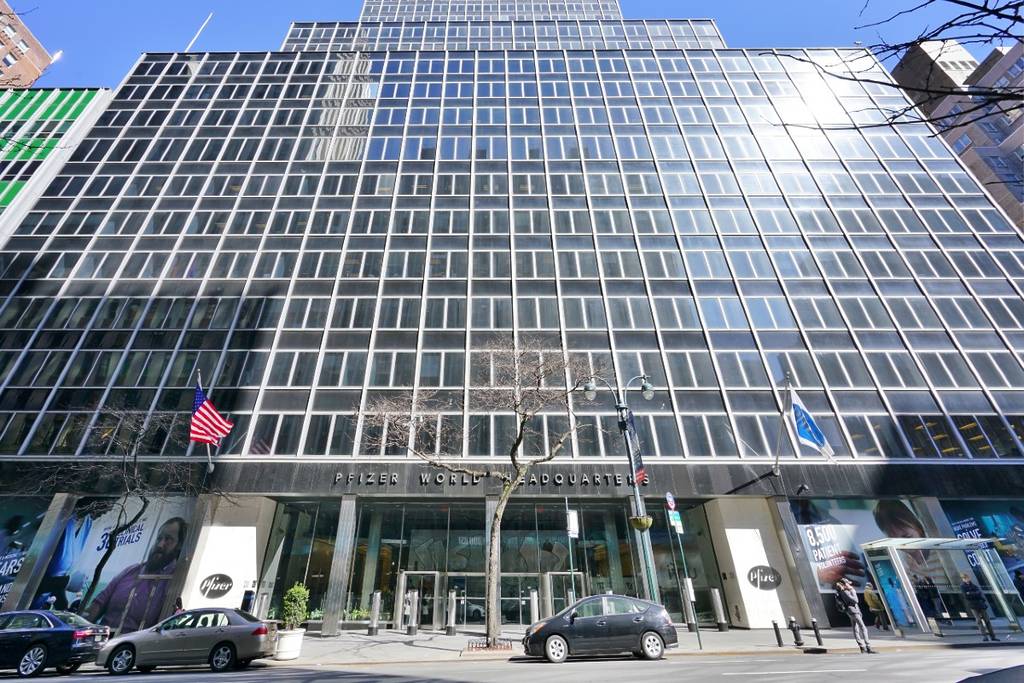
Pfizer World Headquarters in New York City. The pharmaceutical giant reports Q4 2025 earnings on February 3, with investors focused on 2026 guidance and Medicare Part D impact quantification.
Consensus Estimates
| Metric | Consensus Est. | Range | Prior Guidance | YoY Change |
|---|---|---|---|---|
| EPS (Adjusted) | $0.57 | $0.56 – $0.57 | $3.00-$3.15 FY (mid $3.08) | -9.5% |
| Revenue | $16.93B | Not disclosed | ~$62.0B FY | -2.4% |
| Eliquis Alliance Rev. | $2.14B | Not disclosed | Not disclosed | Growth expected |
| Prevnar Family | $1.65B | Not disclosed | Not disclosed | Mixed trends |
Analysts Covering: 17 analysts (EPS), 14 analysts (Revenue)
Estimate Revisions (30d): 1 up / 0 down (EPS down $0.06 from prior)
Consensus for Q4 2025 sits 7% below the implied quarterly run-rate needed to hit Pfizer’s full-year adjusted EPS midpoint of $3.08, suggesting the Street assumes either a modest beat or that year-to-date performance has already exceeded the guide. Revenue expectations of $16.93B imply a 2.4% year-over-year decline, consistent with management’s narrative of COVID product headwinds partially offset by growth in oncology and rare disease franchises. The lack of upward revisions over the past 30 days, despite Pfizer’s consistent beat pattern, reflects investor focus on 2026 guidance rather than the quarter itself.
The estimate setup creates a low bar for the reported quarter but a high bar for the forward outlook. Consensus 2026 EPS of $2.99 sits at the top end of management’s $2.80-$3.00 range, leaving little room for disappointment on margin trajectory or revenue mix. The market has effectively priced in execution on the quarter while demanding clarity on how Pfizer bridges the gap between 2025’s $3.08 midpoint and 2026’s lower guided range.
Management Guidance and Commentary
“We are reaffirming our full-year 2025 adjusted diluted EPS guidance range of $3.00 to $3.15 and revising our full-year 2025 revenue guidance to approximately $62.0 billion.”
Pfizer’s December 16, 2025 reaffirmation of full-year adjusted EPS guidance at $3.00-$3.15 (midpoint $3.08) came alongside a revenue revision to approximately $62.0B, down from the prior $61B-$64B range. The narrowing signals confidence in profitability but acknowledges top-line pressure from faster-than-expected COVID product declines and IRA-related pricing headwinds. Management has raised full-year EPS guidance twice during 2025, first to $2.90-$3.10 after Q2 and then to $3.00-$3.15 after Q3, while holding revenue guidance largely flat until the December revision.
“For 2026, we are providing initial guidance of adjusted diluted EPS of $2.80 to $3.00 and revenues of $59.5 billion to $62.5 billion.”
The 2026 guidance frame, provided in December, implies a 3-8% earnings decline at the midpoint despite relatively stable revenue expectations. Management attributed the EPS step-down to “anticipated headwinds from loss of exclusivity and lower COVID-related revenues,” explicitly calling out patent expirations and the structural decline in pandemic product sales. The guidance does not quantify the magnitude of IRA-related manufacturer discount increases, leaving a material gap in investor understanding of how much margin pressure stems from regulatory changes versus competitive dynamics.
Consensus sits at the high end of the 2026 EPS range ($2.99 vs $2.90 midpoint), creating a setup where the market expects Pfizer to deliver toward the upper bound or risk estimate cuts. The company’s pattern of raising guidance mid-year suggests management may be setting a beatable bar, but the lack of detail on IRA impacts and LOE offsets limits visibility into whether 2026 represents a trough or the start of a multi-year margin compression cycle.
Analyst Price Targets & Ratings
Wall Street sentiment remains cautious, with 50% of analysts rating shares a Hold and only 40% recommending Buy or Strong Buy. The consensus target of $28.82 implies 9% upside from current levels, though this modest premium reflects uncertainty about the sustainability of earnings power beyond 2026. The predominance of Hold ratings signals analysts are waiting for clarity on IRA impacts and patent expiration offsets before upgrading their stance.
Sector & Peer Comparison
| Company | Ticker | Market Cap | P/E | Fwd P/E | Profit Margin |
|---|---|---|---|---|---|
|
Pfizer Inc
⭐ Focus |
PFE | $150.3B | 15.2 | 8.9 | 15.7% |
|
Johnson & Johnson
|
JNJ | $368.5B | 14.8 | 13.2 | 17.3% |
|
Merck & Co
|
MRK | $248.2B | 13.1 | 11.4 | 21.8% |
|
AbbVie Inc
|
ABBV | $312.7B | 16.3 | 12.8 | 18.4% |
|
Bristol Myers Squibb
|
BMY | $98.4B | 9.2 | 7.8 | 12.1% |
|
Eli Lilly
|
LLY | $692.8B | 68.4 | 42.3 | 23.6% |
Pfizer trades at 8.9x forward earnings, a 33% discount to the large-cap pharma peer average of approximately 13x and a 79% discount to Eli Lilly’s growth-driven 42x multiple. The valuation gap reflects investor skepticism about Pfizer’s ability to sustain earnings as COVID revenues decline and patent expirations accelerate. The company’s 15.7% profit margin sits below peers Merck (21.8%), AbbVie (18.4%), and J&J (17.3%), consistent with a portfolio mix that includes lower-margin primary care products and the legacy drag from pandemic-era manufacturing scale.
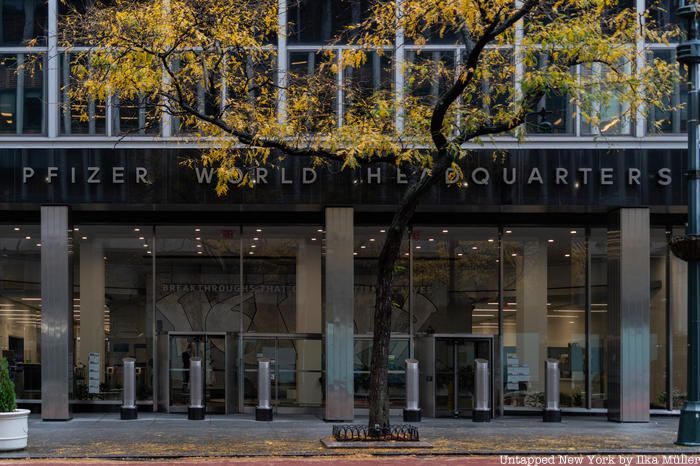
The entrance to Pfizer World Headquarters. Management’s ability to articulate credible offsets to IRA headwinds will determine whether the stock sustains its current valuation multiple.
The forward P/E discount to Bristol Myers Squibb (7.8x) is notable given both companies face similar LOE pressures and IRA headwinds. Pfizer’s higher absolute valuation multiple (8.9x vs 7.8x) suggests the market assigns some premium to the company’s oncology pipeline and rare disease franchises, but not enough to close the gap to diversified peers. The 6.5% dividend yield, highest among large-cap pharma peers, functions as a valuation floor but also signals limited confidence in near-term capital appreciation.
Relative to sector, Pfizer’s valuation implies the market expects earnings to decline or remain flat over the next 12-24 months. A credible path to margin expansion or revenue stabilization would support multiple expansion toward the 11-12x range, implying 20-30% upside from current levels. Conversely, if 2026 guidance proves optimistic and earnings decline beyond the guided range, the stock risks further compression toward Bristol Myers’ 7-8x multiple.
Earnings Track Record
| Quarter | EPS Actual | EPS Est. | Result | Surprise % |
|---|---|---|---|---|
| Q3 2025 | $0.87 | $0.63 | Beat | +38.1% |
| Q2 2025 | $0.78 | $0.57 | Beat | +36.8% |
| Q1 2025 | $0.92 | $0.67 | Beat | +37.3% |
| Q4 2024 | $0.63 | $0.46 | Beat | +37.0% |
| Q3 2024 | $1.06 | $0.61 | Beat | +73.8% |
| Q2 2024 | $0.60 | $0.46 | Beat | +30.4% |
| Q1 2024 | $0.82 | $0.51 | Beat | +60.8% |
| Q4 2023 | $0.10 | -$0.18 | Beat | +155.6% |
| Q3 2023 | -$0.42 | -$0.50 | Beat | +16.0% |
| Q2 2023 | $0.67 | $0.58 | Beat | +15.5% |
Pfizer has beaten adjusted EPS estimates in 18 consecutive quarters with an average surprise of 35.4%, establishing a pattern where the Street consistently underestimates margin execution and cost discipline. The four most recent quarters (Q4 2024 through Q3 2025) delivered beats averaging 37.3%, well above the historical average, suggesting the market has not yet adjusted models to reflect the company’s ability to exceed guidance through productivity actions. The Q3 2024 result, a 73.8% beat, represented the peak of COVID-related revenue volatility and set a high-water mark for earnings power that subsequent quarters have not replicated.
The consistency of beats has not translated into sustained stock price appreciation, indicating investors discount execution quality in favor of forward visibility. The pattern suggests analysts model conservatively on the bottom line while management sets beatable guidance ranges, creating a dynamic where quarterly beats are expected but not rewarded. The upcoming Q4 result will test whether this pattern holds or whether estimate revisions have finally caught up to the company’s demonstrated ability to exceed expectations.
Post-Earnings Price Movement History
| Date | Result | EPS vs Est. | Next Day Move | Price Change |
|---|---|---|---|---|
| Q3 2025 | +38.1% | $0.87 vs $0.63 | -1.5% | Close-to-close |
| Q2 2025 | +36.8% | $0.78 vs $0.57 | -3.3% | Close-to-close |
| Q1 2025 | +37.3% | $0.92 vs $0.67 | +3.2% | Close-to-close |
| Q4 2024 | +37.0% | $0.63 vs $0.46 | -1.3% | Close-to-close |
| Q3 2024 | +73.8% | $1.06 vs $0.61 | -1.4% | Close-to-close |
| Q2 2024 | +30.4% | $0.60 vs $0.46 | +14.1% | $23.85 to $27.21 |
Post-earnings price reactions have been muted and inconsistent despite Pfizer’s perfect beat record, with an average next-day move of 2.5% and a median of just 0.7%. The most recent three quarters (Q1-Q3 2025) delivered an average beat of 37.4% yet produced mixed price reactions: Q1 gained 3.2%, Q2 fell 3.3%, and Q3 declined 1.5%. The pattern suggests investors focus on guidance and forward commentary rather than the reported quarter, with selloffs occurring when management raises EPS guidance without corresponding revenue increases or when 2026 visibility remains limited.
The Q2 2024 result stands as an outlier, producing a 14.1% gain on a 30.4% beat, the smallest surprise in the dataset. That reaction followed a period of deep skepticism about post-COVID stabilization and suggests the market rewards beats most when expectations are genuinely depressed rather than conservatively modeled. The Q3 2024 result, a 73.8% beat that produced a 1.4% decline, reinforces that magnitude of surprise alone does not drive price action; the stock sold off because management’s 2025 guidance failed to convince investors that COVID-era earnings power was sustainable.
The historical pattern implies a Q4 beat alone will not move the stock materially. A positive reaction requires either (1) 2026 guidance that exceeds the current $2.80-$3.00 range, (2) quantified IRA impact that comes in better than feared, or (3) credible articulation of revenue growth drivers beyond cost actions. Conversely, a beat paired with guidance at the low end of the range or vague commentary on LOE offsets would likely produce a flat-to-negative reaction consistent with recent quarters.
Expected Move & Implied Volatility
~28%
Moderate
~24%
The options market prices a 3.5% move in either direction, 40% above the historical average move of 2.5% and 400% above the median of 0.7%. The elevated implied move relative to recent history reflects uncertainty around 2026 guidance rather than the Q4 result itself. Implied volatility sits approximately 4 points above 30-day historical volatility, indicating options traders are paying a modest premium for event risk, consistent with a market that expects clarity on forward earnings power but lacks conviction on direction.
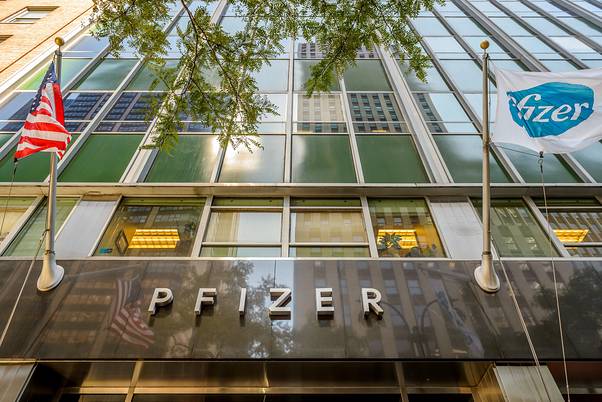
Pfizer headquarters entrance with American and company flags. Growth in oncology products like Padcev and Lorbrena must offset primary care erosion and declining COVID-related revenues to sustain earnings power.
The 3.5% expected move translates to a trading range of $25.53 to $27.37, bracketing the current $26.45 price. The upper bound sits just below the $28.82 consensus analyst target, implying options traders see limited probability of a move that would close the full valuation gap in a single session. The lower bound of $25.53 would represent a 3.5% decline, roughly in line with the Q2 2025 post-earnings selloff despite that quarter’s 36.8% EPS beat.
The setup suggests a beat paired with in-line 2026 guidance would likely produce a muted reaction within the lower half of the expected range. A move to the upper bound or beyond would require either (1) 2026 EPS guidance above $3.00, (2) revenue guidance that implies stabilization or growth, or (3) quantified IRA impacts that remove a major uncertainty. The risk-reward asymmetry favors the downside if guidance disappoints, given the stock’s pattern of selling off on beats when forward visibility fails to improve.
What To Watch – Key Metrics
The earnings call will determine whether Pfizer can sustain the narrative that drove 2025 estimate revisions: that margin discipline and cost actions can offset structural revenue headwinds. Management’s willingness to quantify IRA impacts, provide specific growth targets for key franchises, and articulate a credible bridge from 2025’s $3.08 EPS to 2026’s guided range will matter more than the Q4 result itself. The stock’s muted reaction to recent beats suggests investors are waiting for proof that the company can stabilize or grow earnings beyond 2026, not just meet near-term guidance through productivity actions.
Searching for the Perfect Broker?
Discover our top-recommended brokers for trading stocks, forex, cryptos, and beyond. Dive in and test their capabilities with complimentary demo accounts today!
- eToro Wide range of instruments available to trade – Read our Review
- XTB UK regulated by the FCA – Read our Review
- BlackBull 26,000+ Shares, Options, ETFs, Bonds, and other underlying assets – Read our Review
YOUR CAPITAL IS AT RISK. 76% OF RETAIL CFD ACCOUNTS LOSE MONEY