





Santander UK Group Holdings reported a 6% fall in nine-month profit before tax to £1,158m this morning. The retail and business bank, owned by Spain’s Banco Santander, published the figures at 7.15am, before the London open. Its ordinary shares are unlisted. Profit after tax fell 8% to £840m.
A year earlier, profit before tax was £1,229m. Restructuring and specific provisions rose £361m to £495m, and credit impairments rose £192m to £342m, including a £62m day-one charge, the provision booked when acquired loans join the balance sheet, on TSB’s book.
Chief Executive Officer Mahesh Aditya set out the drivers.
9M-26 profit before tax decreased slightly to £1,158m, mainly due to the provision charge in Q1-26 relating to historical motor finance commission payments and higher restructuring costs, partly offset by TSB’s contribution to profit.
Mahesh Aditya, Chief Executive Officer, Santander UK
TSB, bought from Banco de Sabadell and consolidated from the 1st of May, added £96m of profit before tax. Net interest income, the gap between interest earned and paid, rose 17% to £3,854m. Banking net interest margin, that income over average loans, rose to 2.31% from 2.23%, and to 2.42% in the third quarter.
Costs grew more slowly than income, so the cost-to-income ratio improved to 52% from 57%.
| Metric | 9M-26 | Comparative |
|---|---|---|
| Profit before tax | £1,158m | £1,229m (9M-25) |
| Net interest income | £3,854m | £3,308m (9M-25) |
| Credit impairment charges | £342m | £150m (9M-25) |
| Customer loans | £240.3bn | £200.6bn (Dec-25) |
| Customer deposits | £229.2bn | £190.2bn (Dec-25) |
| CET1 ratio | 14.0% | 15.7% (Dec-25) |
The balance sheet grew with TSB, with customer loans up £39.7bn, but the capital cushion thinned.
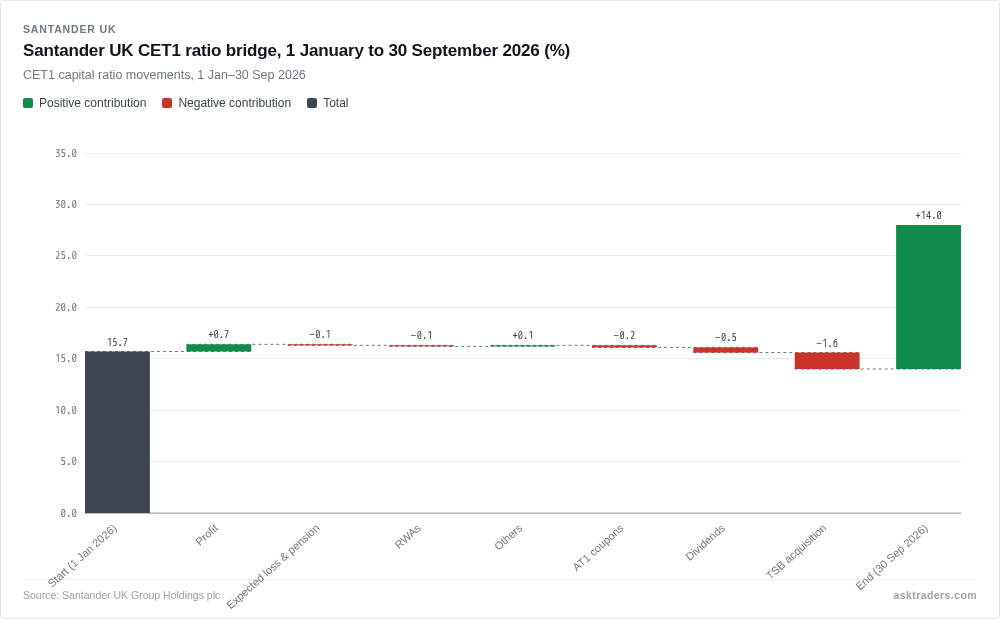
The CET1 ratio, core capital as a share of risk-weighted assets, fell from 15.7% to 14.0%. TSB took 1.6 percentage points and ordinary dividends 0.5, which resumed after the deal completed.
Return on tangible equity, profit relative to shareholders’ tangible equity, was 10.6%, against 10.0% at the end of 2025; the motor finance charge cut it by 112 basis points. The bank’s 2028 targets are a 16% return and at least £400m of cost synergies. For 2026 it expects net lending growth, a stable margin and cost of risk to stabilise.
The motor finance provision stands at £616m, and the Upper Tribunal hearing is expected in the first quarter of 2027.