
The Office for National Statistics (ONS), the UK’s official statistics agency, revised growth for April to June up to 0.5% from 0.4% today at 07:00 UK time. The economy therefore slowed less than first reported after growth of 0.6% in the first three months of the year, which was not revised. The comparison is with the first estimate.
What was announced
The upgrade came with a higher services figure, which grew 0.6% in the quarter against 0.5% in the first estimate. Professional, scientific and technical activity rose 2.3% and information and communication 2.5%. Export volumes rose 2.8%, against 0.5% in the first estimate.
Elsewhere, construction grew 0.8% and production fell 0.1%. Production was revised the other way from services: the first estimate was 0.0%, so the upgrade to headline growth came despite a slightly weaker industrial reading. Thirteen of the 20 subsectors grew, which means most parts of the economy expanded, though not all of them. Education fell 0.4%, and the ONS tied that to the weather in its bulletin.
This was the result of the closure of some schools during the heatwave conditions seen across much of the UK during June.
Office for National Statistics
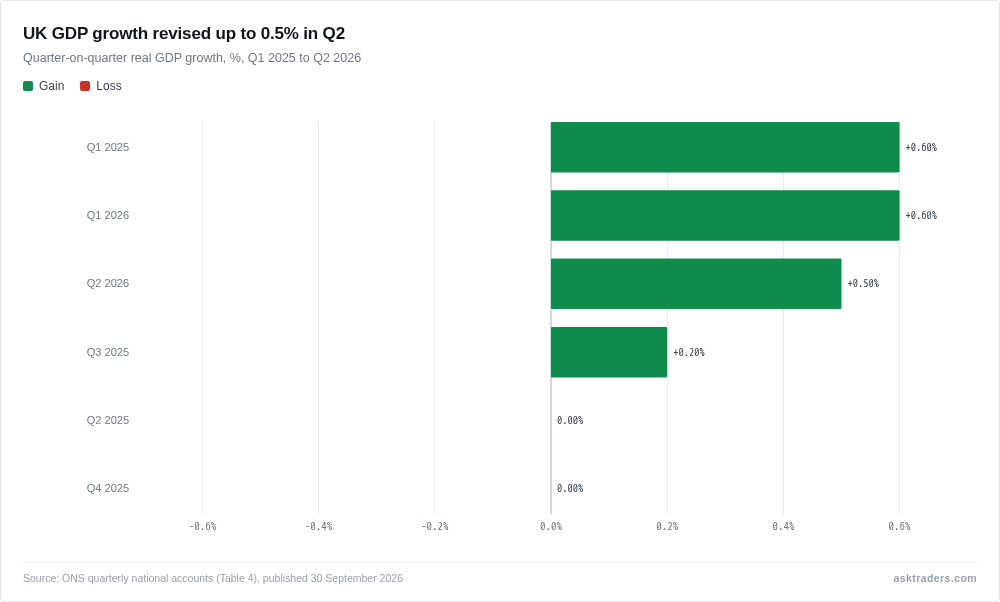
The level of GDP in the second quarter is now 2.0% higher than in the final quarter of 2024, up from 1.9% in the first estimate. Earlier periods were also revised: the second quarter of 2025 is now 0.0%, the third 0.2% and the fourth 0.0%, and growth for 2025 as a whole is 1.2% rather than 1.3%.
First estimate against the revision
Set side by side, the revision is small but it runs in one direction. Quarterly growth moves from 0.4% to 0.5%, services from 0.5% to 0.6%, export volumes from 0.5% to 2.8%, and the level of GDP against the end of 2024 from 1.9% to 2.0%. The first quarter’s 0.6% was left as it was, so the slowdown from that quarter is 0.1 percentage points rather than 0.2.
The export figure is the largest change in the release. Imports were flat at 0.0%, so they did not offset it.
Sectors over the year
Compared with a year earlier, the picture is uneven. Services output is up 1.7%, production is up 0.4% and construction is down 1.0%. Construction therefore grew in the quarter, at 0.8%, while remaining below its level of a year ago.
Business investment is up 5.2% on the year, set against its 1.8% rise in the latest quarter. The two figures cover different periods, so they describe different things rather than a change in one measure.
How the UK compares with the G7
The ONS also publishes second-quarter real GDP growth for the G7 economies. On that measure the UK, at 0.5%, sits second behind Canada.
| Country | Q2 real GDP, quarter on quarter (%) |
|---|---|
| Canada | 0.8 |
| UK | 0.5 |
| Japan | 0.4 |
| US | 0.4 |
| Germany | 0.3 |
| Italy | 0.2 |
| France | 0.0 |
Source: ONS, Table 5.
Market reaction during the day
The market reaction was thin. Business Upturn reported around 1:34pm UK time that the FTSE 100 began firmer, then moved between small gains and flat, and that sterling moved higher.
Sterling closed today at 1.32567 against the dollar, up 0.19% from 1.32318 yesterday. That is the move for the whole day, and it cannot be put down to the GDP figures alone.
What sat behind the growth
On the spending side, household consumption rose 0.3% and government consumption fell 0.5%. Gross fixed capital formation, which is investment in buildings, machinery and similar assets, rose 0.9%, with business investment up 1.8%.
Households fared better than in the first quarter. Real household disposable income per head, meaning income after tax and adjusted for inflation, rose 1.0% to £6,577 after falling 0.8% in the first three months. The saving ratio edged up to 8.8% from 8.6%. Consumption growth, by contrast, was a modest 0.3%.
Real GDP per head grew 0.5% on the quarter and 1.2% on the year. Nominal GDP, which is not adjusted for inflation, rose 0.8% on the quarter and 3.8% on the year, while the GDP deflator, the measure of price changes across the economy, rose 2.4% on the year.
What comes next
The next ONS GDP release is due on the 12th of November.
Firmer growth is one consideration for the Bank of England as it weighs interest rate cuts. For mortgage borrowers, rate decisions feed into borrowing costs. For sterling and gilt yields it is one of several factors traders may weigh alongside other data. None of this points to a particular outcome, and the revised quarter rests on services and exports, with the cumulative gain since the end of 2024 now at 2.0%.