
Booz Allen stock (NYSE:BAH) has underperformed over the past 12 months, pulling back 29.69% whilst the broader markets have been moving higher.
The company reports earnings ahead of today’s market open, providing a test of whether the civil funding slowdown has stabilized at the reduced run rate management established in October.
The quarter carries asymmetric risk as consensus sits at $1.27 EPS on $2.73B revenue (down from $1.55, and $2.92B Y/Y), both implying continued year-over-year pressure and keeping attention on whether the FY2026 reset is fully reflected in expectations.
$11.80B
14.6
$1.27
$2.73B
The setup carries asymmetric risk because the Street has already repriced expectations lower twice in the past nine months. FY2026 revenue consensus declined from $12.82B in May to approximately $11.4B by October as the civil portfolio slowdown persisted longer than initially modeled.
Management’s October guidance cut explicitly framed the environment as bifurcated, with national-security demand (cyber, AI, defense) holding up while civil procurement and funding timing failed to normalize.
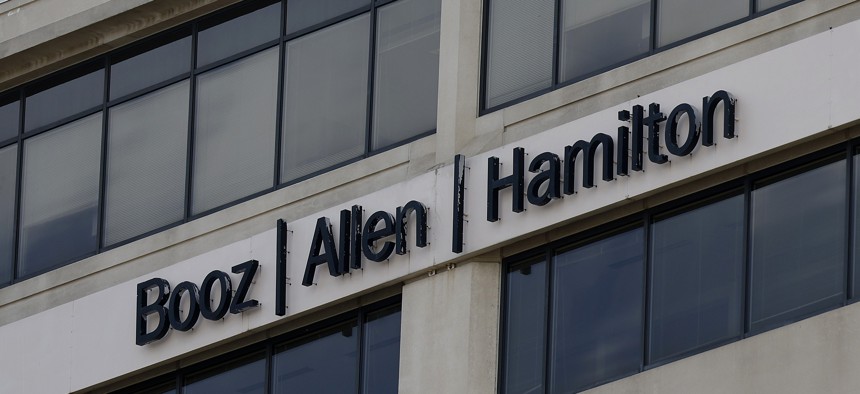
The stock’s 29% decline over the past year reflects sustained de-rating of the forward earnings base. Shares trade at 14.6x trailing earnings, below the company’s historical range, while analyst ratings remain mixed with seven Hold ratings among 14 analysts. CEO Horacio Rozanski’s $2 million insider purchase in October signals management confidence, but the market requires evidence that the civil environment is no longer deteriorating.
Consensus Estimates
| Metric | Consensus Est. | Range | Prior Guidance | YoY Change |
|---|---|---|---|---|
| EPS (Adjusted) | $1.27 | $1.16 – $1.41 | FY26: $5.45-$5.65 | -18.0% |
| Revenue | $2.73B | $2.66B – $2.81B | FY26: $11.3B-$11.5B | -6.6% |
| Operating Margin | 9.8% | 9.2% – 10.1% | Under pressure | -50 bps |
Analysts Covering: 12
Estimate Revisions (30d): 1 up / 0 down
Consensus expectations reflect the October reset rather than incremental deterioration. The $1.27 EPS estimate sits near the low end of management’s FY2026 midpoint trajectory ($5.55 implies roughly $1.39 per quarter), suggesting the Street is modeling conservatively within the revised framework. Revenue consensus of $2.73B tracks approximately 5% below the prior-year quarter, consistent with the full-year guide’s implied decline.
Management Guidance and Commentary
“The funding slowdown we have been experiencing in our civil business has continued and we now expect it to persist for a longer period of time than we previously anticipated.”
Management’s October commentary explicitly extended the timeline for civil recovery, marking the second guidance reduction in the fiscal year. The FY2026 framework cut revenue expectations by approximately $800M at the midpoint (from $12.25B to $11.4B) and adjusted EPS by $0.83 (from $6.38 to $5.55). The company attributed the revision to persistent civil funding delays and procurement friction, while reiterating strength in national-security markets including cyber, AI, and warfighting technology.

The guidance cut included lower adjusted EBITDA expectations, implying margin compression beyond revenue decline. Management highlighted workforce reductions of approximately 2,500 employees (7% of headcount) implemented in May, with additional cost actions referenced in October. The company maintained its FY2026 free cash flow range of $850M-$950M, supported by favorable cash-tax treatment under Section 174, but the lower earnings base constrains capital deployment flexibility.
Analyst Price Targets & Ratings
Wall Street sentiment remains cautious, with exactly half of analysts rating shares a Hold. The consensus target of $102.18 implies modest 6.7% upside from current levels, reflecting uncertainty about the timing and magnitude of civil business recovery. The lack of Strong Sell ratings suggests analysts view the current valuation as reasonable given the uncertainty, but the prevalence of Hold ratings indicates limited conviction in near-term catalysts.
Sector & Peer Comparison
| Company | Ticker | Market Cap | P/E | Fwd P/E | Profit Margin |
|---|---|---|---|---|---|
|
Booz Allen Hamilton
⭐ Focus |
BAH | $11.80B | 14.6 | 13.8 | 7.1% |
|
Leidos Holdings
|
LDOS | $18.50B | 18.2 | 15.6 | 5.8% |
|
CACI International
|
CACI | $9.20B | 19.5 | 16.8 | 6.2% |
|
Science Applications
|
SAIC | $6.80B | 15.8 | 14.2 | 4.9% |
|
ManTech International
|
MANT | $4.10B | 16.4 | 14.9 | 5.5% |
Booz Allen trades at a discount to government services peers on both trailing and forward P/E multiples, reflecting the market’s concern about revenue trajectory and civil exposure. The company’s 14.6x trailing P/E sits approximately 15% below the peer group average of 17.2x, while the 13.8x forward multiple implies limited confidence in near-term earnings growth. This valuation gap has widened over the past year as BAH’s stock declined 28% while peers showed more resilient performance.
Earnings Track Record
| Quarter | EPS Actual | EPS Est. | Result | Surprise % |
|---|---|---|---|---|
| Oct 2025 | $1.49 | $1.53 | Miss | -2.6% |
| Jul 2025 | $1.48 | $1.49 | Miss | -0.7% |
| Apr 2025 | $1.61 | $1.61 | Miss | -0.3% |
| Jan 2025 | $1.55 | $1.50 | Beat | +3.3% |
| Oct 2024 | $1.81 | $1.49 | Beat | +21.5% |
| Jul 2024 | $1.38 | $1.52 | Miss | -9.2% |
| Apr 2024 | $1.33 | $1.23 | Beat | +8.1% |
| Jan 2024 | $1.41 | $1.14 | Beat | +23.7% |
Booz Allen’s 65% beat rate over the past 20 quarters reflects solid execution during periods of stable demand, but the pattern shifted in fiscal 2026 as civil funding pressure emerged. The company missed estimates in each of the past three quarters, though the misses were modest (ranging from 0.3% to 2.6%) and primarily reflected revenue shortfalls rather than earnings execution failures.
Post-Earnings Price Movement History
| Date | Surprise | EPS vs Est. | Next Day Move | Price Change |
|---|---|---|---|---|
| Oct 2025 | -2.6% | $1.49 vs $1.53 | +3.8% | $98.89 → $102.60 |
| Jul 2025 | -0.7% | $1.48 vs $1.49 | +4.3% | $102.86 → $107.31 |
| Apr 2025 | -0.3% | $1.61 vs $1.61 | +2.0% | $105.28 → $107.36 |
| Jan 2025 | +3.3% | $1.55 vs $1.50 | -0.2% | $128.36 → $128.12 |
| Oct 2024 | +21.5% | $1.81 vs $1.49 | +0.8% | $162.05 → $163.39 |
Post-earnings price reactions show a counterintuitive pattern where guidance and forward commentary drive stock movement more than quarter-level beats or misses. The average next-day move of 1.7% masks significant variance, with misses actually producing larger positive moves (2.4%) than beats (0.3%) over the recent sample. This pattern reflects the market’s focus on whether results confirm or challenge the forward outlook rather than backward-looking performance.
Expected Move & Implied Volatility
32.5%
68%
28.3%
The options market implies a 5.2% move in either direction, significantly above the 1.7% historical average next-day move. This elevated expectation reflects uncertainty about whether management will confirm the October guidance framework or introduce new concerns about civil recovery timing. The 68th percentile IV ranking indicates options traders see this report as more consequential than typical quarters.
Expert Predictions & What to Watch
Key Outlook: Cautiously Bearish
The base case assumes Booz Allen delivers results within the revised FY2026 framework (EPS near $1.27, revenue near $2.73B) while maintaining guidance ranges. This outcome would confirm the October reset is holding but would not provide a catalyst for re-rating given the lack of visibility into civil recovery timing.
Key Metrics to Watch
The most critical variable is management’s characterization of the civil funding environment and whether commentary suggests stabilization or further deterioration. The company has framed the slowdown as timing-related rather than structural, but the persistence of pressure has raised questions about whether federal budget constraints or competitive dynamics are more significant factors than initially communicated.
Searching for the Perfect Broker?
Discover our top-recommended brokers for trading stocks, forex, cryptos, and beyond. Dive in and test their capabilities with complimentary demo accounts today!
- eToro Wide range of instruments available to trade – Read our Review
- Vantage High levels of account and deposit protection – Read our Review
- XTB UK regulated by the FCA – Read our Review
YOUR CAPITAL IS AT RISK. 76% OF RETAIL CFD ACCOUNTS LOSE MONEY