




If you want a stake in artificial intelligence, the obvious move is to back the companies building the models. The hard part is knowing which one. The race is crowded, the lead keeps changing hands, and today’s front-runner is no guarantee of tomorrow’s winner.
There’s another way in. Whoever comes out on top, they all need the same things: chips to do the computing, networks to connect those chips, power and cooling to keep them running, and buildings to house it all. Put simply, they need data centres. That’s the case for a data-centre play. Instead of betting on one horse, you back the businesses selling to every horse in the race. It’s the gold-rush logic of selling picks and shovels rather than digging for gold yourself.
The demand is not in doubt. Amazon, Alphabet, Microsoft, Meta and Oracle spent $691 billion on property and equipment over their latest four reported quarters. That is nearly double the $357 billion they spent in the four quarters before, and several of them have already said there’s more to come.
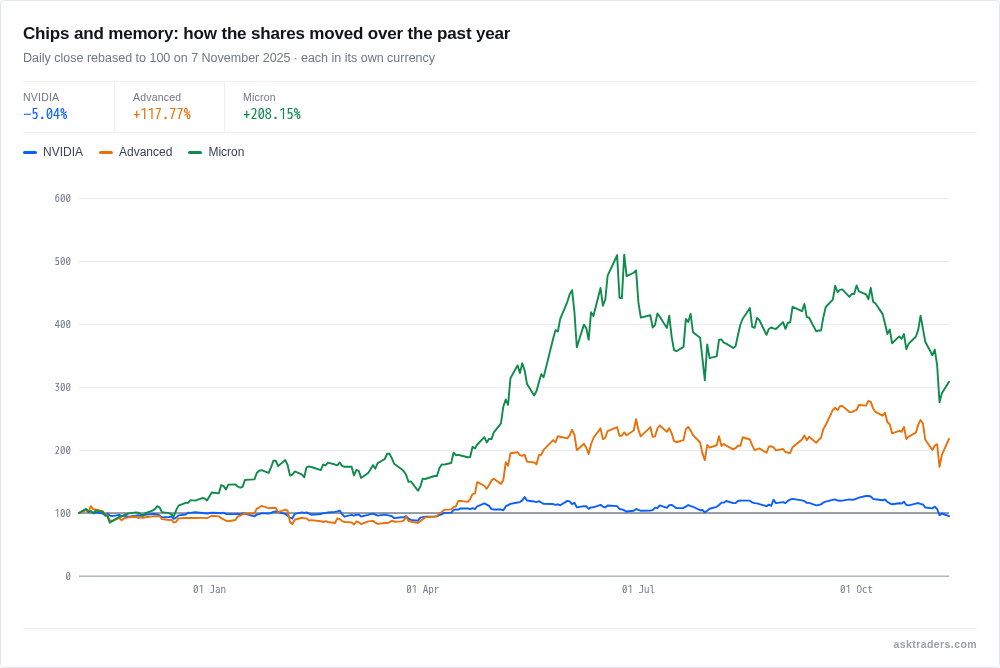
But the past year is also a reminder that being in the supply chain is not a free pass. We looked at 14 listed companies that help build and run AI data centres, from the chipmakers at the heart of the servers to the landlords that own the buildings. Over the twelve months to 9 November, Micron’s shares more than tripled and AMD’s more than doubled. CoreWeave’s more than halved, and even NVIDIA, the face of the AI boom, ended the year slightly down.
So the question isn’t only whether the build-out keeps going. It’s which of the companies riding it are worth owning, and at what price.
Who Builds a Data Centre?
It helps to think of an AI data centre as a stack, with a different kind of company at each level:
- Chips and memory: the processors and memory that do the actual AI work (NVIDIA, AMD, Micron).
- Networking: the links that let thousands of chips talk to each other at speed (Arista, Astera Labs, Cisco).
- Servers and power: the machines the chips go into, plus the power and cooling that keep them running (Super Micro, Vertiv).
- AI cloud builders: newer firms that build data centres and rent out the computing power inside them (CoreWeave, Nebius, Applied Digital).
- Data-centre property: the landlords that own the buildings and rent out space, power and connections (Digital Realty, Equinix, GDS).
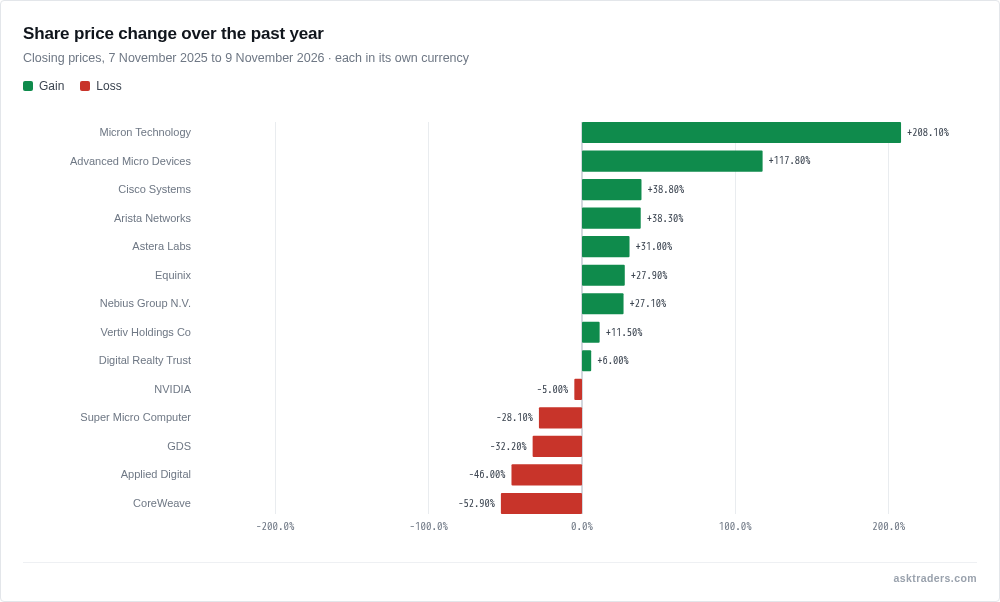
Here’s how all 14 have done over the past year, from a 52.9% fall to a 208.1% gain.
| Company | Ticker | Layer | Market cap | Change over the year | Latest revenue growth |
|---|---|---|---|---|---|
| NVIDIA | NVDA | Chips and memory | $4.31 trillion | -5.0% | +65.5% |
| Advanced Micro Devices | AMD | Chips and memory | $736 billion | +117.8% | +34.3% |
| Micron Technology | MU | Chips and memory | $781 billion | +208.1% | +256.3% |
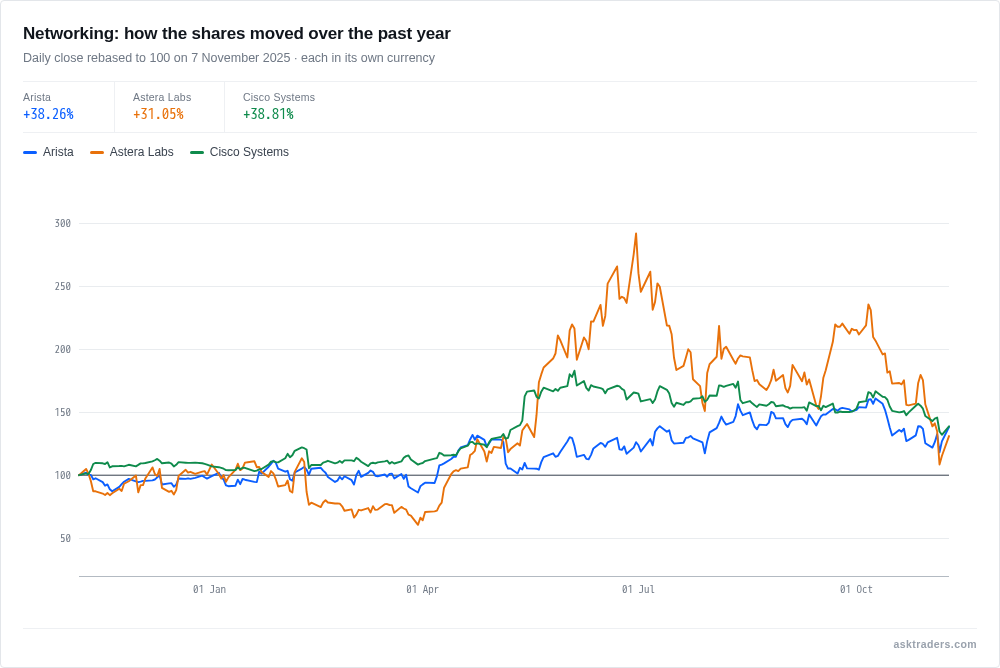
| Arista Networks | ANET | Networking | $216 billion | +38.3% | +28.6% |
| Astera Labs | ALAB | Networking | $37.9 billion | +31.0% | +115.1% |
| Cisco Systems | CSCO | Networking | $389 billion | +38.8% | +11.8% |
| Super Micro Computer | SMCI | Servers and power | $19 billion | -28.1% | +77.8% |
| Vertiv Holdings Co | VRT | Servers and power | $77.2 billion | +11.5% | +27.7% |
| CoreWeave | CRWV | AI cloud builders | $27 billion | -52.9% | +167.9% |
| Nebius Group N.V. | NBIS | AI cloud builders | $35.9 billion | +27.1% | +350.9% |
| Applied Digital | APLD | AI cloud builders | $5.06 billion | -46.0% | +167.5% |
| Digital Realty Trust | DLR | Data centre property | $69.3 billion | +6.0% | +10.0% |
| Equinix | EQIX | Data centre property | $104 billion | +27.9% | +5.9% |
| GDS | GDS | Data centre property | $4.46 billion | -32.2% | +10.8% |
The change column is the share price change over the past twelve months, dividends excluded, each in its own currency.
Who’s Paying for It All
Every company in this list ultimately depends on how much the big cloud groups keep spending, so their budgets are worth a closer look. Over their latest four reported quarters, as recorded in their cash flow statements, Amazon spent $215 billion, up 79.1%. Alphabet spent $160 billion, up 105.2%, and Microsoft $136 billion, up 96.9%. Meta spent $104 billion, up 66.5%, and Oracle $75.7 billion, up 176.0%. Quarter ends differ by company, and Oracle’s window ends on 31 August.
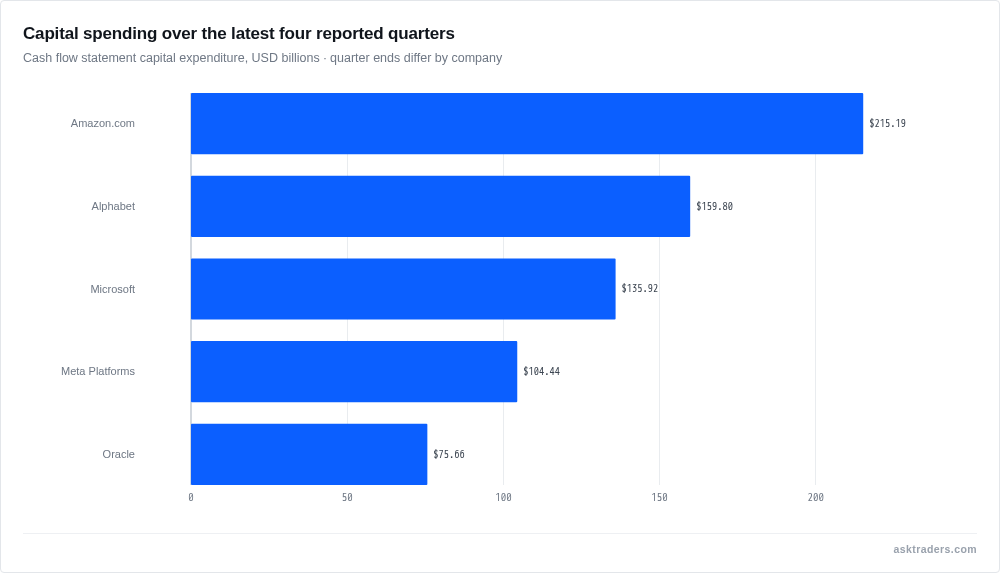
The pace is picking up, too. Together the five spent $76.3 billion in the last quarter of 2024 and $230 billion in the third quarter of 2026, with spending rising in every quarter in between.
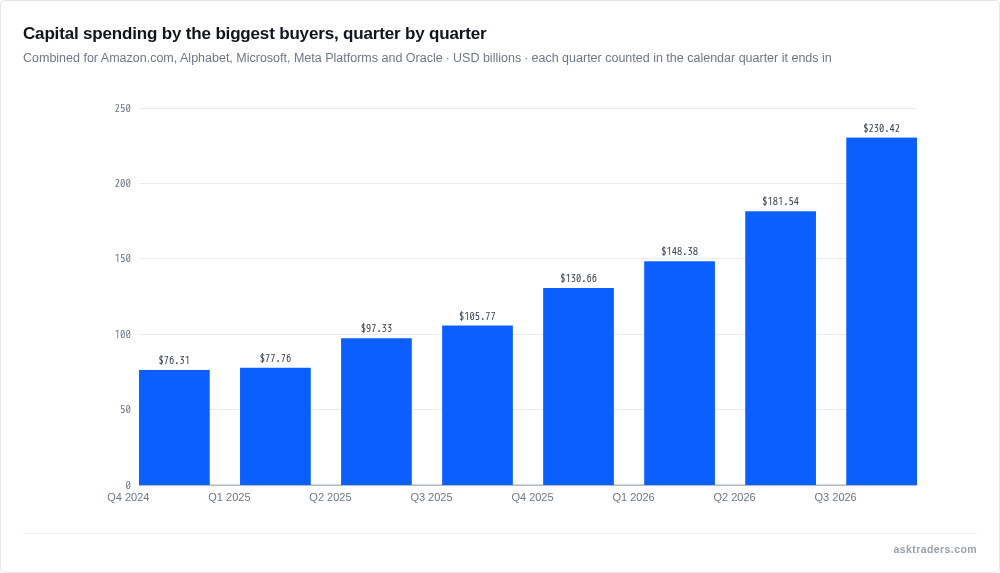
And the buyers say they aren’t done. On Alphabet’s earnings call on 28 October, chief financial officer Anat Ashkenazi said, as reported by Business Insider and Reuters:
We continue to expect our CapEx to increase significantly in 2027.
Anat Ashkenazi, Alphabet
A day later, Amazon chief executive Andy Jassy said Amazon would spend meaningfully more in 2027, according to the same outlets, though he gave no figure for how much. Meta’s chief financial officer Susan Li said on 21 October that the company expects to keep investing aggressively, while it is still working out its budget and capacity plans for next year.
Chips and Memory
This is where the actual AI work happens, and where the best-known names sit. NVIDIA and AMD design the processors that train and run AI models, while Micron supplies the memory those processors can’t work without. Their customers are cloud companies and AI-model builders.
NVIDIA
NVIDIA (NASDAQ: NVDA) is the name most people think of when they think of AI hardware. It designs the chips and systems that data centres buy to run AI, and its latest quarter came almost entirely from its Data Center business, built around the Blackwell chip family and networking products. Meta is among its customers, and it still sells gaming graphics chips and car platforms on the side.
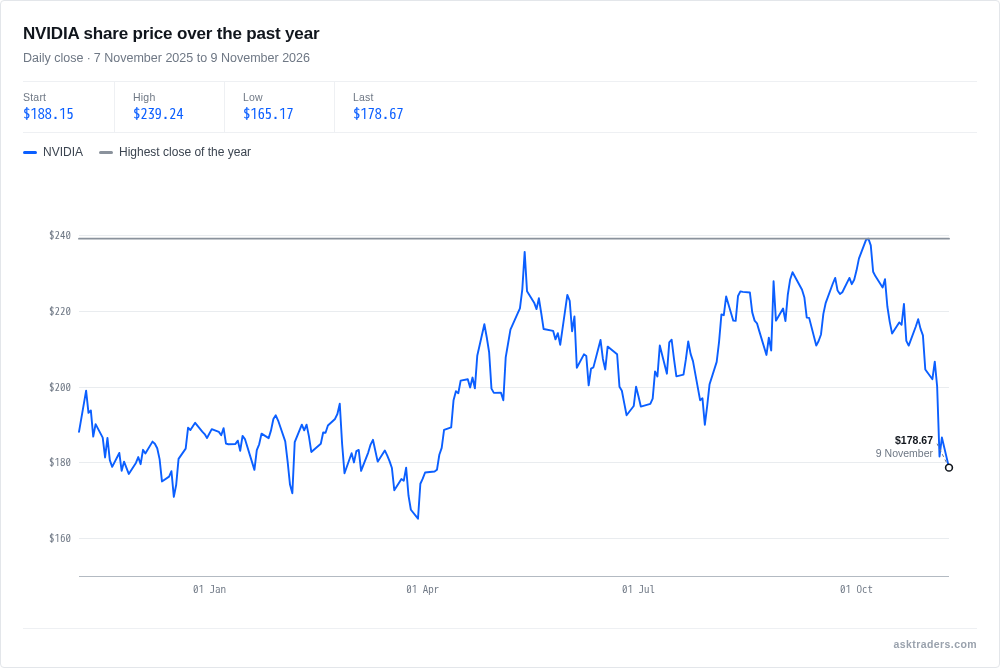
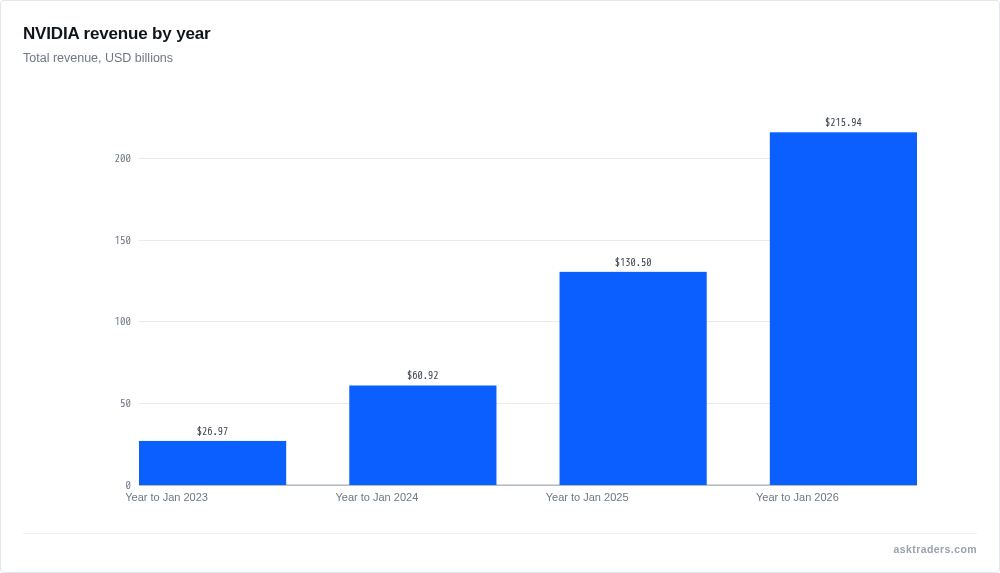
For all that, the shares went nowhere over the year. They closed at $178.67 on 9 November, down 5.0%, and 25.3% below their peak of $239.24 on 6 October. The business itself hasn’t stalled: revenue grew 65.5% in the year to January 2026 and the profit margin is 63.7%. The company is worth $4.31 trillion and trades on 22.6 times trailing earnings, with a 0.56% yield. Analysts are overwhelmingly positive, with 59 of the 62 covering it rating it a buy, two a hold and one a sell.
On 27 October NVIDIA announced an expanded collaboration with Meta to improve training and inference (running a trained model) for Meta’s Muse family of AI models. One thing to watch is costs. Insider Monkey reported that management expects memory costs to keep rising into next year, and guides gross margin to 74% for the quarter ending October, then 71% to 72% the quarter after. NVIDIA has beaten estimates in each of its last four quarters.
AMD
Advanced Micro Devices (NASDAQ: AMD) is NVIDIA’s main challenger. It has three businesses: data centre, PCs and gaming, and embedded chips. For AI it sells Instinct accelerators such as the MI450 Series, EPYC server processors and complete Helios racks of linked chips. Anthropic, Meta, Microsoft, OpenAI and Oracle Cloud Infrastructure are all named as running workloads on Helios.
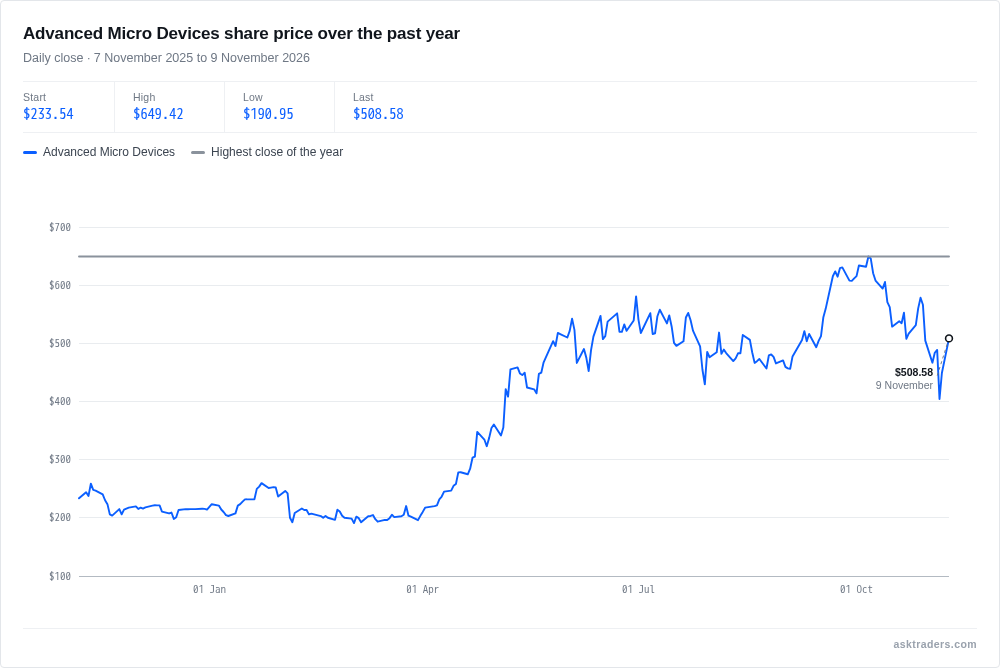
Investors have rewarded the challenger. AMD closed at $508.58 on 9 November, up 117.8% on the year, though 21.7% below its high of $649.42 on 6 October. It is now worth $736 billion. Revenue grew 34.3% in the year to December 2025 and the profit margin is 16.8%. That success comes at a price: at 95.9 times trailing earnings, it is one of the more expensive stocks in this group. Of 53 analysts, 43 rate it a buy and 10 a hold.
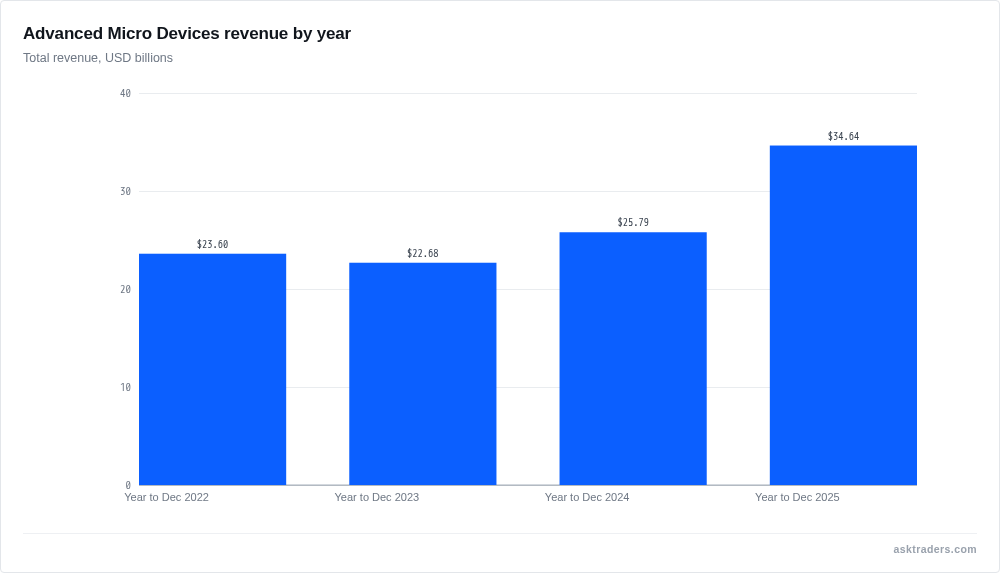
Its third-quarter results on 3 November gave the bulls more to work with. Insider Monkey’s summary puts record revenue at $13.4 billion, up 45%, with Data Center revenue up 97% to $8.5 billion and fourth-quarter guidance of about $17 billion. Benzinga reported that chief executive Lisa Su, looking ahead to 2027, acknowledged that demand was outstripping supply and said she expects Data Center to make up more than 80% of AMD’s revenue. AMD has beaten estimates in each of its last four quarters.
Micron
Micron Technology (NASDAQ: MU) makes the memory and storage that AI chips depend on: DRAM, the working memory of a computer; NAND flash storage; and high-bandwidth memory. Its HBM4, stacked memory built into AI accelerators and designed for NVIDIA’s Vera Rubin platform, is now in high-volume production. It also sells 256GB DDR5 server memory modules and 245TB data-centre SSDs.
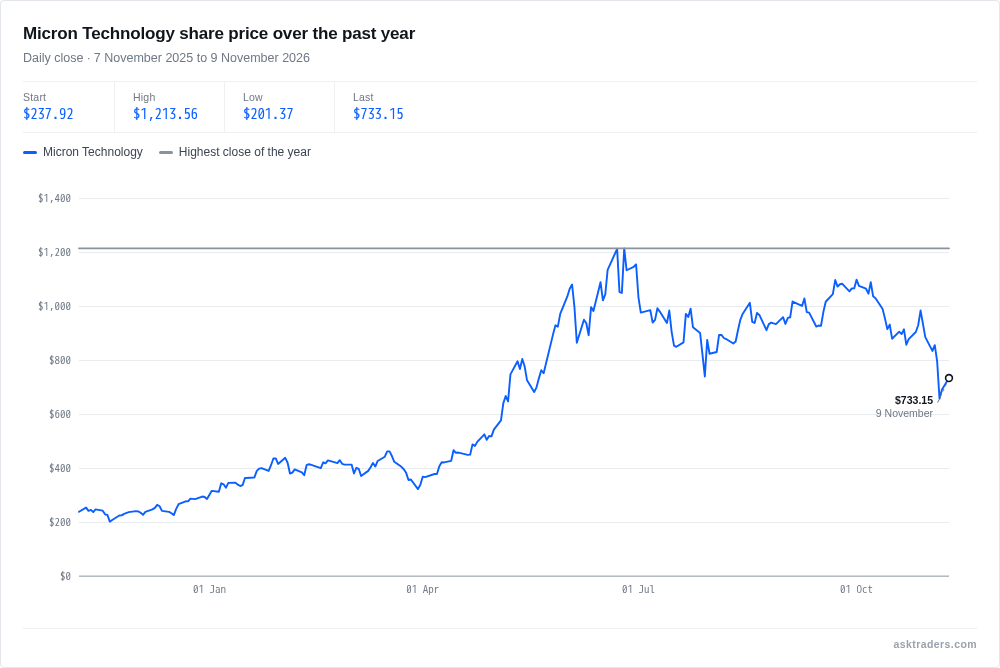
Micron has been the standout of the year. The shares closed at $733.15 on 9 November, up 208.1%, which makes it worth $781 billion, more than AMD. It has been a bumpy ride, though: the price is still 39.6% below its June peak of $1,213.56. The numbers behind the rally are striking, with revenue up 256.3% in the year to August 2026 and a profit margin of 63.8%. Yet the shares trade on just 9.3 times trailing earnings, with a 0.09% yield. Of 49 analysts, 45 rate it a buy and four a hold.
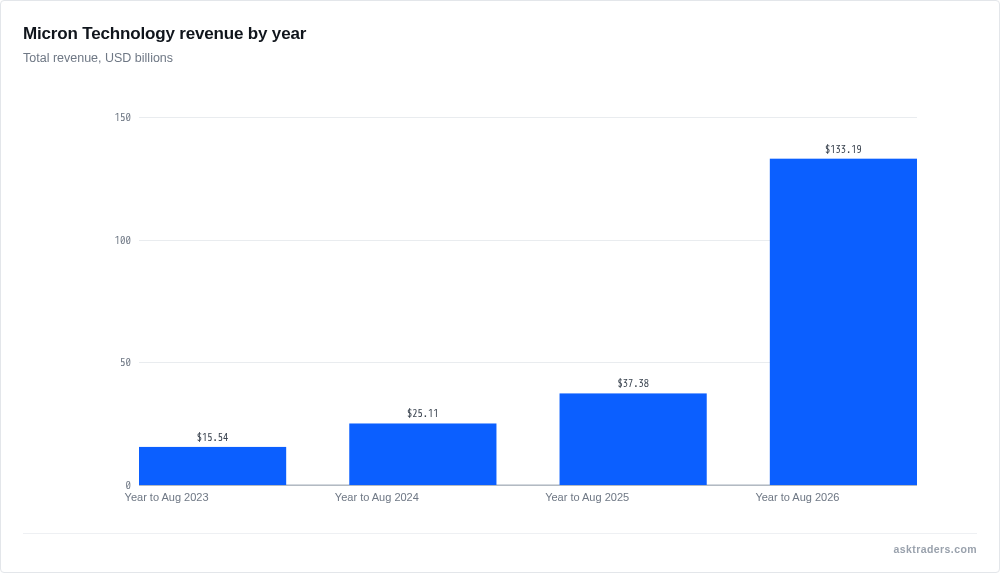
Memory has a long history of boom and bust, and Micron is open about the risk. According to Insider Monkey’s summary of its fiscal fourth-quarter results, the company acknowledges that new industry capacity could lead to oversupply and squeeze prices and margins, and that Samsung, SK Hynix and Sandisk may price aggressively. Separately, Micron announced on 5 November that board member Linnie M. Haynesworth will retire from the board. It has beaten estimates in each of its last four quarters.
Networking
An AI data centre is only as fast as the connections between its chips, and thousands of them need to swap data constantly. These three companies build those links, and the giant cloud providers, known as hyperscalers, are their biggest customers. All three shares ended the year higher.
Arista Networks
Arista Networks (ANET) makes the switches and software that connect servers inside data centres, including AI clusters, and sells mainly to large cloud and AI operators. Its line-up includes 1.6-terabit products, very fast network ports for the switch networks inside AI clusters, and rack-scale designs.
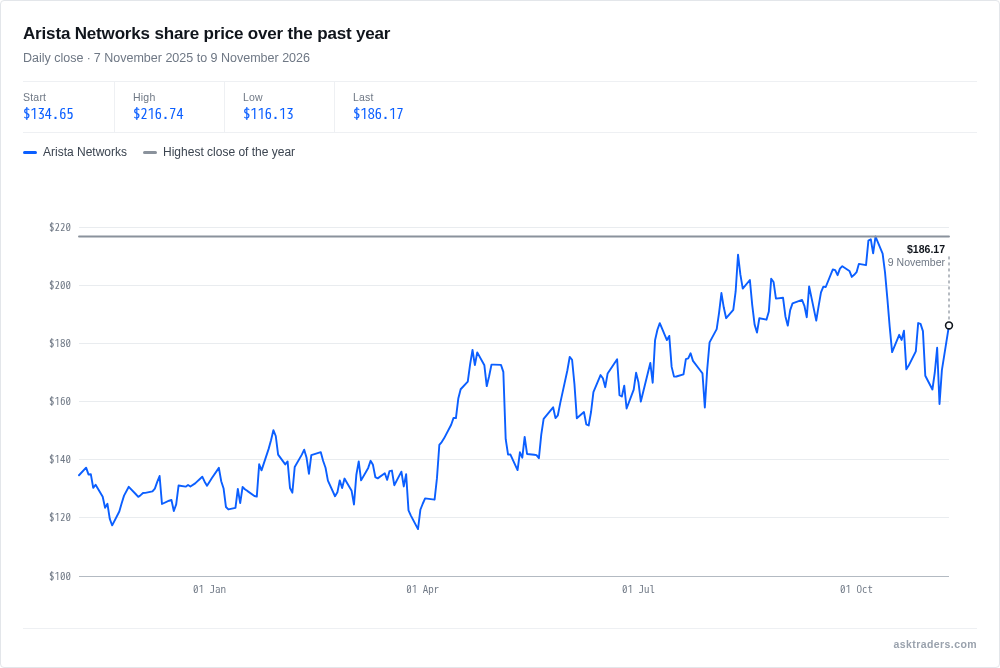
Arista is one of the more profitable names in the group. The profit margin is 40.0%, revenue grew 28.6% in the year to December 2025, and the shares closed at $186.17 on 9 November, up 38.3% on the year and 14.1% below their October high of $216.74. It is worth $216 billion and trades on 45.8 times trailing earnings. Analysts are almost unanimous, with 29 of 30 rating it a buy and one a hold.
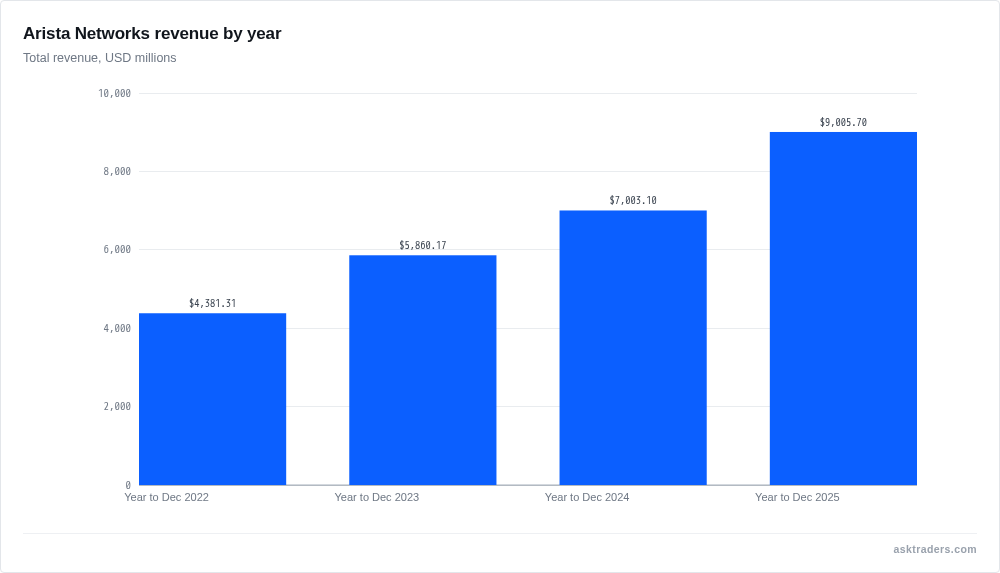
Growth is speeding up. Third-quarter revenue, reported on 3 November, was $3.66 billion, up 58.5% on the year, according to a PRNewswire summary, with fourth-quarter guidance of $3.9 billion to $4.0 billion. Chairperson and chief executive Jayshree Ullal called it another momentous quarter, with record profitability that beat even her own high expectations. Arista has beaten estimates in each of its last four quarters.
Astera Labs
Astera Labs (NASDAQ: ALAB) works deeper inside the machine. Its chips, boards and software move data between processors, memory and networking within AI servers and racks, and its customers are cloud and hyperscale operators. Its Scorpio fabric switches, which link processors and memory inside a rack, are now its biggest product family by revenue.
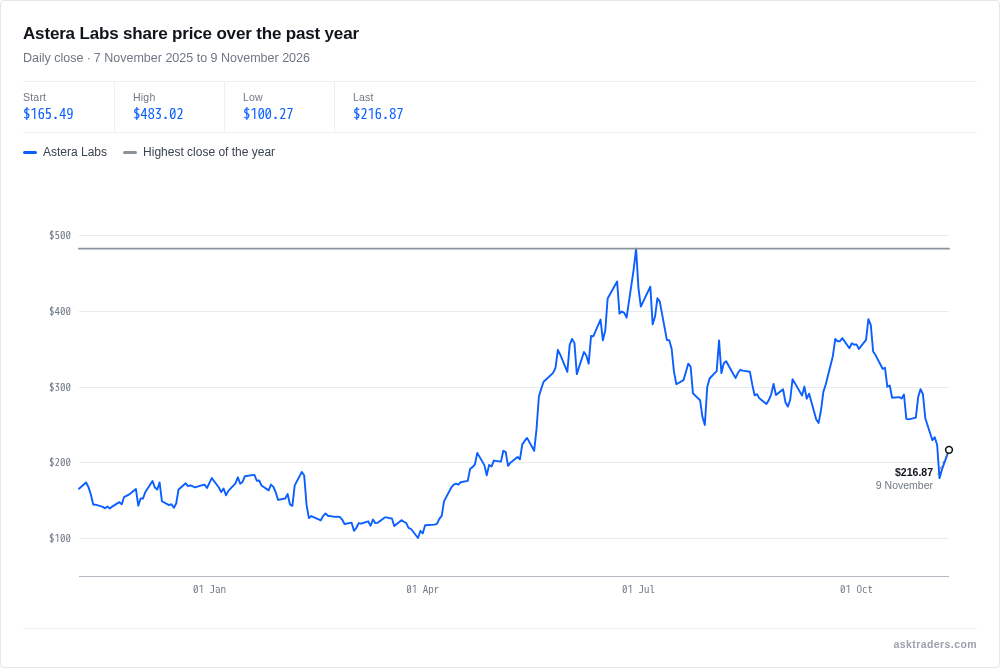
The shares show how quickly sentiment can swing. Astera closed at $216.87 on 9 November, up 31.0% on the year, but that is less than half its June peak of $483.02. The business has kept growing fast, with revenue up 115.1% in the year to December 2025 and a 29.6% profit margin. It is worth $37.9 billion on 75.3 times trailing earnings, and 18 of 25 analysts rate it a buy, with seven at hold.
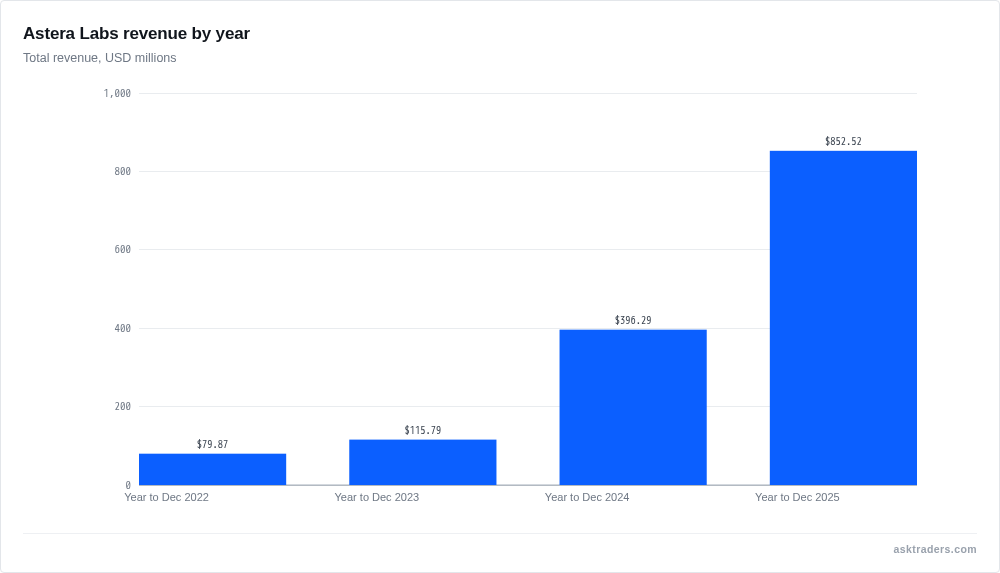
Third-quarter revenue reached a record $584.9 million on 3 November, up 49% on the previous quarter and 154% on a year earlier, according to a Fly On Wall Street commentary carried by PR Newswire. GuruFocus, citing BMO, puts fourth-quarter guidance at $730 million to $750 million. Because Astera’s sales depend on customers building new data centres, it is exposed to the political risk Investing.com reported on 6 November: fears that Democratic policymakers could block US data-centre projects. Astera has beaten estimates in each of its last four quarters.
Cisco
Cisco Systems (NASDAQ: CSCO) is the veteran of the group, a long-established networking company selling routers, switches and security technology. In AI data centres, high-density routers such as its 8000 Series link servers and connect sites together, and the largest cloud operators are among its customers.
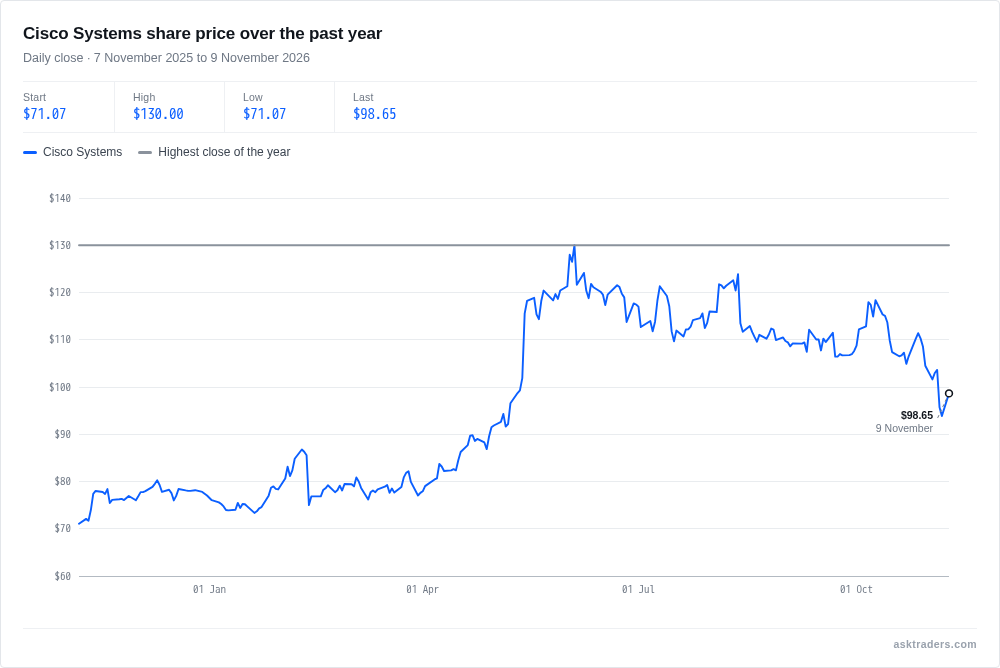
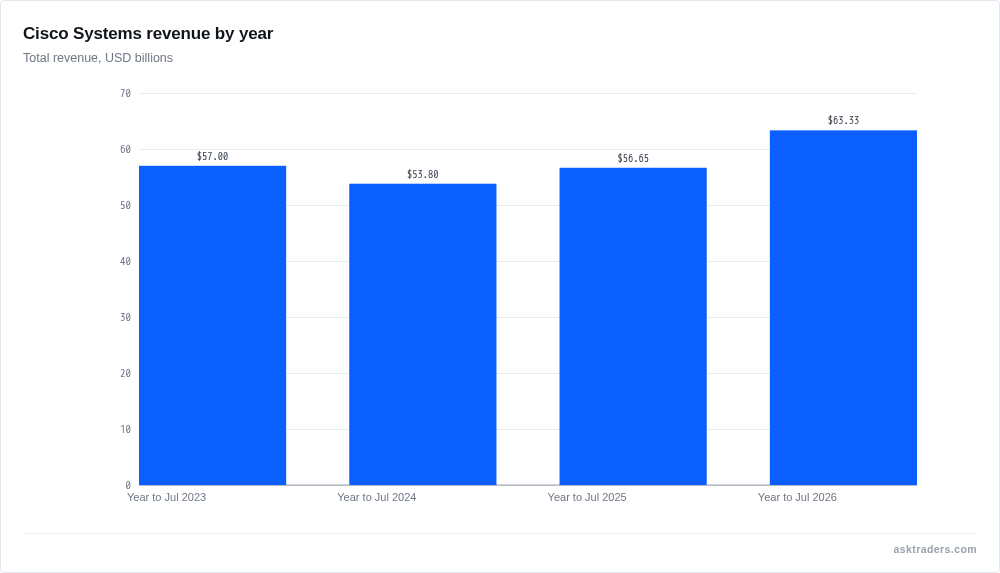
Cisco grows more slowly than the newer names, but it has still done well for shareholders. Revenue rose 11.8% in the year to July 2026, the profit margin is 20.9%, and the shares closed at $98.65 on 9 November, up 38.8% on the year and 24.1% below their June high of $130.00. It is worth $389 billion, trades on 28.2 times trailing earnings and offers the highest yield in the group at 1.79%. Of 29 analysts, 19 rate it a buy and 10 a hold.
Not everyone is convinced. Insider Monkey reported that Morgan Stanley cut Cisco to equal-weight from overweight, citing lower gross margins in its AI business and the risk that customers bought early to get ahead of price rises. On the other side, US fibre-broadband operator Schurz Broadband Group is rolling out Cisco’s 8000 Series routers across four operating companies, though that is a broadband deal rather than a hyperscaler order. Cisco has beaten estimates in each of its last four quarters.
Servers and Power
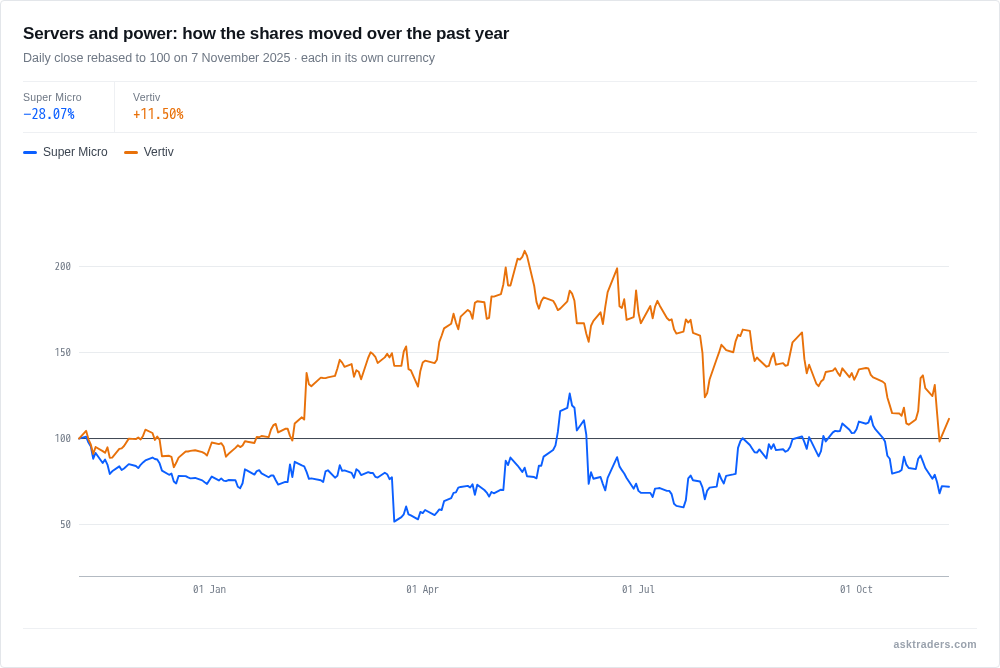
Chips are no use until they’re built into working machines, plugged in and kept cool. Super Micro builds the AI servers and full racks, which are cabinets of servers installed as a single unit. Vertiv supplies the power and cooling equipment that keeps them running. The two had very different years.
Super Micro
Super Micro Computer (NASDAQ: SMCI) builds servers and storage systems, and for AI it assembles servers and full racks around NVIDIA GPUs for data-centre operators and AI developers. It specialises in direct liquid-cooled racks, which carry heat away from densely packed chips, and Zacks reports it is already shipping 150kW racks, cabinets drawing 150 kilowatts of power, in volume.
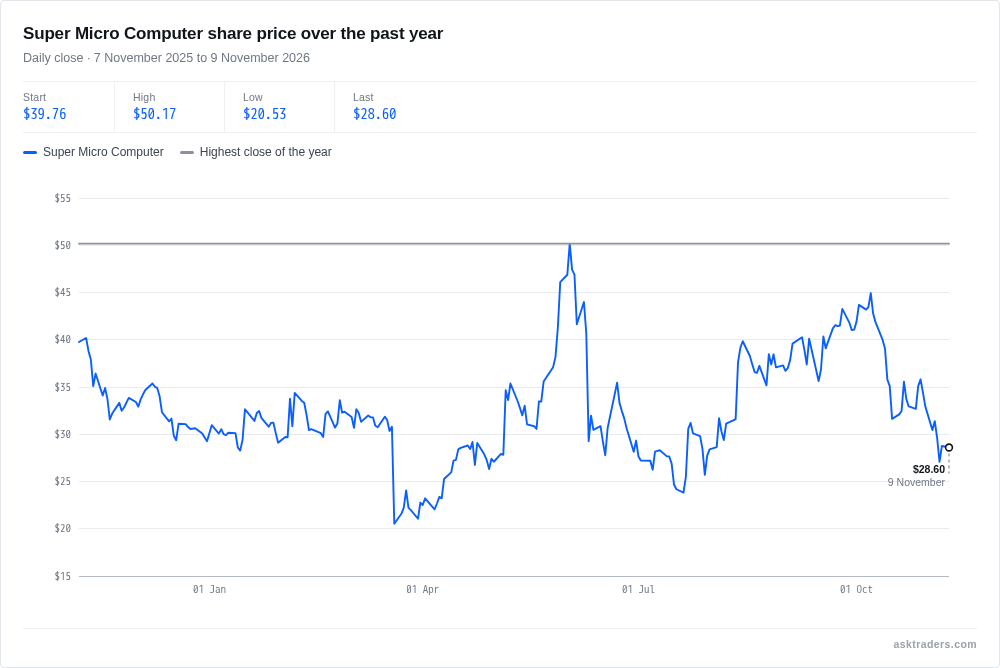
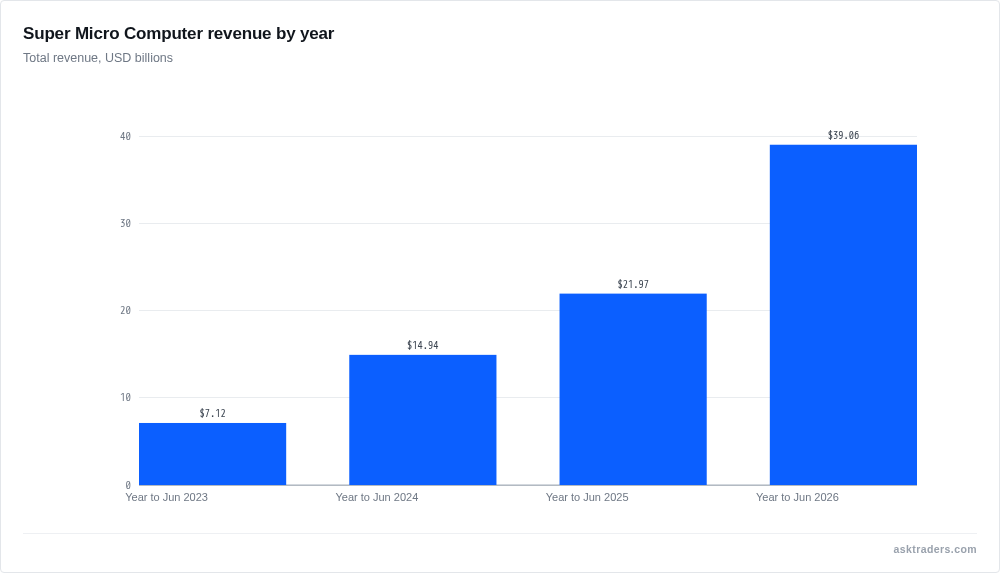
Super Micro shows that selling a lot isn’t the same as making a lot. Revenue grew 77.8% in the year to June 2026, but the profit margin is just 6.8%, by far the thinnest of the profitable companies here. The shares closed at $28.60 on 9 November, down 28.1% on the year and 43.0% below their June high of $50.17, leaving the company worth $19 billion on 6.1 times trailing earnings. Analysts are the most cautious of the group: four rate it a buy, 11 a hold and three a sell.
Export controls are a recurring theme. Bloomberg has reported, citing documents filed with Beijing regulators, that Moonshot AI rented 32 Super Micro servers fitted with NVIDIA B300 GPUs in China, valued at 432 million yuan, and that it could not determine whether a US export licence had been obtained. A Super Micro spokesperson said the company does not do business with these entities and is committed to complying with US export controls. The report does not accuse Super Micro of wrongdoing, but it also notes an earlier Department of Justice probe into illegal chip sales to China by three of its employees. Super Micro has beaten estimates in each of its last four quarters.
Vertiv
Vertiv Holdings (VRT) designs, makes and services the power and cooling kit inside data centres. That runs from battery backup, which keeps servers running through outages, and switchgear, the electrical switching and protection equipment, to liquid cooling and heat-rejection systems that expel heat outdoors. Its customers are data-centre operators and AI-computing builders, and it has a dedicated AI and high-performance computing business.
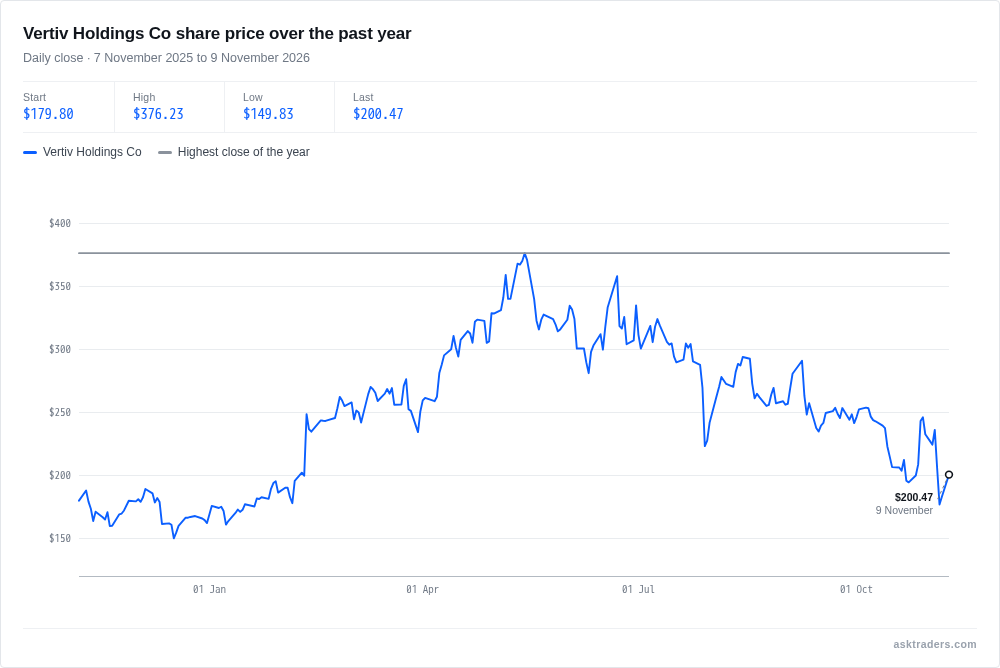
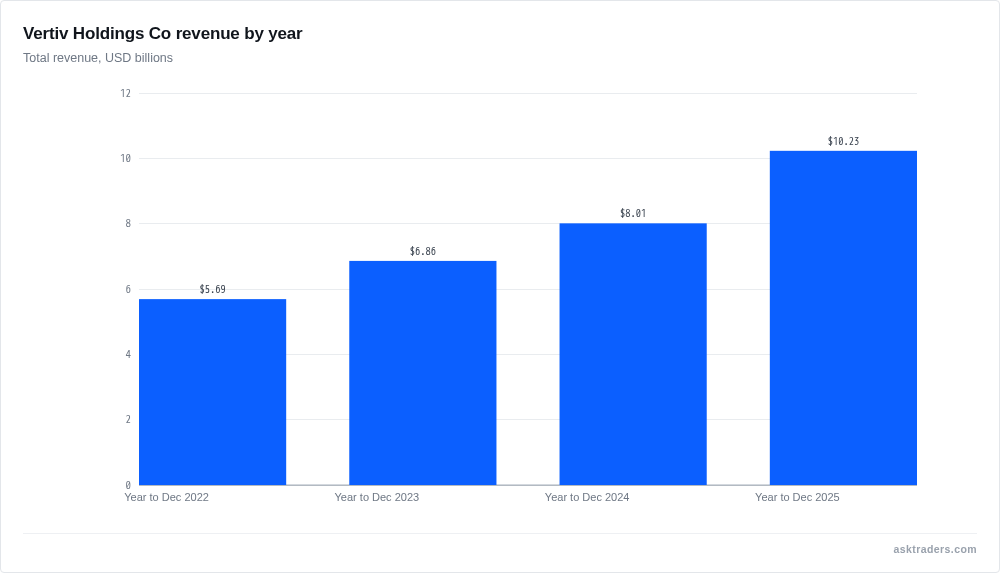
Vertiv closed at $200.47 on 9 November, up 11.5% on the year, but that hides a sharp fall from its May peak of $376.23, which the shares are now 46.7% below. Revenue grew 27.7% in the year to December 2025 with a 16.0% profit margin. The company is worth $77.2 billion on 37.5 times trailing earnings, with a 0.12% yield, and 26 of 30 analysts rate it a buy, with four at hold.
The latest results were strong. On 28 October Vertiv reported third-quarter net sales up 61%, organic orders (excluding acquisitions and currency effects) up more than 100%, and diluted earnings per share up 91%, and it raised its full-year 2026 guidance across all key metrics. The worry is politics. Seeking Alpha reported on 6 November that newly elected US governors have pledged to pause data-centre construction, citing Cleanview tracker data that put about 40% of pending US capacity at risk. Vertiv has beaten estimates in three of its last four quarters.
AI Cloud Builders
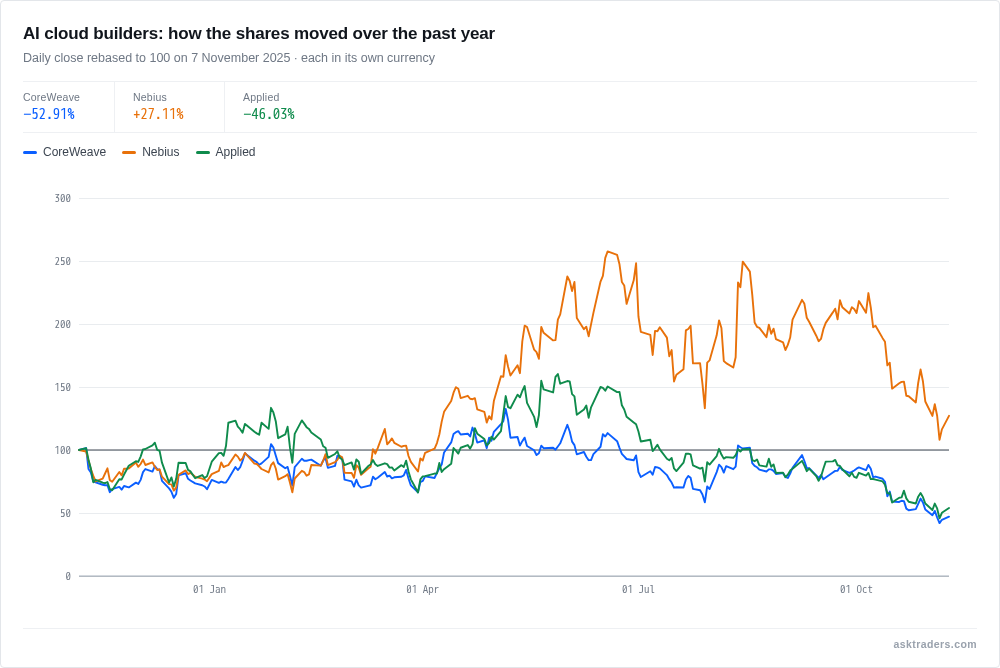
These are the newcomers, often called neoclouds. They build or run AI data centres and rent out the computing power inside them to AI developers and big technology companies. They have grown fastest of all, but this is also where the past year was roughest.
CoreWeave
CoreWeave (NASDAQ: CRWV) rents out GPU computing power from AI data centres that it builds and pays for with borrowed money. AI developers train and run their models on CoreWeave Cloud, which runs on NVIDIA Blackwell chips. The company is not yet profitable.
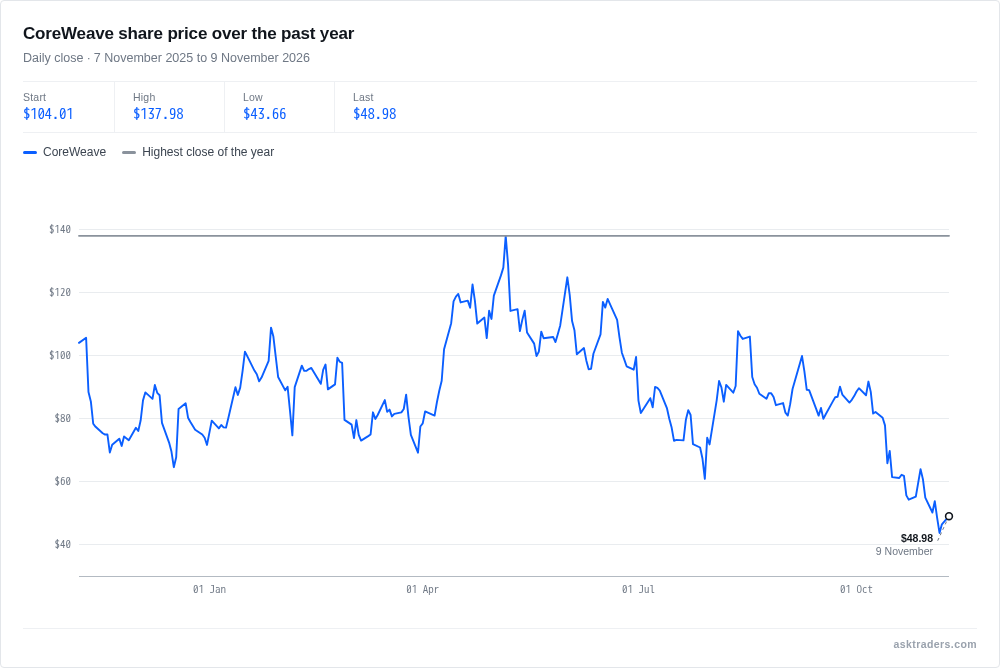
CoreWeave was the worst performer of the 14. The shares closed at $48.98 on 9 November, down 52.9% on the year and 64.5% below their May high of $137.98, valuing the company at $27 billion. Revenue grew 167.9% in the year to December 2025, but the profit margin is minus 25.4%. Analysts are still mostly positive, with 32 of 42 rating it a buy, seven a hold and three a sell.
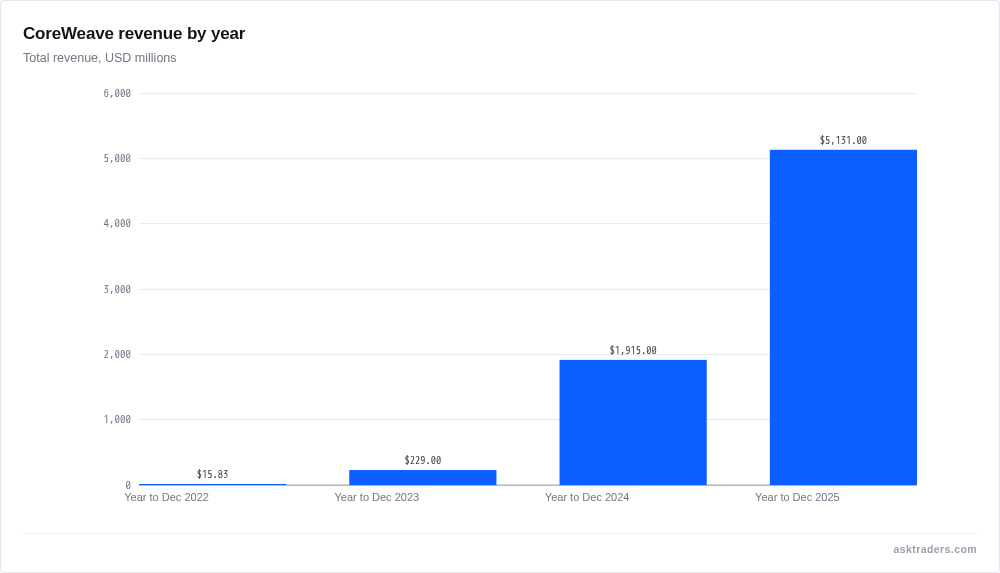
Debt is the heart of the story. Bloomberg reported that because CoreWeave funds construction with borrowing, it needs continual strong growth to service that debt, and that its bonds fell after the 3 November US elections to levels widely seen as distressed, with yields above 15%. New business is still coming in: Zacks reports a multi-year agreement to power Wayve’s AI driver training, with Wayve moving from Weights & Biases to CoreWeave Cloud to train its foundation models.
Nebius
Nebius Group N.V. (NASDAQ: NBIS) builds AI infrastructure from top to bottom: large GPU clusters, cloud platforms and developer tools, using its own hardware, software, managed inference and storage. Its customers are AI developers and large technology firms, and it has a strategic alliance with NVIDIA. It also owns TripleTen, an education business, and Avride, an autonomous-driving unit.
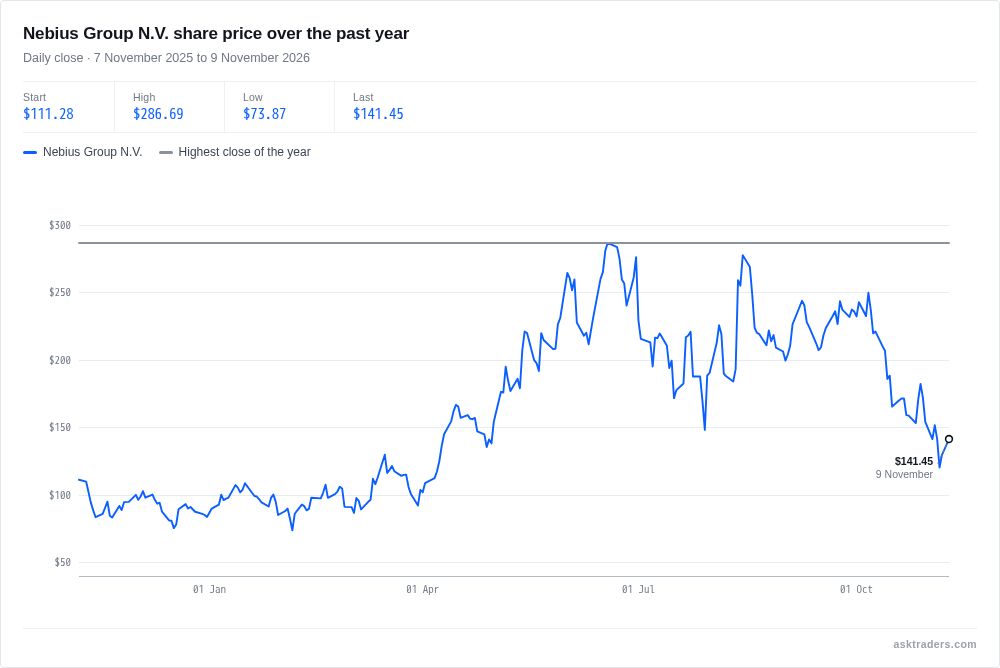
Nebius is the one neocloud in this list whose shares rose. They closed at $141.45 on 9 November, up 27.1% on the year, though still about half their June peak of $286.69. Revenue grew 350.9% in the year to December 2025, the fastest of the 14, and the company is just about profitable, with a 3.1% margin. It is worth $35.9 billion, and 15 of 22 analysts rate it a buy, six a hold and one a sell.
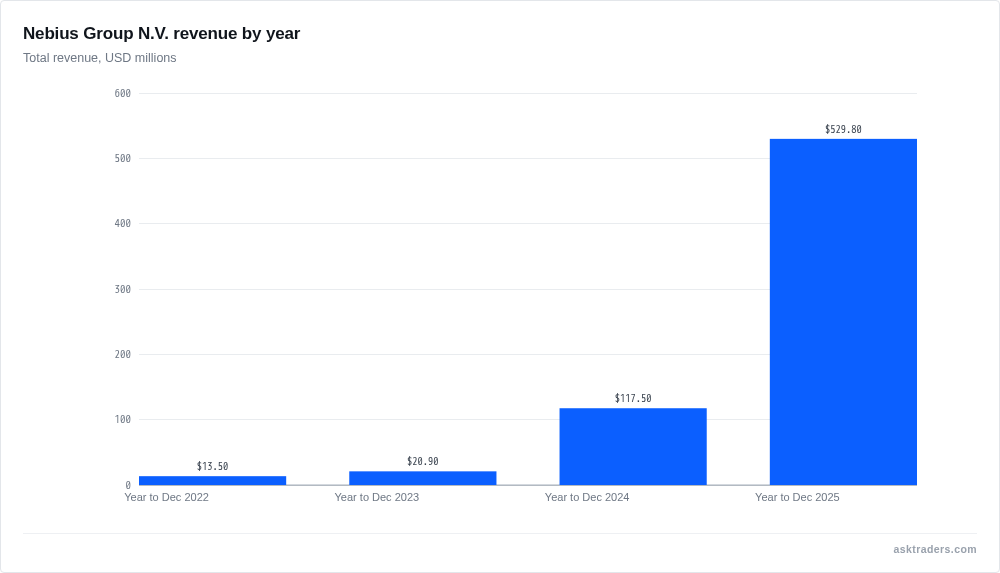
On 22 October Nebius announced a $3.5 billion financing facility with Citi, though only the headline was available. The risks are shared across the neoclouds. Bloomberg has reported that the US elections showed many voters oppose data centres near their communities, and that Microsoft is reportedly tightening oversight of some neocloud projects. Nebius has beaten estimates in three of its last four quarters.
Applied Digital
Applied Digital (NASDAQ: APLD) designs, builds and runs high-performance computing campuses in North Dakota, then leases the powered buildings to tenants for AI computing. It was formerly Applied Blockchain and still hosts crypto-mining machines at its older sites.
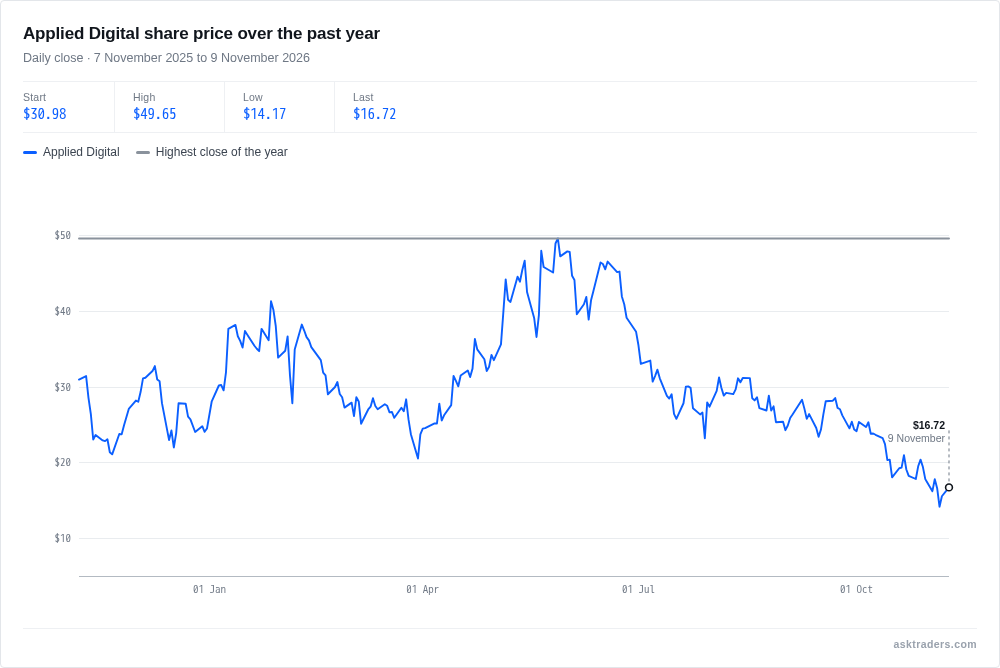
Applied Digital closed at $16.72 on 9 November, down 46.0% on the year and 66.3% below its May high of $49.65, leaving it worth $5.06 billion. Revenue grew 167.5% in the year to May 2026, but the profit margin is minus 53.0%. Even so, 14 of its 16 analysts rate it a buy, with two at hold.
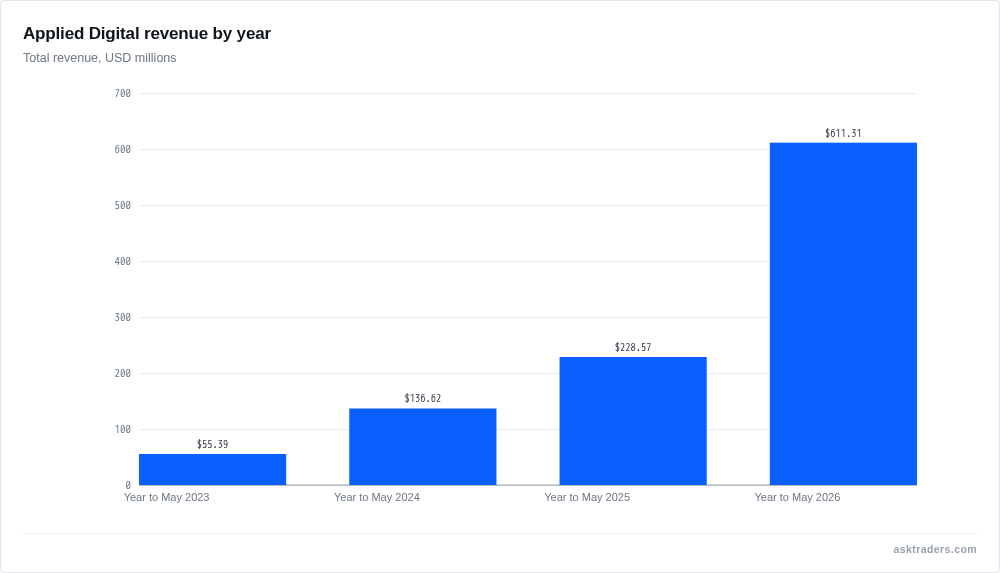
The order book looks impressive. Its fiscal first-quarter 2027 results on 7 October showed revenue up 322% to $341.9 million, according to Zacks, with 1.41 gigawatts of critical IT load (the power available to run tenants’ computers) leased across five campuses, representing $36 billion of contracted base-term rent. But the business leans heavily on a few customers, with the three largest making up 88% of quarterly revenue. Debt was about $6.4 billion against $3.7 billion of cash at the end of August. Applied Digital has beaten estimates in two of its last four quarters.
Data Centre Property
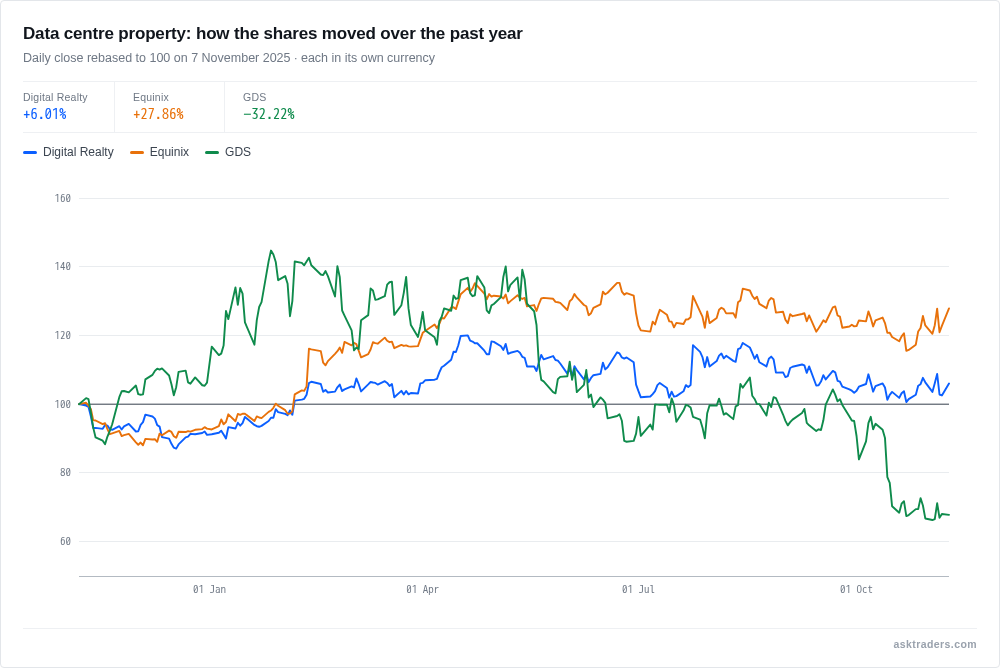
Someone has to own the buildings. These companies rent out space, power and cooling, and sell interconnection, which is direct network links between customers in the same building. Digital Realty and Equinix are REITs, property companies that pay out most of their income to shareholders, and they serve cloud, enterprise and AI customers. GDS builds and runs data centres in China. Landlords are usually the steadier end of the market, and the two US names lived up to that this year.
Digital Realty
Digital Realty Trust (NYSE: DLR) owns and runs data centres, renting out space, power, cooling and network connections to cloud, enterprise and AI customers. It also runs innovation labs where customers can test high-density, liquid-cooled AI hardware before rolling it out at scale.
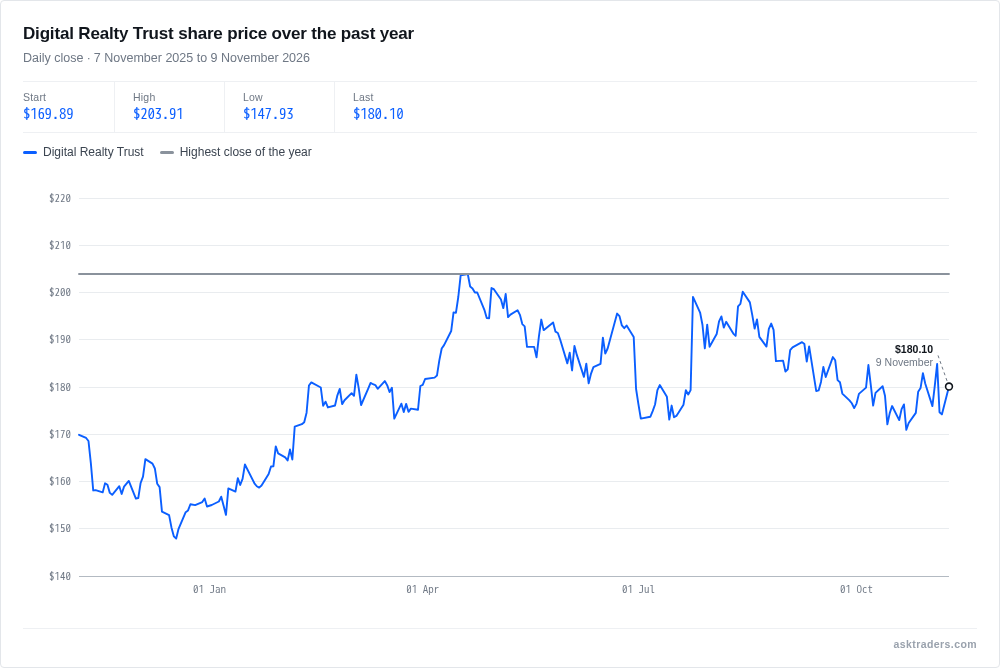
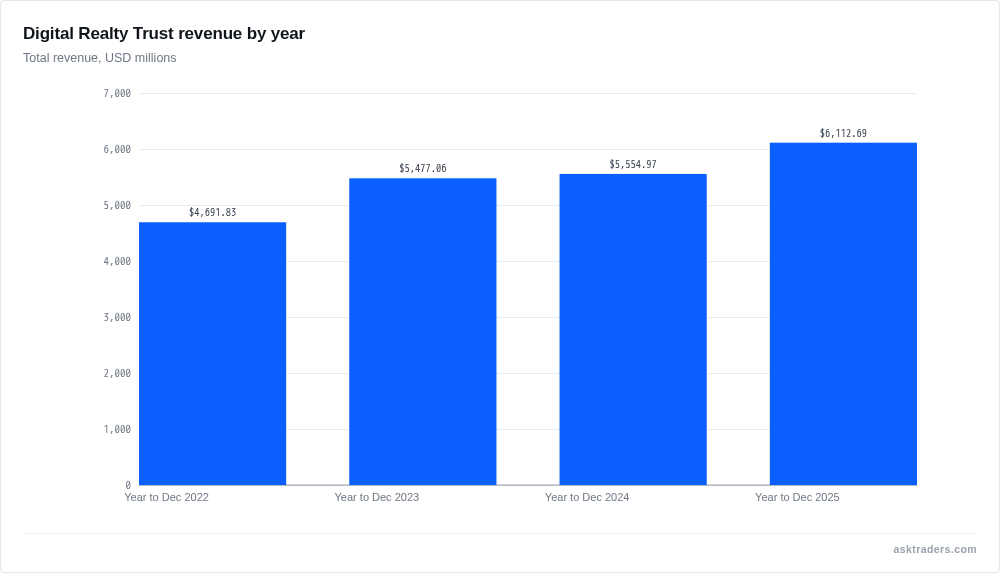
Digital Realty closed at $180.10 on 9 November, up a modest 6.0% on the year and 11.7% below its April high of $203.91. Revenue grew 10.0% in the year to December 2025 and the profit margin is 13.1%. Worth $69.3 billion, it trades on 76.0 times trailing earnings, but as a REIT it also pays a 2.71% yield. Of 34 analysts, 29 rate it a buy and five a hold.
On 5 November it opened its first Innovation Lab in Latin America, at the Vinhedo II campus in São Paulo, built for high-density AI workloads including liquid-cooled racks at 150 kW per cabinet and above. It follows labs in Northern Virginia, Tokyo and London. On the risk side, Bernstein analyst Madison Rezaei flagged Georgia as an underappreciated source of data-centre backlash after its Public Service Commission flipped to a 3-2 Democratic majority. She named Digital Realty’s 2.0-gigawatt Project Bunkhouse among the campuses exposed, though she said the risk is mainly to future pricing rather than a stop sign on current construction. Digital Realty has beaten estimates in each of its last four quarters.
Equinix
Equinix (NASDAQ: EQIX) rents space, power and cooling in its own data centres to cloud providers, networks and businesses running AI workloads. It is best known for interconnection, the direct links between customers inside its buildings, and it also runs xScale sites, large data centres built for hyperscale customers.
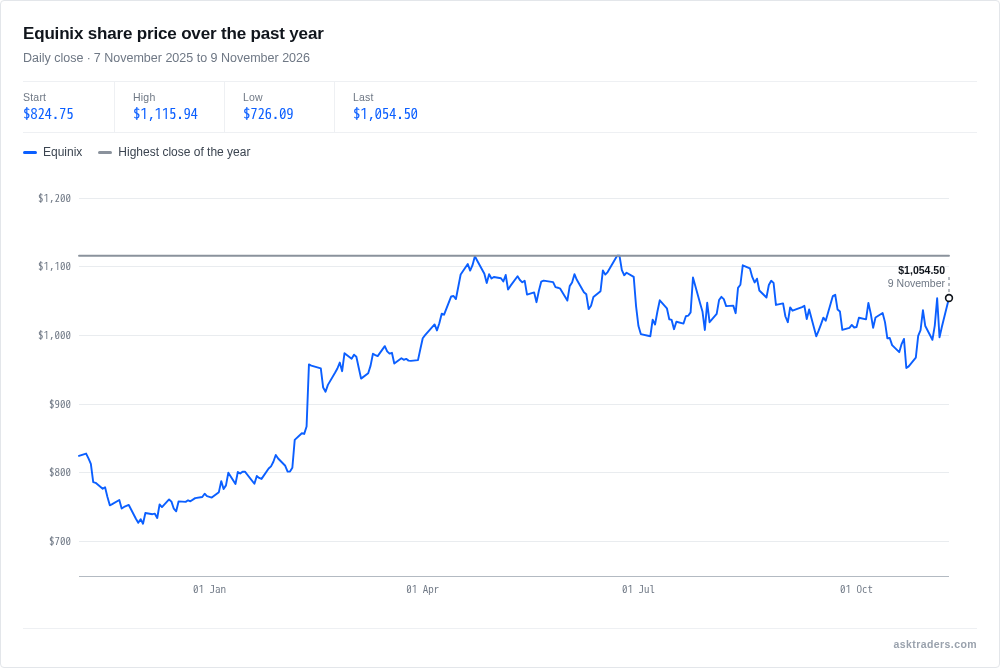
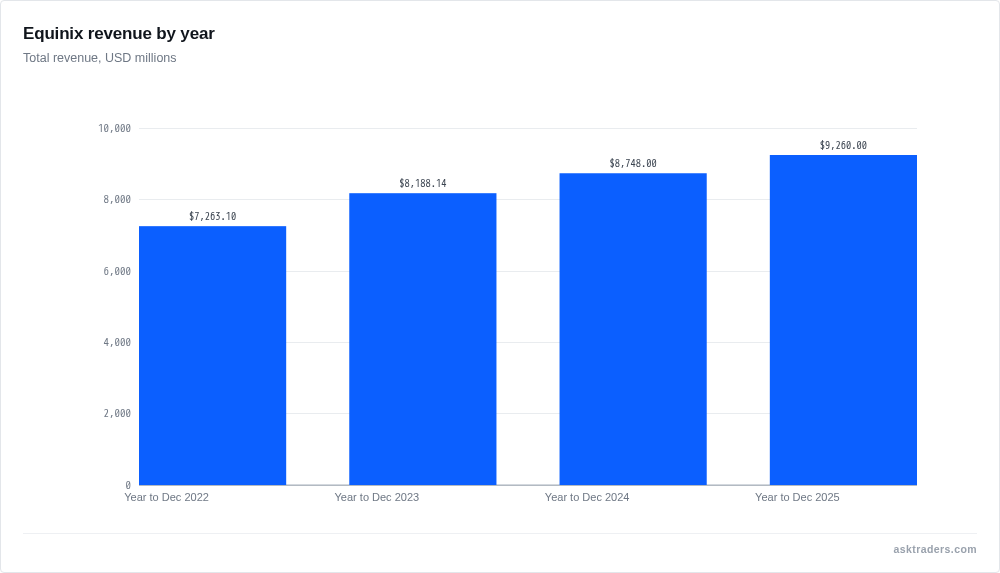
Equinix is a useful reminder that the fastest grower isn’t always the best investment. Its revenue grew just 5.9% in the year to December 2025, the slowest of the 14, yet the shares closed at $1,054.50 on 9 November, up 27.9% and only 5.5% below their June high of $1,115.94. The profit margin is 16.2%, the company is worth $104 billion on 60.8 times trailing earnings, and the yield is 2.04%. Of 35 analysts, 30 rate it a buy and five a hold.
A financing subsidiary has issued €2.5 billion of green senior notes in four tranches, at a blended all-in rate of 4.82% a year after hedges, with the proceeds going to eligible green projects. BMO Capital Markets analysts Ari Klein and John P. Kim said state election results raise the risk of development delays and possible moratoriums. They added, though, that vacancy below 1% and strong AI demand should support pricing for operators that already have buildings. Equinix has beaten estimates in two of its last four quarters.
GDS
GDS Holdings (NASDAQ: GDS) develops and runs high-performance data centres in China and leases the capacity to customers. Zacks reports that these include China’s three largest hyperscale cloud groups and emerging AI firms, and that it booked a record 470 megawatts in the first half of 2026. It is also listed in Hong Kong.
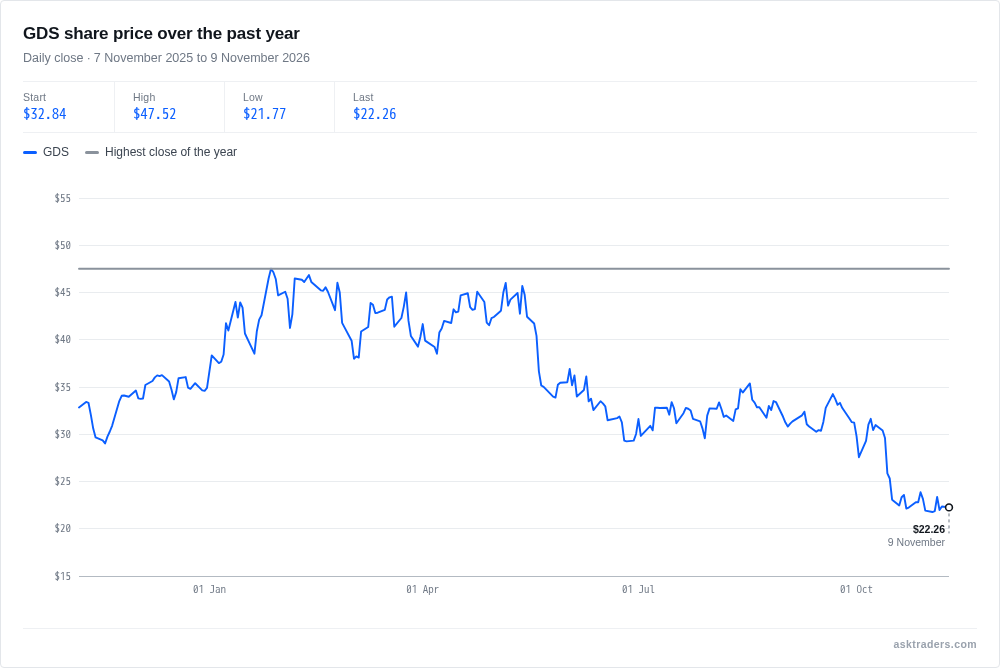
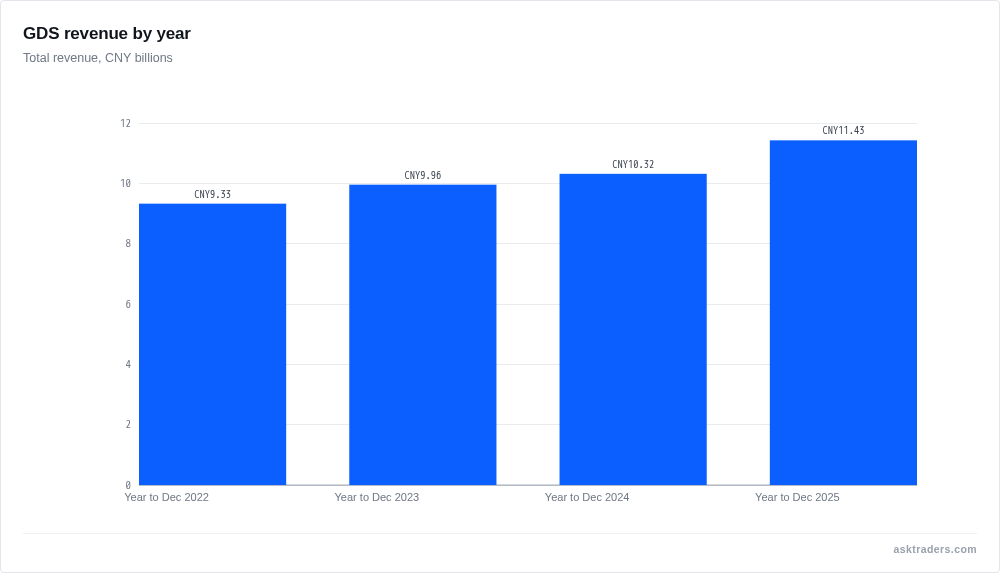
GDS closed at $22.26 on 9 November, down 32.2% on the year and 53.2% below its January high of $47.52, leaving it worth $4.46 billion. Revenue grew 10.8% in the year to December 2025, with the latest twelve months coming to 12.3 billion CNY. The profit margin is 30.5% and the shares trade on 10.4 times trailing earnings. All 16 analysts covering it rate it a buy.
Power bills are biting. Zacks reports that GDS’s adjusted EBITDA margin (operating profit before depreciation, as a share of revenue) fell 220 basis points to 45.5% in the second quarter because electricity costs took a bigger slice of revenue. It also flags heavy debt and capital spending. GDS has beaten estimates in two of its last four quarters.
What Could Slow It Down
The whole case rests on the big buyers continuing to spend, and there are signs that won’t always be smooth. CNBC reported on 29 October that Microsoft and Alphabet both reported capital spending below analyst estimates. Microsoft’s chief financial officer Amy Hood said delays at third-party AI-chip providers will push some available capacity out to the first half of 2027.
The neoclouds carry their own risks. The BBC reported on 1 November that CoreWeave has built up $35.1 billion of debt, a figure from analyst Cory Johnson, and that the success of neoclouds depends on the big AI developers and hyperscalers that are their main customers. It also quoted Gartner predicting that 80% of neoclouds will stop operating independently by 2030.
Then there’s politics. Business Insider reported that the Nasdaq 100 fell more than 6% on 5 November, its worst day since 2020. The outlet linked the fall to fears that Democratic election gains could mean tighter permitting and more scrutiny of data centres’ power and water use, though that is its reading rather than a confirmed cause. It also cited UBS projecting that roughly 30% of the data-centre capacity expected to be added in 2028 could be affected by construction pauses.
So, Is the Data-Centre Play Worth It?
The basic case holds up. The biggest buyers are spending more than ever, they say they will spend more again next year, and nearly every company here is growing. Owning the suppliers also spreads your bet across the whole industry rather than one AI lab.
What the past year shows is that the supply chain is not one trade. The layer a company sits in told you surprisingly little. Among chipmakers, returns ran from NVIDIA’s 5.0% fall to Micron’s 208.1% gain, and among the AI cloud builders from CoreWeave’s 52.9% fall to Nebius’s 27.1% rise. The details that differ are the ones worth weighing: how much a company has borrowed, how much profit it keeps from each sale, how much it relies on a handful of customers, and how much investors are already paying for its earnings.
Analysts remain positive on almost all 14, including several of the year’s biggest fallers. A picks-and-shovels approach may take the guesswork out of choosing an AI winner, but choosing which picks and shovels to own still takes some care.