






Kohl’s (NYSE: KSS), the US department-store chain, raised its full-year outlook today after comparable sales rose 1.2% in the third quarter, and its shares jumped 17%. The company reported before the US market opened, and adjusted earnings per share came in far above the consensus.
The stock stood at $24.90 at 8.37pm London time, a delayed quote taken before the US session ended, up from yesterday’s close of $21.20. The gain follows a 4.7% fall yesterday ahead of the results.
Comparable sales, which measure sales at stores open a year or more, rose 1.2% in the quarter to the 31st of October, and net sales were up 1.3% at $3,452m. Adjusted EPS, the company’s own profit-per-share measure, was $1.76. Analysts had forecast a loss of $0.01 a share on average, and a year earlier it was $0.10. It was the fifth straight quarter ahead of consensus. Chief executive Michael Bender said the company had returned to top-line growth.
The quality of the earnings is weaker than the headline. GAAP EPS, the figure under standard accounting rules, was $2.15, helped by a $137m tax benefit, a $61m gain on the sale of two properties and about $45m of tariff refunds, money returned after US import duties were refunded. The adjusted $1.76 strips out only the property gain, so it still includes the tax benefit and the tariff refund.
Kohl’s now expects full-year comparable sales of flat to up 0.5% and diluted EPS of $4.30 to $4.50. The company itemises $2.60 of that as one-offs: $0.40 from real estate, $1.03 from tariff refunds and $1.17 from the tax benefit. That leaves far less from the core business than the range suggests.
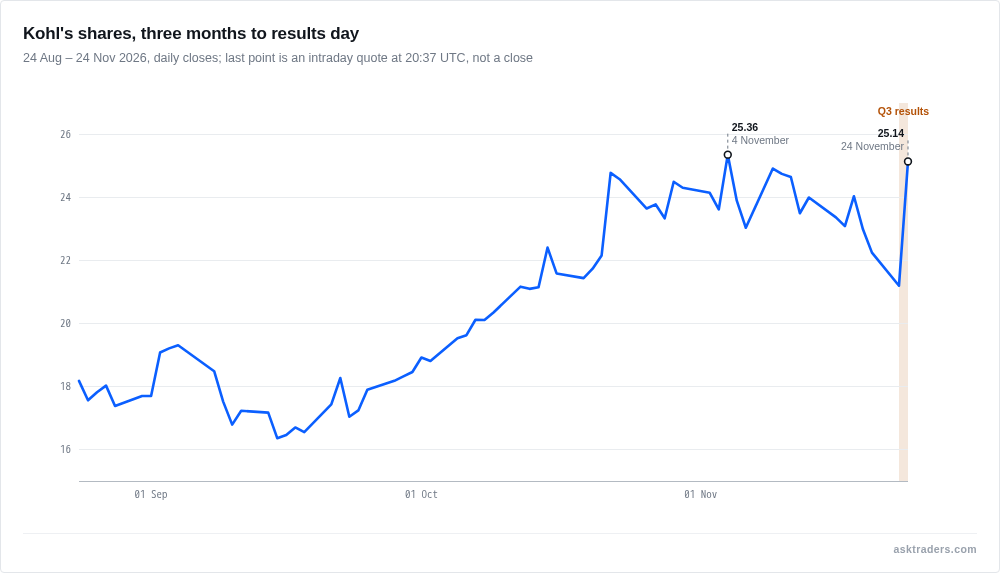
The fourth-quarter guide is more cautious: comparable sales of flat to up 2% and EPS of $0.95 to $1.15, including about $0.10 from tariff refunds. The shares had slipped from their early-November high before the results, so the jump brings them back close to that level.
Management also named risks. Bender told analysts on the earnings call about pressure on shoppers:
The core customers that we serve are facing inflationary pressures in their daily expenses that are altering their behaviors when shopping discretionary categories.
Michael Bender, Kohl’s
Digital sales fell 1% in the quarter, and a warm early November weighed on cold-weather goods.