
Catalyst is our new weekly newsletter. Each edition breaks down one market-moving event and the stocks positioned to benefit. Early editions are free. Sign up below to get every new Catalyst straight to your inbox.
When a market phenomenon which has been a key driver of global equity growth since 1999 appears to be unwinding, then investors need to take note.
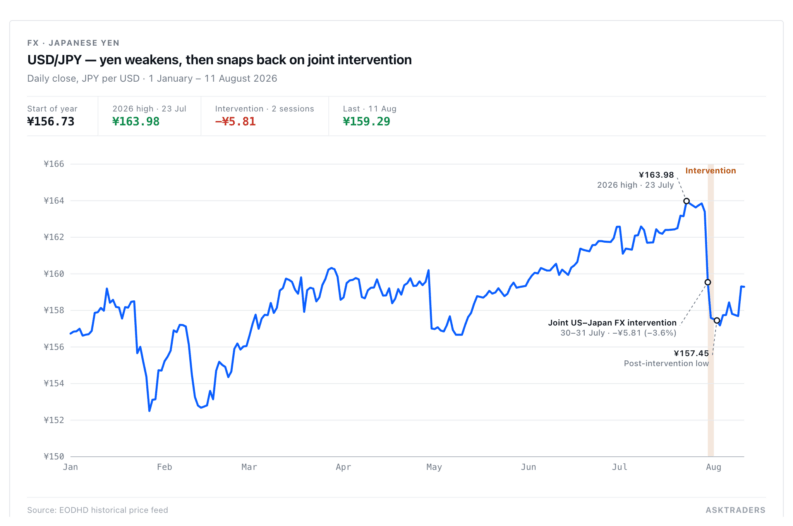
USD/JPY, January–August 2026: the pair climbed from ¥156.7 in early January to a 2026 high of ¥163.98 on July 23, then broke sharply to ¥157.6 by July 31 — a decline of over 6 yen in five trading days, coincident with the joint US–Japan intervention. It has since stabilised in a ¥157–159 range, last trading at ¥159.20 on August 11.
The Japanese yen carry trade has long served as a core engine of global market liquidity. Investors have borrowed trillions of dollars’ worth of Japanese yen at near zero interest rates, converted the yen into their preferred currency, and purchased higher-yielding assets such as US growth stocks.
Ten days ago, the status quo broke when US and Japanese central banks began their first joint effort in almost 30 years to support a weakening yen. It appears that without active market intervention a slide in the price of yen would leave the Bank of Japan to raise interest rates to support its currency and simultaneously kill off the biggest carry trade the world has ever seen.
Will the intervention be successful or are we facing the situation where “you can’t buck the market”. Repaying the yen debt would trigger forced liquidations through high-beta stock sectors and increase uncertainty regarding stock valuations. This points towards portfolio rebalancing and taking positions in stocks which may be more resilient to the new paradigm (and still fare relatively well should the unwinding not materialise).
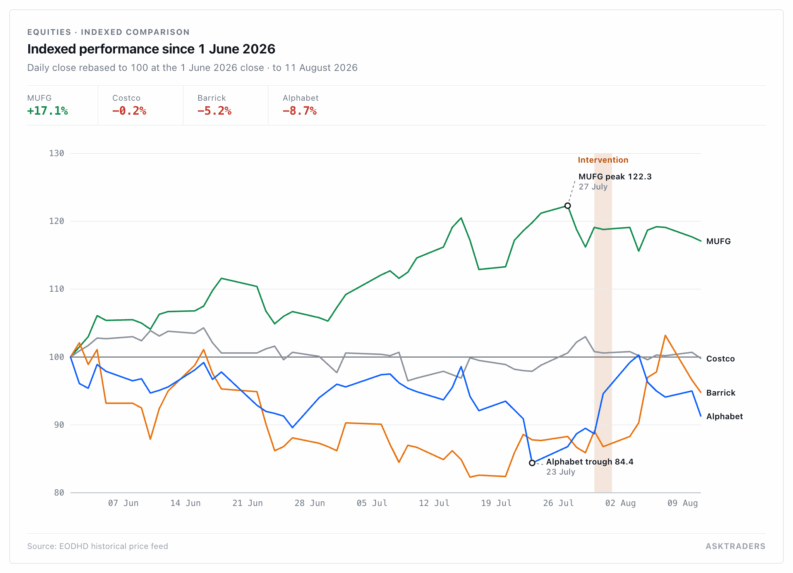
Indexed performance since June 1, 2026: GOOGL is down ~8.6% (from $376 to $343.80), B is down ~5% but with a sharp round-trip (low $34.84 on July 16 to high $43.68 on August 7, back to $40.13), MUFG is up ~17.1% ($18.89 to $22.12), and COST is down ~0.2% ($946 to $944.32) — broadly consistent with the resilience thesis below.
The Picks
Rather than retreating to uninvested cash, tactical asset allocation should pivot toward high-conviction entities characterised by structural insulation, low debt levels, or direct tailwinds from normalizing currency trends.
1. Alphabet (GOOGL) — Defence Against Higher Borrowing Costs
Alphabet’s cash balance of $55bn means it faces zero refinancing or debt-servicing risks in a tightening global credit market. There would also be options to invest and gain market share from competitors who are pressured by a deteriorating wholesale funding market.
2. Mitsubishi UFJ (MUFG) — Interest Rate Beneficiary
Banks typically see margins and profitability improve as interest rates rise. MUFG is Japan’s largest financial institution and could capture immediate fundamental upside as the domestic yield curve normalizes.
3. Barrick Mining (B) — Fiat Safe Haven
As a premier global gold producer, Barrick functions as a highly liquid equity proxy for precious metals. It attracts structural safe-haven inflows exactly when institutional investors seek shelter from systemic fiat volatility.
4. Costco (COST) — Defensive Cash Flow
Costco operates a sticky, subscription-based wholesale club model that delivers recurring, highly predictable revenue flows. Its inelastic demand profile shields equity value from macro-driven economic slowdowns or shifting consumer sentiment.
Signs This Is Serious
Changes to broker ratings
GOOGL: Following July 23 earnings, several firms cut price targets despite maintaining ratings — UBS (neutral, PT $400→$379), Morgan Stanley (overweight, PT $415→$400), Truist (buy, PT $430→$420), DA Davidson (neutral, PT $375→$350), Wells Fargo (overweight, PT $418→$411) — though BMO, Barclays and Roth Capital raised targets over the same period. Consensus rating 4.41/5, average target $428.
B (Barrick): Five separate firms cut price targets over the last five weeks while maintaining bullish ratings — BofA (buy, PT $58→$56→$54), JPMorgan (overweight, PT $58→$50), Barclays (equal-weight, PT $41→$39), Scotiabank (sector outperform, PT $63→$57), RBC (outperform, PT $51→$49). Consensus rating 4.09/5, average target $52.62 vs. a current price of $40.13.
COST: JPMorgan maintained overweight but trimmed its price target from $1,110 to $1,100 (July 9). Consensus rating 3.97/5, average target $1,077.
MUFG: No recent rating changes on file; consensus rating steady at 3.0/5, average target $21.59.
Insider trading
GOOGL: Persistent insider selling through H1 2026, most notably CEO Sundar Pichai’s recurring monthly sale of ~32,500 shares under a 10b5-1 plan at prices declining from ~$335 (Feb) to ~$308 (March).
B (Barrick): No 2025/2026 insider filings on record — the most recent logged activity dates to 2022–2024.
COST: A mix of small insider buys (Nov 2025–Feb 2026) alongside routine small executive sales at similar price levels — a broadly neutral signal.
What to Watch
Price charts and volume
USD/JPY: The break from ¥163.98 (July 23) to ¥157.6 (July 31) was the sharpest multi-day FX move of the year.
GOOGL: Fell from a 2026 high of ~$384 (Aug 5) to $343.80 (Aug 11), a ~10.5% drawdown in four sessions on elevated volume (28.7m shares Aug 11).
B: Volume nearly doubled to 29.2m shares on Aug 10 amid a rebound from July lows.
MUFG / COST: Both traded in comparatively narrow, stable ranges over the same period.
Economic calendar
Sep 15–16: FOMC meeting (prediction markets currently price ~58% odds of a rate move).
Sep 18: BoJ Interest Rate Decision — the direct counterpart event to the FOMC.
Sep 30: BoJ Tankan survey (Q3) — large manufacturers/non-manufacturers indices and capex; BoJ Summary of Opinions; US Core PCE Price Index (Aug) — the Fed’s preferred inflation gauge; US ADP Employment Change (Sep).
Also of note: Reuters Tankan Index (Sep 10) and a series of JGB auctions (2-yr, 20-yr, 40-yr) through September.