





GSK (LON: GSK) said its twice-yearly biologic Exdensur matched monthly Nucala at achieving remission in a phase III trial in eosinophilic granulomatosis with polyangiitis (EGPA), a rare blood-vessel inflammation. Shares in the London-listed drugmaker were higher in early trade today.
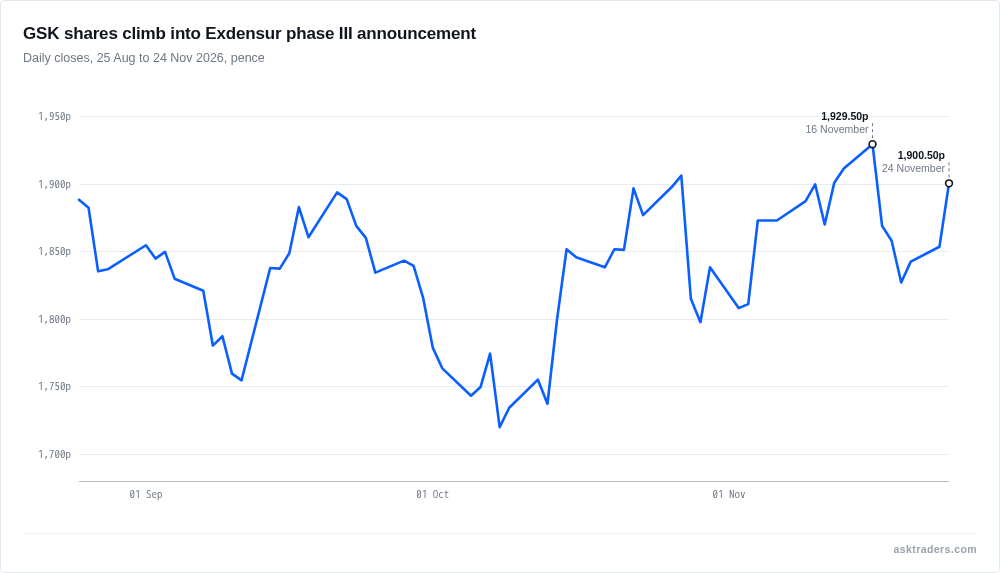
GSK stood at 1,919p in a delayed quote at 8.06am, up 18.5p, or 0.97%, from yesterday’s close of 1,900.5p. The shares rose 2.5% yesterday, before the announcement, which came in a 7am statement ahead of the market open.
The OCEAN trial enrolled 162 people with relapsing or refractory EGPA across 19 countries, all on standard of care. In the 52-week, double-blind study, Exdensur (depemokimab) 200mg every 26 weeks was compared with Nucala (mepolizumab) 300mg every four weeks.
Exdensur met its primary non-inferiority endpoint, meaning it was shown to be at least comparable to Nucala, not better. Remission meant a BVAS score of zero and an oral corticosteroid dose of 4mg a day or less at weeks 36 and 52. Adverse events were similar in incidence and severity in both arms.
The difference lies in dosing: two doses a year against one every four weeks. EGPA affects about 34 people per million worldwide, over 90% of whom have asthma, and is treated with high-dose oral corticosteroids and immunosuppressants. Nucala was the first biologic approved for it.
Exdensur is already approved in the US for severe asthma, and in the EU, Japan, China and the UK for severe asthma and chronic rhinosinusitis with nasal polyps. It is not approved for EGPA anywhere and is also being explored in COPD. Dr Kaivan Khavandi, GSK’s senior vice president and global head of respiratory, immunology and inflammation R&D, said:
These data reinforce depemokimab’s ultra-long-acting profile, showing that it could help patients achieve disease remission with twice-yearly dosing, reducing the need for corticosteroids and other immunosuppressive therapies. We look forward to sharing the results with regulators to help further evolve the standard of care for people living with EGPA.
Dr Kaivan Khavandi, GSK
GSK plans to file in the first half of 2027, and the full results are still to go to a scientific congress and a peer-reviewed journal, with no dates given.